

Maddy summaryHRES 675 is a symbolic resolution expressing the U.S. House of Representatives' support for designating September 2025 as "National Prostate Cancer Awareness Month." It directly affects all Americans, particularly men at risk of prostate cancer - including those with family history, African-American men (who face higher incidence and mortality rates), and men under 65 (40% of new cases). The resolution calls for raising public awareness about screening methods, encouraging research into prevention and treatment, and promoting community actions to combat prostate cancer. It does not create new laws or allocate funding, but urges public and private efforts to improve early detection and outcomes.
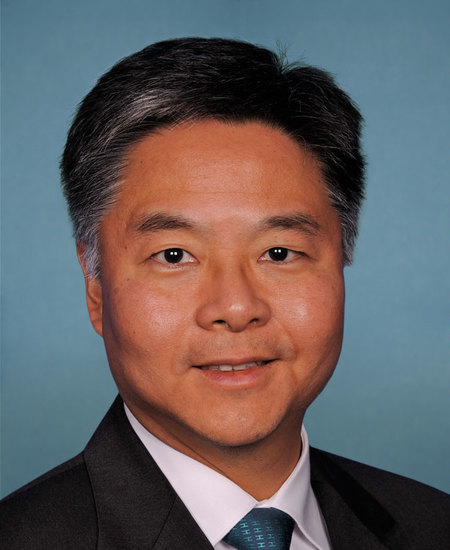
Rep. Ted Lieu
Sponsored bills
Maddy summaryThe Tipped Worker Protection Act eliminates the sub-minimum wage for tipped workers, requiring employers to pay the full minimum wage instead of the current $2.13/hour rate that relies on tips to make up the difference. During a transition period, tipped workers would receive a minimum cash wage of $3.60/hour in the first year, increasing by $1.50 annually until reaching the full minimum wage. The bill also prohibits employers from keeping tips or using them for anything other than distributing to employees, requires transparency about service charges, and establishes rules for voluntary tip pooling. This bill directly affects workers in restaurants, bars, and other service industries who traditionally receive tips as part of their compensation.
Maddy summaryHR 5073, the INFORM Act of 2025, requires immigration authorities to notify the immediate family of a detained individual within 24 hours if they are transferred to a different detention facility. This applies directly to immigrants held under U.S. immigration law and their immediate family members, defined as parents, children, spouses, and certain extended family like step-relatives or domestic partners. The law mandates that notifications include the reason for the transfer and full contact details (name, address, phone number, and point of contact) for the new facility. It establishes a specific timeline and content requirement for these notifications to improve transparency during detention transfers. The bill focuses on procedural changes for facility transfers, not on altering detention policies or immigration eligibility.
Maddy summaryHR 5093, the District of Columbia National Guard Home Rule Act, would transfer authority over the District of Columbia National Guard from the President of the United States and the Commanding General to the Mayor of the District of Columbia. The bill amends federal laws and the District's home rule charter to replace references to federal officials with the Mayor in provisions covering appointments, deployment orders, and military courts. This change would make the Mayor the commander-in-chief of the D.C. National Guard, aligning local control with the District's home rule structure. The bill directly affects the District of Columbia National Guard and the Mayor's office by shifting leadership authority from federal to local oversight.
Maddy summaryHR 5065 requires all states receiving federal K-12 education funds to establish statewide policies for schools. It mandates that school districts develop clear codes of conduct defining acceptable and unacceptable behavior between staff and students, and between students themselves. The bill also requires all school staff to receive annual training on these codes, federal/state reporting requirements, Title IX protections, and sexual abuse prevention. This affects every public K-12 school in the U.S. through state education agencies, with funding provided through existing Elementary and Secondary Education Act programs.
Maddy summaryThis bill establishes a federal grant program to fund research on using generative AI in healthcare. The Secretary of Health and Human Services will award grants to eligible entities like universities, non-profits, and government agencies to study how AI can improve clinical documentation, reduce administrative burdens, speed up insurance claims, and enhance patient service. Grants prioritize projects focused on reducing clinician burnout, addressing health disparities, and expanding care for medically underserved populations. The law aims to support practical AI applications that make healthcare more efficient and accessible without mandating specific technologies or outcomes.
Maddy summaryHR 5018, the Naomi Schwartz and Susan Rose Safe Parking Act of 2025, adds "safe parking" as an eligible activity under the federal Emergency Solutions Grant Program. It directly affects homeless individuals living in vehicles, including motor homes, by making funding available for programs that provide them with safe overnight parking and supportive services to transition to stable housing. The bill defines "safe parking" as activities offering a secure place to park vehicles overnight while connecting residents to re-housing support. This change allows communities to use federal grants to establish and operate such parking programs, which were previously ineligible under the program's rules.
Maddy summaryThis bill requires the National Oceanic and Atmospheric Administration (NOAA) to restore full staffing levels within 30 days of enactment, including reinstating employees terminated between January 20, 2025, and the bill's passage. It mandates the immediate reinstatement of specific NOAA programs, including the discontinued "Billion-Dollar Weather and Climate Disasters" product and two environmental databases tracking ocean currents and marine buoys. The bill allocates $6.756 billion in funding for NOAA's operations through fiscal year 2026 to support these staffing and program restorations. It directly affects NOAA employees, state/local emergency response efforts, and the public relying on NOAA's weather forecasting and disaster data for safety planning.
Maddy summaryThe SUN Act (HR 4998) requires the President to submit a detailed report to Congress within 15 days whenever National Guard members are deployed domestically for non-disaster purposes under specific laws. The report must include the legal basis for the deployment, evidence of reduced violence, input from local law enforcement, total costs, and a certification that the deployment won’t interfere with disaster response capabilities. It applies to all domestic uses of the National Guard except for responses to natural disasters under the Stafford Act. The bill aims to enhance congressional oversight of military deployments on U.S. soil.
Maddy summaryThis bill (HJRES 115) terminates a presidential emergency declaration made on August 11, 2025, which claimed a "crime emergency" in Washington, D.C. It directly affects the District of Columbia by ending federal restrictions that prevented D.C. from using $1 billion in locally-raised funds for public safety, law enforcement, fire services, and schools. The resolution cites that the emergency declaration was legally flawed - section 740 of the DC Home Rule Act does not permit federalizing the Metropolitan Police Department - and notes that D.C. violent crime has reached a 30-year low. The bill formally ends the emergency under the DC Home Rule Act, restoring D.C.'s authority over its own budget and public safety resources.