

Maddy summaryThe FAIR Act requires immigration detention centers to provide detained immigrants with access to forms needed to contact their congressional representatives, including a Privacy Waiver form (ICE Form 60-001) and a Congressional Privacy Release form, upon written request. Detainees must receive these forms and a multilingual handbook explaining constituent services within 90 days of the bill’s enactment, with the handbook provided in their language or via interpreter. Centers must notify the detainee’s congressional office within seven days of a request and allow access to communication tools like computers and printers for ongoing contact. Failure to comply allows detainees to file complaints or sue in federal court, with enforcement mechanisms detailed in the bill. The law takes effect 90 days after enactment.
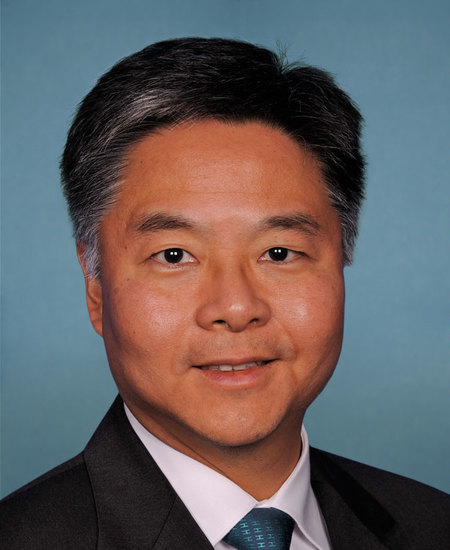
Rep. Ted Lieu
Sponsored bills
This bill designates the facility of the United States Postal Service located at 28201 Franklin Parkway in Santa Clarita, California, as the "Deputy Ryan Clinkunbroomer Post Office Building".
Maddy summaryHR 6123, the "Promoting Diplomacy with Australia Act," requires the U.S. Assistant Secretary of State for East Asia and Pacific Affairs to submit a report within 30 days of enactment on the capacity of the U.S. diplomatic mission in Australia. The report must detail current staffing and operations, planned growth for 2025-2030, interagency expansion, necessary support systems, resource gaps affecting U.S. objectives (including the Australia-U.S. alliance and AUKUS partnership), and recommendations for additional facilities, staffing, and funding. This procedural bill mandates a comprehensive analysis to address potential shortfalls but does not enact new policy or funding.
Maddy summaryThe Global Respect Act (HR 6151) requires the U.S. President to publicly list foreign officials responsible for severe human rights violations against LGBTQI individuals, including torture, prolonged detention, or violence based on sexual orientation or gender identity. It mandates denying visas and entry to listed individuals and requires annual reports on the list's updates and impacts. The bill also directs the State Department to track global violence against LGBTQI people and update annual human rights reports to include discrimination based on sexual orientation or gender identity. These provisions directly affect foreign government officials and entities implicated in such abuses, aiming to increase accountability through U.S. visa restrictions.
Maddy summaryThe EXPERTS Act of 2025 requires agencies to disclose funding sources and potential conflicts of interest for studies submitted during rulemaking, including who funded research and any financial relationships that might influence findings. It establishes an Office of the Public Advocate within the Office of Management and Budget to assist public participation in rulemaking, conduct social equity assessments, and improve outreach to underrepresented groups. The bill also mandates that agencies consider social equity impacts when creating rules and requires detailed explanations for withdrawing proposed regulations. These provisions aim to increase transparency, inclusivity, and accountability in the federal regulatory process.
Maddy summaryHR 5894, the RESTRAIN Act, prohibits the United States from conducting any explosive testing of nuclear weapons or other nuclear explosions. It directly affects U.S. nuclear weapons programs by banning such testing using federal funds for fiscal year 2026 and beyond. The bill's key mechanism is a funding restriction: no money authorized for fiscal year 2026 or later may be used for explosive nuclear testing or other nuclear explosions. However, it explicitly excludes subcritical nuclear tests (which do not sustain a chain reaction) from this prohibition. The law aims to enforce a permanent ban on nuclear detonations while preserving the ability to conduct certain non-explosive testing.
Maddy summaryThe HEAL-AI Act (HR 6077) establishes a federal grant program to fund medical schools and teaching hospitals in training medical students, residents, and faculty on using artificial intelligence in healthcare. It requires grantees to develop curricula covering AI diagnostics, ethical issues (like bias and patient privacy), and clinical integration, while limiting administrative costs to 10% of funds. Schools must report annually on program progress and publicly share educational materials, with priority given to institutions serving underserved communities. The program allocates $1 million annually from 2026-2030, totaling $5 million over five years, to support competency-based AI literacy in medical education.
Maddy summaryThis bill amends Section 1983 of federal law (42 U.S.C. 1983) to explicitly allow lawsuits against federal officials who violate constitutional rights while acting under federal authority. It directly affects individuals whose constitutional rights were allegedly infringed by federal employees, such as law enforcement or agency staff. The key provision inserts "of the United States" before "of any State" in the statute, expanding the existing legal remedy for state officials to cover federal officials as well. This creates a clear, standalone legal path for citizens to seek redress for federal constitutional violations without relying on precedent.
Maddy summaryThe Climate Solutions Act of 2025 establishes binding national targets to reduce U.S. greenhouse gas emissions. It requires electric utilities to generate 100% renewable electricity by 2035 and sets cumulative annual energy efficiency targets for electricity (reaching 11.25% savings by 2032) and natural gas (reaching 4.05% savings by 2032). The bill mandates the EPA to set annual emissions reduction targets, requiring U.S. net emissions to be 52% below 2005 levels by 2035 and reach net zero by 2050. These provisions directly affect energy providers, utilities, and all consumers through new federal standards for renewable energy adoption and efficiency improvements.
Maddy summaryHR 6049, the No Payola Act, repeals a requirement that Senate staff notify the Senate when legal process seeks to disclose Senate data. It also requires Senators who received funds from private lawsuits under the repealed provision to repay those funds to the Treasury. The bill directly affects Senators who might have been involved in legal cases related to the repealed notification rules. This is a procedural change eliminating specific reporting obligations and financial penalties for certain Senate-related legal actions.