This resolution supports the designation of National Asian American, Native Hawaiian, and Pacific Islander Mental Health Day.
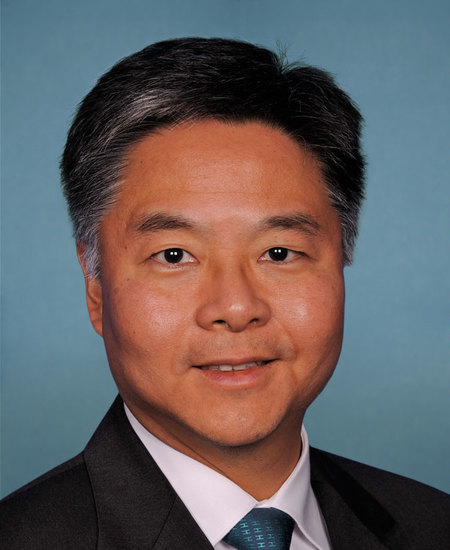
Rep. Ted Lieu
Sponsored bills
21st Century Federal Writers' Project Act This bill creates a grant program in the Department of Labor to provide eligible entities with funds to assist individuals who are unemployed or underemployed in order to document in writing and images American society and the broad impacts and effects of the COVID-19 pandemic in the United States. In addition, Labor must (1) establish a repository of works developed through the grant program in which grantees submit completed works from subgrantees, including giving credit to each writer or artist, and make such works available to the public; and (2) forward the completed work to the Library of Congress to archive such material. The Library must establish an archive program in its American Folklife Center for collection and public availability, in a digital format of such written and visual works.
Adoption Tax Credit Refundability Act of 2021 This bill makes the tax credit for adoption expenses refundable.
Coronavirus Frontline Workers Fair Pay Act This bill provides hazard pay, in addition to regular pay, to health care and essential workers for specified periods during the COVID-19 public health emergency. Health care workers, which include physicians and support staff, among others, are eligible for a maximum of $35,000 in aggregate hazard pay. Essential workers, as determined by the Cybersecurity and Infrastructure Security Agency, are eligible for a maximum of $25,000 in aggregate hazard pay. The Department of the Treasury must make payments to employers based on an employer's quarterly projections of the number of hours worked by eligible employees, including specified hours worked prior to the enactment of this bill. Employers must issue hazard payments to eligible employees not later than 14 days after receiving payments from Treasury. The bill establishes and provides funding for the Coronavirus Essential and High-Risk Health Care Workers Hazard Payment Fund to implement this program.
Helping Ensure Life- and Limb-Saving Access to Podiatric Physicians Act or the HELLPP Act This bill adds podiatrists as covered physicians under the Medicaid program. Additionally, the bill revises certain documentation requirements related to Medicare coverage of therapeutic shoes for individuals with diabetes. Finally, the bill subjects payments made to a Medicaid provider or supplier to a continuing levy for federal taxes owed by the provider or supplier.
This resolution supports the designation of Mental Health Awareness Month and declares mental health a national priority.
Transit to Trails Act of 2021 This bill directs the Department of Transportation (DOT) to establish the Transit to Trails Grant Program to award grants to certain governmental and private entities for projects that increase transportation access and mobility to public lands, inland and coastal waters, parkland, or monuments for critically underserved communities. For example, DOT must (1) prioritize approving certain projects, such as projects that use low-or zero-emission vehicles and those that provide free or discounted rates for low-income riders; (2) develop transportation planning procedures for projects conducted under the program that are consistent with metropolitan and statewide planning processes; and (3) ensure that all new transportation connectors and routes developed under the program are accessible to people with disabilities. The bill requires grant awards to be at least $25,000 and not more than $500,000. Further, the bill requires publicized schedules and routes for transportation systems that are developed after the receipt of a grant under the program.
Transform, Heal, and Renew by Investing in a Vibrant Economy Act or the THRIVE Act This bill establishes a program to address the economy, racial justice, and climate change. The President must establish a board to advise the President and the heads of federal departments and agencies regarding the implementation of this bill. The President, in consultation with the board, must establish a 10-year plan to create a society that enables and supports greater racial, Indigenous, gender, environmental, and economic justice; work opportunities; healthy communities; a stable climate; and healthy ecosystems. In addition, the President, in consultation with the board, must implement a program that provides support to public or private entities that carry out qualified programs. The programs must meet certain labor, equity, and environmental conditions and support infrastructure, including to expand access to pollution-free, renewable, and affordable energy; care workers and social infrastructure (e.g., health care infrastructure); expanded access to housing; efforts to protect and restore biodiversity or natural habitats and efforts to remediate pollution in communities harmed by environmental, economic, or socioeconomic injustice; agriculture, including agricultural workers; or the development and transformation of the U.S. industrial base, including by expanding manufacturing of clean technologies.

This concurrent resolution commemorates the 30th anniversary of Operation Provide Comfort (the humanitarian operation to defend and deliver aid to Kurdish refugees fleeing attacks by the Hussein regime), and it reaffirms the strong American-Kurdish partnership.
Global Climate Change Diplomacy Act This bill requires the Department of State to take specified actions to address global climate change. Specifically, the State Department must establish and staff Climate Change Officer positions, the holders of which shall be assigned to U.S. embassies, consulates, or diplomatic missions. Each officer shall provide climate change mitigation expertise, engage with international entities concerned with addressing climate change, and facilitate U.S. engagement in bilateral and multilateral cooperation on climate change. Each chief of mission in a foreign country must take certain climate change-related actions, including (1) developing a strategy to improve and increase studying, mitigating, and adapting to climate change; and (2) certifying that considerations related to climate change are incorporated in activities, management, and operations of the U.S. embassy or other diplomatic post under the director of the chief of mission. The State Department must also establish a curriculum at its Foreign Service Institute to provide employees with specialized climate change training, and it must ensure that embassy personnel responsible for contracts, grants, or acquisitions are trained on evaluating such agreements for considerations related to sustainability and climate change.