This bill requires airports to broadcast in terminals automated announcements about the penalty for interfering with cabin or flight crews.
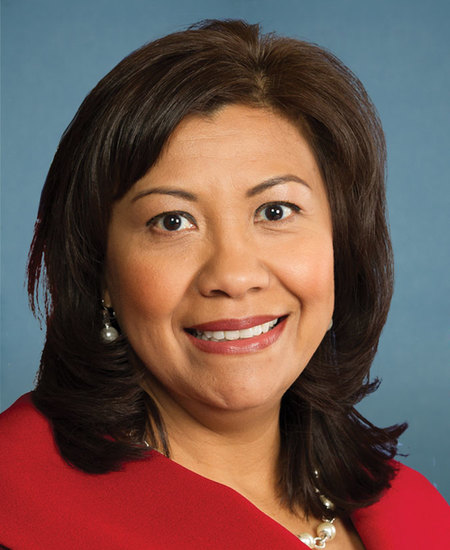
Rep. Norma J. Torres
Sponsored bills
Central American Women and Children Protection Act of 2021 This bill temporarily authorizes the Department of State to enter into bilateral compacts with the governments of El Salvador, Guatemala, and Honduras to strengthen criminal justice systems, social supports, and other means to protect women and children from domestic and gender-based violence. At least 15 days before entering a compact, the State Department must submit to Congress a copy of the proposed agreement and related materials. Authority to enter a compact terminates on September 30, 2023, and a compact may last no more than six years. To support the objectives outlined in a compact, the State Department may provide assistance to international organizations, civil society, or other private entities for programs and activities to prevent and respond to domestic and gender-based violence in a compact country. The bill bars the provision of assistance to the government of a compact country as direct budgetary support. The State Department may suspend or terminate the assistance if a compact country or entity receiving the assistance engaged in conduct contrary to U.S. national security interests or inconsistent with the objectives of the compact. The State Department must notify Congress at least 15 days before suspending or terminating assistance. The bill also requires the State Department to annually report on progress made under each compact, including its effect on reported violence against women and children and other domestic and gender-based violence indicators.
Diversity and Inclusion at the Department of State Act This bill establishes a new position and requires other activities to promote diversity and inclusion in the Department of State. The bill creates the presidentially-appointed position of Chief Diversity and Inclusion Officer in the Office of the Deputy Secretary of State to, among other activities, develop a strategic plan to guide implementation of diversity and inclusion efforts and support State Department personnel from traditionally underrepresented groups. The officer reports directly to the Secretary of State. Additionally, the State Department must establish a Diversity and Inclusion Leadership Council to coordinate applicable strategic plans, initiatives, and policies. The bill also modifies merit selection processes for promotions, performance pay, and related matters to promote diversity and inclusion in the Foreign Service. Specifically, it adds factors (e.g., testimony from peers and subordinates or demonstrated support for diversity and inclusion) that may be considered in recommendations and rankings related to a Foreign Service officer's performance. The State Department must also establish a mentorship program for entry- and mid-level members of the Foreign Service and periodically offer a Senior Executive Service development program to members of the civil service in the top two pay grades. Senior Executive Service members serve as high-level managers within federal agencies. The bill requires the State Department to report on its diversity and inclusion efforts, as well as demographic information about members of boards that make personnel decisions and candidates for the Senior Executive Service.

Smoke Planning and Research Act of 2021 This bill requires the Environmental Protection Agency (EPA) to research and mitigate the impacts of smoke emissions from wildland fires. Specifically, the EPA must establish (1) four Centers of Excellence for Wildfire Smoke at institutions of higher education, and (2) a grant program to support community mitigation efforts.
Averting Loss of Life and Injury by Expediting SIVs Act of 2021 or the Allies Act of 2021 This bill increases the number of special immigrant visas available to qualified Afghan nationals who worked for the U.S. government or the North Atlantic Treaty Organization (NATO) missions in Afghanistan. The bill also relaxes certain qualifications for such visas. Specifically, this bill makes available an additional 8,000 visas for principal aliens under this special visa program, to be available until all such visas have been issued. (The numerical limitations in this program apply only to the principal alien who applies for the visa, not to any accompanying spouse or child.) Under this bill, an alien may qualify based on a credible basis for concern about the possibility of an ongoing serious threat in Afghanistan due to their work with the U.S. government or a NATO mission, where currently the alien must have experienced such a threat. The bill also eliminates a requirement for each applicant to submit a credible sworn statement describing that threat. Furthermore, for an applicant qualifying for a visa by performing duties for U.S. military personnel stationed with a NATO mission, this bill eliminates a requirement that the duties performed qualify as sensitive and trusted duties. If an alien submits a visa application that included an accompanying spouse or child but the alien passes away before the application is granted, the surviving spouse or child shall remain eligible to receive a visa under that application. Currently, a surviving spouse or child retains eligibility only if the application was approved before the alien passed away.
Refugee Sanitation Facility Safety Act of 2021 This bill directs the Department of State, when providing overseas assistance for refugees, to ensure the provision of safe and secure access to sanitation facilities, with a special emphasis on women, girls, and vulnerable populations.
G.I. and Veterans Education Empowerment Act or the GIVE Act This bill requires the Department of Veterans Affairs to provide veterans and members of the Armed Forces with information about whether (1) a postsecondary education institution is listed on the College Navigator website as being affiliated with a certain religion, (2) an institution is minority serving, and (3) an institution is gender specific.
This resolution expresses support for the designation of Journeyman Lineworkers Recognition Day. (A journeyman lineworker is a person who builds and maintains electrical power systems.)
New Collar Jobs Act of 2021 This bill provides incentives for cybersecurity education. Specifically, the bill establishes an employee cybersecurity education tax credit for an employer who incurs costs for an employee who earns a certain cybersecurity certificate or degree. If a business claims such a credit, then federal agencies must award a score increase to each competitive proposal submitted by the business for a federal contract valued at more than $5 million. In addition, the Department of Education must cancel eligible student loans for borrowers who have (1) made 36 consecutive monthly payments, and (2) held a cybersecurity job in an economically distressed area during at least 12 months of payments. Finally, the bill makes cybersecurity course instructors eligible for awards under the CyberCorps Scholarship for Service program.
Safe Schools Improvement Act of 2021 This bill requires states to direct their local educational agencies (LEAs) to establish policies that prevent and prohibit bullying and harassment of elementary and secondary school students. In particular, these policies must prohibit bullying and harassment based on race, color, national origin, sex, sexual orientation, gender identity, disability, or religion. Further, LEAs must provide (1) students, parents, and educational professionals with annual notice of the conduct prohibited in their disciplinary policies; (2) students and parents with grievance procedures that target such conduct; and (3) the public with annual data on the incidence and frequency of that conduct at the school and LEA level. The Department of Education must conduct and report on an independent biennial evaluation of programs and policies to combat bullying and harassment in elementary and secondary schools. The National Center for Education Statistics must collect state data to determine the incidence and frequency of the conduct prohibited by LEA disciplinary policies.