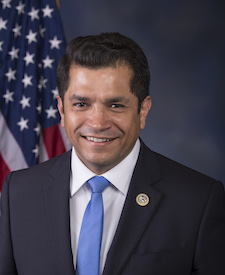
Photo of Jimmy Gomez
D United States House · District 34 · California On the 2026 ballot

Rep. Jimmy Gomez

Compare
Total votes
2,837
all sessions
Attendance
96%
100 missed
Lower than 86% of chamber peers
With party
97%
of cast votes
Near the chamber average
Bipartisan score
2%
crosses aisle rarely
Near the chamber average
Sponsored
1,161
bills & resolutions
Near the chamber average
Committees
6
assignments
1,161 bills and resolutions

Sponsored bills

Total
1,161
Primary
61
Co-sponsor
1,100
This page
1,161
matching current filters
Co-sponsor HRES 271
In committee · Indiana House · Co-sponsor
Honoring the accomplishments and legacy of César Estrada Chávez.

Maddy summaryThis resolution (HRES 271) is a symbolic House of Representatives measure honoring César Estrada Chávez, a civil rights leader who co-founded the United Farm Workers and advocated for farmworkers' rights through nonviolent action. It recognizes his life, legacy, and the "¡Sí se puede!" (Yes, we can!) slogan, referencing his work on fair wages, safe conditions, and the 1975 California Agricultural Labor Relations Act. The resolution encourages the public to commemorate his legacy through service and education, consistent with existing state observances of his birthday (March 31) in multiple states. It has no legal effect or policy changes, as it is purely commemorative.

In committee Mar 31, 2025 1 co-sponsor
Co-sponsor HR 1661
In committee · Indiana House · Co-sponsor
SAFE Act of 2025

Save America's Forgotten Equines Act of 2025 or the SAFE Act of 2025 This bill permanently prohibits the slaughter of equines (e.g., horses and mules) for human consumption. (Current law prohibits the slaughter of dogs and cats for human consumption. This bill extends the prohibition to equines.) Specifically, this bill prohibits a person from knowingly (1) slaughtering an equine for human consumption; or (2) shipping, transporting, possessing, purchasing, selling, or donating an equine to be slaughtered for human consumption or equine parts for human consumption. The bill subjects a violator to a fine. The bill applies to conduct in or affecting interstate or foreign commerce or within the special maritime and territorial jurisdiction of the United States. However, it does not apply to an activity carried out by an Indian for a religious ceremony. As background, in recent years, the appropriations acts have prohibited the Department of Agriculture (USDA) from using federal funds to inspect horses before they are slaughtered for human consumption. Therefore, there are currently no USDA-inspected horse slaughter facilities in the United States.

In committee Mar 28, 2025 1 co-sponsor
Co-sponsor HRES 261
In committee · Indiana House · Co-sponsor
Recognizing the heritage, culture, and contributions of Latinas in the United States.

Maddy summaryHRES 261 is a symbolic resolution recognizing the heritage, culture, and contributions of Latinas in the United States. It celebrates Latinas' historical and ongoing roles in fields like business, military service, science, arts, and public office, while acknowledging persistent challenges like wage gaps and systemic barriers. The resolution specifically highlights that Latinas make up approximately 1 in 6 U.S. women (31 million people) and emphasizes their economic impact (contributing $1.3 billion to GDP in 2021) and cultural achievements. It does not create new policies or allocate funds but formally honors these contributions and calls for continued efforts to address inequities. This resolution directly affects Latinas as a recognized demographic group within U.S. society.

In committee Mar 27, 2025 1 co-sponsor
Co-sponsor HR 2410
In committee · Indiana House · Co-sponsor
Revitalizing Downtowns and Main Streets Act

Maddy summaryHR 2410 creates a 20% federal tax credit for developers converting older non-residential buildings (at least 20 years old) into affordable housing. The credit applies to qualified conversion costs, requiring that 20% of units be rent-restricted for residents earning 80% or less of the area median income for 30 years. It establishes a $12 billion national credit limit, with $3 billion reserved for conversions in economically distressed areas, and mandates state-level allocation plans prioritizing projects near transit and employment. The bill directly affects developers seeking tax incentives for downtown revitalization, not tenants or local governments.

In committee Mar 27, 2025 1 co-sponsor
Co-sponsor HR 2038
In committee · Indiana House · Co-sponsor
American Housing and Economic Mobility Act of 2025

Maddy summary# Summary of the American Housing and Economic Mobility Act of 2025 This comprehensive legislation addresses housing affordability, civil rights, financial inclusion, and tax policy through multiple titles: **Fair Housing Expansion (Title I):** - Expands protections under the Fair Housing Act to include gender identity, sexual orientation, marital status, source of income, and veteran status - Requires housing providers receiving federal assistance to comply with enhanced accessibility standards (twice as many units must be accessible) **Community Reinvestment Act Strengthening (Title II):** - Requires banks to form diverse Community Advisory Committees in each metropolitan area - Mandates regular biannual consultations between bank executives and community advisory groups - Requires detailed data collection on lending practices by demographic factors (including race, ethnicity, and disability status) - Establishes new requirements for banks to analyze and report on disparities in access to credit **Veterans' Housing Access (Title III):** - Expands eligibility for VA home loans to include direct descendants of veterans who served between June 22, 1944, and April 11, 1968, who are first-time, first-generation homebuyers **Public Housing Improvements (Title IV):** - Requires public housing agencies to analyze where participants live and develop strategies to increase access to higher-opportunity neighborhoods - Mandates regional collaboration among housing agencies to reduce disparities in access - Requires HUD to develop mapping tools to help agencies analyze neighborhood access **Estate Tax Reforms (Title V):** - Increases estate tax rates for large estates (over $13 million) - Reduces the basic exclusion amount from $13 million to $3.5 million - Imposes a 10% surtax on estates exceeding $1 billion - Increases the exclusion limit for farm real property from $750,000 to $3 million - Increases the exclusion for land subject to conservation easements from $500,000 to $2 million - Creates a new 5-8% surcharge on high-income estates and trusts **Additional Provisions:** - Strengthens credit union service to underserved areas - Raises public welfare caps for banks to increase investments in low-income communities - Requires new data collection and reporting requirements for financial institutions This legislation represents a significant expansion of housing rights, financial inclusion, and tax policy reforms aimed at reducing disparities in access to housing and financial services while reforming the estate tax system.


In committee Mar 27, 2025 1 co-sponsor
Co-sponsor HR 2368
In committee · Indiana House · Co-sponsor
Raise the Age Act of 2025

Maddy summaryThis bill would require federal firearms licensees to prohibit sales of specific high-capacity rifles and shotguns to people under 21. It targets semiautomatic centerfire rifles and shotguns capable of holding more than 5 rounds in their magazines, raising the age limit from 18 to 21 for these weapons. Exceptions apply for active military members and certain government employees authorized to carry firearms. The law directly affects gun retailers and individuals under 21 seeking to purchase these specific firearms. It modifies existing federal gun sale rules without changing age requirements for other firearms.

In committee Mar 26, 2025 1 co-sponsor
Co-sponsor HR 2338
In committee · Indiana House · Co-sponsor
WRCR Act of 2025

Maddy summaryThe WRCR Act of 2025 expands the Earned Income Tax Credit (EITC) to include qualifying students who meet specific criteria, such as receiving a Federal Pell Grant or having household income below 300% of the poverty line. It lowers the age requirement for eligibility from 25 to 18 and creates a special rule treating certain care-giving and learning activities as "compensated work" for EITC purposes. The bill increases credit percentages for certain taxpayers, modifies phaseout amounts to $4,000 (single filers) and $30,000 (joint filers), and establishes an advance payment system allowing monthly EITC payments up to 75% of the estimated credit. These changes directly affect low-income workers, students, and families with children who qualify for the EITC, with the advance payments beginning in 2026 for taxable years after 2024.

In committee Mar 25, 2025 1 co-sponsor
Co-sponsor HR 17
In committee · Indiana House · Co-sponsor
Paycheck Fairness Act

Maddy summaryThe Paycheck Fairness Act strengthens equal pay protections by expanding the definition of "sex" to include pregnancy, childbirth, sexual orientation, gender identity, and sex characteristics. It modifies employer defenses for pay disparities to require proof that any pay difference is job-related, not based on sex, and accounts for the entire pay gap. The bill prohibits employers from asking about salary history, enhances penalties for violations, and requires employers with 100+ employees to collect and report detailed pay data by race, sex, and job category. It also establishes training programs for employers on eliminating pay bias and creates a National Equal Pay Enforcement Task Force to coordinate enforcement efforts. This legislation directly affects employers, particularly those with 100+ employees, and aims to address pay disparities impacting women, people of color, and other underrepresented groups.

In committee Mar 25, 2025 1 co-sponsor
Co-sponsor HJRES 80
In committee · Indiana House · Co-sponsor
Establishing the ratification of the Equal Rights Amendment.

Maddy summaryH.J. Res. 80 would declare the Equal Rights Amendment (ERA) part of the U.S. Constitution, asserting it has been ratified by 38 states (three-fourths of the states) despite the original 1972 deadline. If passed, this resolution would formally establish the ERA as a constitutional amendment, requiring all federal and state laws to align with its gender equality protections. The bill does not create new laws but confirms the ERA's status as part of the Constitution, affecting how laws are interpreted and enforced. It is a procedural step to resolve the legal dispute over the ERA's validity after decades of debate.

In committee Mar 24, 2025 1 co-sponsor
Co-sponsor HRES 195
In committee · Indiana House · Co-sponsor
Of inquiry requesting the President of the United States to furnish certain information to the House of Representatives relating to the operations of the Social Security Administration after January 20, 2025, including information on the Department of Government Efficiency's access to the Social Security Administration and to information in the possession of such Administration.

Maddy summaryThis resolution (HRES 195) requests the President to provide the House of Representatives with specific documents and communications related to the Social Security Administration (SSA) after January 20, 2025. It seeks information about the Department of Government Efficiency’s (DOGE) access to SSA systems, visits to SSA offices, compliance with certain executive orders, call volumes, office closures, and staff reductions. The request covers documents like IT access logs, correspondence, audit trails, and operational metrics, all to be provided within 14 days of the resolution's adoption. As a procedural oversight measure, it does not change laws but aims to gather facts about SSA operations.

In committee Mar 21, 2025 1 co-sponsor
Showing 221 to 230 of 1,161 bills
Previous 1 … 22 23 24 … 117 Next