

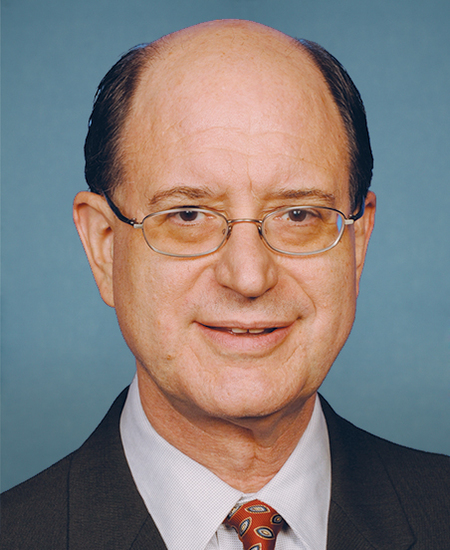
Photo of Brad Sherman
D United States House · District 32 · California On the 2026 ballot

Rep. Brad Sherman

Compare
Total votes
2,837
all sessions
Attendance
99%
41 missed
Near the chamber average
With party
98%
of cast votes
Near the chamber average
Bipartisan score
1%
crosses aisle rarely
Near the chamber average
Sponsored
1,414
bills & resolutions
Near the chamber average
Committees
7
assignments
1,414 bills and resolutions

Sponsored bills

Total
1,414
Primary
54
Co-sponsor
1,360
This page
1,414
matching current filters
Primary HR 4819
In committee · Indiana House · Lead sponsor
Click to Cancel Act of 2025

Maddy summaryHR 4819, the Click to Cancel Act of 2025, makes the Federal Trade Commission's November 2024 "Negative Option Rule" permanent law. This rule directly affects businesses that use automatic renewal subscriptions (like streaming services or software) and their consumers, requiring clear, easy cancellation options. The bill codifies the FTC's existing rule, treating violations as unfair or deceptive practices under the FTC Act, and grants the FTC full authority to enforce it using existing powers and penalties. The key change is that businesses must now explicitly obtain consumer consent for recurring charges and provide straightforward cancellation methods, moving beyond the previous rule-based guidance.

In committee Jul 29, 2025 0 co-sponsors
Co-sponsor HR 4806
In committee · Indiana House · Co-sponsor
College Transparency Act

Maddy summaryThe College Transparency Act requires the federal government to create a new student data system that collects and shares information about college enrollment, costs, completion rates, and post-graduation outcomes. This system will directly affect colleges and universities (which must submit data), students (whose information is collected with privacy protections), and families (who will access the data to make informed education decisions). The bill mandates the development of a public website providing customizable, aggregate data on student demographics, costs, and outcomes, while prohibiting the collection of sensitive information like health records or political affiliation. The system aims to reduce reporting burdens on institutions by consolidating data collection and making information more transparent for prospective students. It includes strong privacy and security requirements to protect student information, with the data system to be developed within four years of the bill's enactment.

In committee Jul 29, 2025 1 co-sponsor
Co-sponsor HR 4797
In committee · Indiana House · Co-sponsor
EATS Act of 2025

Maddy summaryThis bill removes a barrier preventing most low-income students from accessing SNAP benefits. It amends the Food and Nutrition Act to explicitly allow students enrolled at least half-time in recognized higher education programs to qualify for SNAP, reversing a prior exclusion. The key change eliminates the previous requirement that students meet specific exceptions (now deleted) and adds a new eligibility category under Section 3(m)(5). This directly affects low-income undergraduate and graduate students at colleges and training programs who were previously ineligible. The changes take effect January 2, 2026.

In committee Jul 29, 2025 1 co-sponsor
Co-sponsor HR 4796
In committee · Indiana House · Co-sponsor
Restoring Essential Healthcare Act

Maddy summaryHR 4796, the Restoring Essential Healthcare Act, repeals a provision that blocked Medicaid payments to certain healthcare providers during a specific period. It directly affects Medicaid beneficiaries who received care from these providers between the enactment of the prior law (Public Law 119-21) and this bill's enactment. The key provision retroactively restores Medicaid payments for services already provided during that blocked period, treating the payment restriction as if it never existed. This change ensures eligible individuals and providers receive reimbursement for covered care delivered during the prohibited timeframe.

In committee Jul 29, 2025 1 co-sponsor
Co-sponsor HR 4763
In committee · Indiana House · Co-sponsor
PTO Act

Maddy summaryHR 4763, the PTO Act, requires most employers to provide employees with at least 1 hour of paid annual leave for every 25 hours worked, with a maximum of 80 hours per year. It applies to private-sector workers and certain government employees, protecting their right to use paid leave for any purpose without disclosing the reason. The bill mandates employers to maintain health benefits during leave, allow carryover of up to 40 hours of unused leave, and pay out unused leave upon separation. It also prohibits employers from discriminating against employees for using paid leave or requiring them to find replacements while on leave. The law includes enforcement mechanisms, allowing employees to file complaints with the Department of Labor or pursue private lawsuits.

In committee Jul 25, 2025 1 co-sponsor
Co-sponsor HCONRES 45
In committee · Indiana House · Co-sponsor
Recognizing the need to improve physical access to many federally funded facilities for all people of the United States, particularly people with disabilities.

Maddy summaryHCONRES 45 is a symbolic congressional resolution recognizing barriers to physical access in federally funded facilities for people with disabilities. It reaffirms support for the Americans with Disabilities Act (ADA) and the Architectural Barriers Act of 1968, and pledges to prioritize inclusive design in future infrastructure projects. The resolution does not create new legal requirements or funding but formally acknowledges ongoing accessibility challenges faced by over 70 million Americans with disabilities. It cites recent data on disability prevalence and existing federal guidelines for pedestrian access, emphasizing the need for equal access to public facilities.

In committee Jul 23, 2025 1 co-sponsor
Co-sponsor HR 4696
In committee · Indiana House · Co-sponsor
Renewing Immigration Provisions of the Immigration Act of 1929

Maddy summaryHR 4696 amends Section 249 of the Immigration and Nationality Act to update eligibility for a registry program that provides a pathway to legal status for long-term residents. It changes the requirement from entering the U.S. before January 1, 1972, to entering at least 7 years before the application date. This adjustment bases eligibility on a rolling 7-year window instead of a fixed historical cutoff, allowing more recent long-term residents to qualify. The bill directly affects individuals who entered the U.S. after 1972 but maintained continuous residence for at least seven years prior to applying.

In committee Jul 23, 2025 1 co-sponsor
Co-sponsor HR 4688
In committee · Indiana House · Co-sponsor
COOL OFF Act

Maddy summaryThis bill requires a 3-business-day waiting period before someone can receive a handgun from another person who isn't a licensed gun seller. It applies to most private handgun transfers but includes exceptions for law enforcement, family loans (like between spouses or parents and children), temporary transfers to prevent imminent harm, and transfers for shooting or hunting under specific conditions. The waiting period begins when the recipient first offers to take possession of the gun. The law would take effect 90 days after enactment.

In committee Jul 23, 2025 1 co-sponsor
Co-sponsor HJRES 108
In committee · Indiana House · Co-sponsor
Proposing an amendment to the Constitution of the United States providing that there is no immunity from criminal prosecution for an act on the grounds that such act was within the constitutional authority or official duties of an individual, and providing that the President may not grant a pardon to himself or herself.

Maddy summaryH.J. Res. 108 proposes a constitutional amendment to remove legal immunity for federal officials, including the President, from criminal prosecution for actions taken while performing official duties. It would prohibit the President from granting pardons to themselves and eliminate the defense that "official authority" excuses violations of federal or state law (with limited exceptions for certain congressional actions). If ratified, this amendment would require Congress to pass implementing laws to enforce these changes. The proposal is currently in the House Judiciary Committee and requires approval by three-fourths of state legislatures to become part of the Constitution.

In committee Jul 22, 2025 1 co-sponsor
Co-sponsor HR 4140
In committee · Indiana House · Co-sponsor
Burma GAP Act

Maddy summaryHR 4140, the Burma GAP Act, requires the U.S. to prioritize accountability for genocide and crimes against humanity committed against Rohingya in Myanmar. It establishes a U.S. Special Representative for Burma to coordinate international sanctions, support Rohingya protection efforts, and advance transitional justice, with specific funding authorizations of $5 million annually for atrocity investigations and $4 million for evidence collection. The bill directs the State Department to support Rohingya refugees in Bangladesh through humanitarian aid, gender-based violence prevention, education, and legal assistance, while promoting durable solutions like safe repatriation and citizenship rights. It mandates annual reports to Congress on U.S. efforts to address atrocity risks, document crimes, and advance accountability, directly affecting Rohingya communities, the Burmese military junta, and U.S. foreign assistance programs.

In committee Jul 22, 2025 1 co-sponsor
Showing 221 to 230 of 1,414 bills
Previous 1 … 22 23 24 … 142 Next