

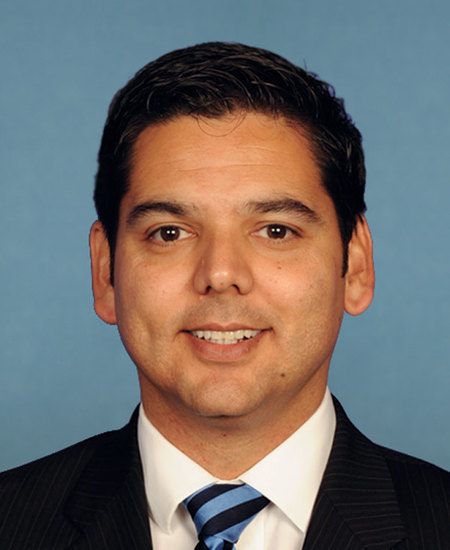
Photo of Raul Ruiz
D United States House · District 25 · California On the 2026 ballot

Rep. Raul Ruiz

Compare
Total votes
2,837
all sessions
Attendance
99%
22 missed
Near the chamber average
With party
98%
of cast votes
Near the chamber average
Bipartisan score
1%
crosses aisle rarely
Near the chamber average
Sponsored
1,024
bills & resolutions
Near the chamber average
Committees
4
assignments
1,024 bills and resolutions

Sponsored bills

Total
1,024
Primary
144
Co-sponsor
880
This page
1,024
matching current filters
Co-sponsor HR 2081
In committee · Indiana House · Co-sponsor
Donut Dollies Congressional Gold Medal Act

Maddy summaryHR 2081, the Donut Dollies Congressional Gold Medal Act, authorizes a Congressional Gold Medal to honor the 627 women who served as Red Cross volunteers in the Supplemental Recreation Activities Overseas (SRAO) program during the Vietnam War. The bill directs the Treasury Secretary to design and strike the medal, which will be presented by Congress and then given to the Smithsonian Institution for display. It also allows the sale of bronze duplicates to cover costs, with proceeds going to the U.S. Mint fund. This commemorative act recognizes the volunteers' service supporting over 280,000 troops through recreation programs across Vietnam from 1965 to 1973.

In committee Mar 11, 2025 1 co-sponsor
Co-sponsor HR 2045
In committee · Indiana House · Co-sponsor
Medicare Dental, Vision, and Hearing Benefit Act of 2025

Maddy summaryThis bill would expand Medicare to cover dental, vision, and hearing services for beneficiaries 65 and older (and some younger people with disabilities), effective January 1, 2026. It would provide 100% coverage for preventative dental services in 2026, with basic and major dental services gradually increasing to 80% coverage by 2029. Vision benefits would include 80% coverage for annual eye exams and specific limits on eyeglasses, frames, and contact lenses ($100 per year for lenses, $100 every two years for frames, $200 every two years for contacts). Hearing services would include 80% coverage for hearing exams and hearing aids, with a limit of one hearing aid per ear every 48 months. The bill also adds oral health professionals to the United States Preventive Services Task Force to help guide coverage decisions.

In committee Mar 11, 2025 1 co-sponsor
Co-sponsor HR 2033
In committee · Indiana House · Co-sponsor
Military Spouse Hiring Act

Maddy summaryHR 2033, the Military Spouse Hiring Act, expands the Work Opportunity Tax Credit to include spouses of active-duty military personnel. It adds "qualified military spouse" as an eligible category for the tax credit, meaning employers who hire such spouses can claim the credit. A "qualified military spouse" is defined as someone certified by a local agency as married to an active-duty service member at the time of hire. The credit applies to hires occurring after the bill's enactment date. This directly affects military spouses seeking employment and employers hiring them, providing a tax incentive to encourage their hiring.

In committee Mar 11, 2025 1 co-sponsor
Co-sponsor HR 2016
In committee · Indiana House · Co-sponsor
Feed Our Families Act of 2025

Maddy summaryThe Feed Our Families Act of 2025 ensures SNAP (Supplemental Nutrition Assistance Program) benefits continue for 90 days during the first government funding lapse in a fiscal year. It appropriates emergency funds from the Treasury to cover SNAP operations for the initial 90 days of a lapse in discretionary appropriations for the program. These funds are held in reserve and can only be used to maintain SNAP program services during that period. The bill directly affects millions of low-income households relying on SNAP benefits by preventing immediate disruptions during early government shutdowns.

In committee Mar 10, 2025 1 co-sponsor
Co-sponsor HR 1988
In committee · Indiana House · Co-sponsor
Pay Federal Workers and Servicemembers Act

Maddy summaryThis bill (HR 1988) provides unemployment benefits eligibility for certain federal workers and military members during government shutdowns. It deems eligible employees - such as military personnel, NOAA Commissioned Corps members, and excepted civilian workers performing emergency duties - as "totally separated from federal service" during funding gaps. This allows them to access unemployment benefits immediately, without waiting periods, for weeks of unemployment starting March 14, 2025. The bill directly affects federal employees who remain on duty but are unpaid due to shutdowns.

In committee Mar 10, 2025 1 co-sponsor
Co-sponsor HR 1871
In committee · Indiana House · Co-sponsor
Water Conservation Rebate Tax Parity Act

Maddy summaryHR 1871, the Water Conservation Rebate Tax Parity Act, changes federal tax rules to allow homeowners to exclude certain water-related rebates from taxable income. It expands the existing tax exclusion to cover rebates for water conservation measures (like efficient fixtures), storm water management (such as rain gardens), and wastewater management (like septic system upgrades), but only for the homeowner's principal residence. These rebates must come from public utilities, storm water providers, or state/local governments. The changes apply to rebates received after December 31, 2021, and do not affect tax treatment for rebates received before 2022.

In committee Mar 5, 2025 1 co-sponsor
Co-sponsor HR 1877
In committee · Indiana House · Co-sponsor
Protecting Americans’ Social Security Data Act

Protecting Americans’ Social Security Data Act This bill prohibits political appointees and special government employees from accessing Social Security data systems that contain personally identifiable information about Social Security beneficiaries. Specifically, political appointees and special government employees may not access systems maintained by the Social Security Administration (SSA) that issue or record Social Security account numbers, that are used to determine eligibility for or to pay Social Security benefits, or that otherwise contain personally identifiable information about individuals receiving or applying for benefits.  The bill also establishes a civil right of action for an individual whose information was negligently accessed or disclosed in violation of these provisions. The individual may bring suit against the United States if the violator was a U.S. employee or officer, or against the violator if they were not a U.S. employee or officer. Such a claim must be brought within two years of the affected individual’s discovery of the violation. Upon a finding of liability, defendants are liable for specified monetary damages.  If an individual is criminally charged or subject to proposed disciplinary or adverse action by a federal or state agency for having accessed or disclosed information in violation of these provisions, SSA must notify the individual whose information was accessed or disclosed of the violation as soon as practicable.  Finally, the bill requires the SSA Office of the Inspector General to investigate and report to Congress on any unauthorized access to or disclosure of information in a beneficiary data system.

In committee Mar 5, 2025 1 co-sponsor
Co-sponsor HR 1876
In committee · Indiana House · Co-sponsor
Keeping Our Field Offices Open Act

Maddy summaryHR 1876, the "Keeping Our Field Offices Open Act," prevents the Social Security Administration (SSA) from closing, consolidating, or restricting access to its field offices, hearing offices, or resident stations for 180 days after enactment, with exceptions for emergencies. The bill requires the SSA Commissioner to submit a detailed report to Congress by January 2029, analyzing closure criteria, transportation burdens for elderly/disabled users, cost-benefit impacts, and plans to replace lost services. For future closures, it mandates 120 days of public notice, two public hearings, and a final report to Congress, while ensuring total office numbers don’t fall below 2025 levels. This directly affects SSA field offices, their users (including elderly and disabled individuals), and employees. The bill’s key mechanism is a procedural safeguard to ensure transparency and minimize disruption before any office changes take effect.

In committee Mar 5, 2025 1 co-sponsor
Co-sponsor HR 14
In committee · Indiana House · Co-sponsor
John R. Lewis Voting Rights Advancement Act of 2025

Maddy summaryThis bill strengthens the Voting Rights Act of 1965 by clarifying how to prove voting discrimination and expanding requirements for preclearance of voting changes. It establishes new standards for determining when voting practices dilute minority voting strength or deny/abridge voting rights, requiring plaintiffs to show specific conditions for vote dilution claims and including factors like historical discrimination and racial polarization in court analyses. The bill modifies the criteria for determining which states and political subdivisions must seek preclearance for voting changes, and adds new transparency requirements for jurisdictions to publicly disclose changes to voting qualifications, polling locations, and election districts. It directly affects states and local governments that implement voting policies, particularly those with a history of voting rights violations or that make changes to voting qualifications, procedures, or district boundaries. The bill aims to prevent discriminatory voting practices by providing clearer standards for courts and requiring greater transparency in voting rule changes.

In committee Mar 5, 2025 1 co-sponsor
Co-sponsor HR 20
In committee · Indiana House · Co-sponsor
Richard L. Trumka Protecting the Right to Organize Act of 2025

Maddy summaryThe Richard L. Trumka Protecting the Right to Organize Act of 2025 strengthens workers' organizing rights by making it an unfair labor practice for employers to threaten permanent replacement of striking workers, discriminate against workers who support unions, or require employees to attend employer campaigns unrelated to their job duties. It expands the definition of "employee" to make it harder for companies to classify workers as independent contractors and requires employers to post notices about workers' rights in conspicuous locations. The bill establishes a new electronic voting system for union elections, creates a 90-day bargaining period before mediation can be requested, and increases penalties for violations of labor laws. These changes are intended to make it easier for workers to form unions and negotiate better wages and working conditions.

In committee Mar 5, 2025 1 co-sponsor
Showing 251 to 260 of 1,024 bills
Previous 1 … 25 26 27 … 103 Next