

Maddy summaryThis bill helps spouses of U.S. military members (active or reserve duty, honorably discharged) who have filed for immigration as immediate relatives. It removes specific inadmissibility barriers, including certain criminal history checks unrelated to immigration status, for these spouses during visa processing. It also allows spouses previously removed from the U.S. to apply for visas from abroad and temporarily return as nonimmigrants to reunite with their service member spouse while their applications are pending.
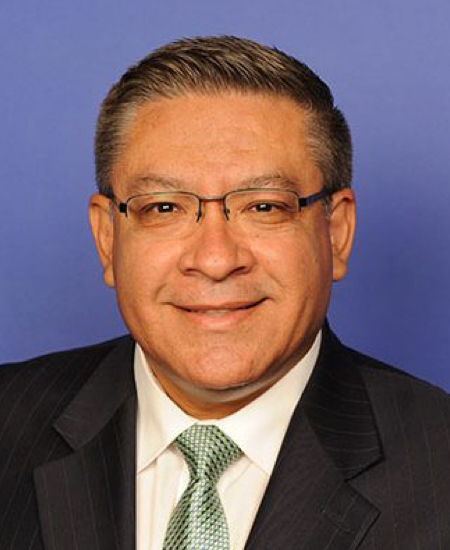
Rep. Salud O. Carbajal
Sponsored bills
Maddy summaryThe Valve Safety Fairness Act of 2025 requires the Pipeline and Hazardous Materials Safety Administration to apply an existing 2022 pipeline safety rule to Type A gas gathering lines. This rule mandates specific valve installations and rupture detection systems to prevent pipeline failures and enhance safety. The bill directly affects natural gas pipeline operators managing Type A gathering lines, which transport gas from wells to processing facilities, by requiring compliance with these safety standards. The legislation extends current safety requirements to a previously excluded pipeline category without creating new rules.
Stronger Communities through Better Transit Act This bill requires the Department of Transportation (DOT) to establish a grant program to support operating projects for public transportation and related service improvements, particularly in underserved communities and areas of persistent poverty. Specifically, the bill requires DOT to allocate funding under the program for urbanized areas, states, and Indian tribes that are recipients of funds under either the Federal Transit Administration's (FTA's) Urbanized Area Formula Funding program or Formula Grants for Rural Areas program. Eligible recipients may use funding for operating costs associated with projects that improve public transportation service for transit-dependent populations and support increased transit ridership (e.g., service expansion, information technology enhancements, and workforce development). DOT must apportion the funding so that recipients receive funds that are proportional to their share of operating costs. The bill also provides for an increased federal cost share for operating assistance for projects or programs carried out in areas of persistent poverty or underserved communities. DOT must set up a multimodal access measurement interface for public agencies to aid transit agencies in determining and reporting on access to jobs and essential services. A grant recipient must (1) report specific information to the FTA for inclusion in the National Transit Database, and (2) survey transit riders and non-riding residents regarding transit service improvements. Further, the bill expands the purposes of the public transportation programs to include supporting public transportation's role in combating climate change through growing/retaining transit ridership.
Maddy summaryThis resolution (HRES 417) is a symbolic gesture to honor the National Science Foundation (NSF) on its 75th anniversary. It recognizes the NSF’s founding in 1950 to advance science, engineering, and education, highlighting its role in supporting research across all 50 states, fostering global scientific collaboration, and enabling key innovations like the internet, MRI technology, and AI. The resolution does not create new policy or funding but formally commends the NSF’s mission and achievements, including its annual support for roughly 350,000 researchers and its contribution to 268 Nobel Prize-winning discoveries. It concludes by reaffirming congressional support for the NSF’s ongoing work.
Maddy summaryThis bill clarifies that the President has no constitutional authority to withhold funds Congress has appropriated. It creates new legal mechanisms allowing private citizens and state/local governments to sue the federal government for impoundments of appropriated funds. The bill strengthens the Comptroller General's oversight role by requiring executive branch cooperation in investigations of potential violations. Federal employees who knowingly violate these provisions would face personal liability and lose immunity protections. The legislation aims to reinforce Congress's constitutional authority over the budget process.
Maddy summaryHR 2492, the Fire Safe Electrical Corridors Act of 2025, allows electrical utilities to cut trees near power lines on National Forest System and Bureau of Land Management lands without needing a separate timber sale, provided the work follows existing land management plans and environmental laws. Utilities must provide any proceeds from selling removed vegetation (minus transportation costs) to the federal government, though the bill does not require them to sell the material. This applies specifically to agreements for power line maintenance on federal lands managed by the Agriculture Secretary (Forest Service) or Interior Secretary (BLM). The bill focuses on streamlining vegetation management near power lines while ensuring federal land management rules and environmental protections are followed.
Maddy summaryHR 3368, the "Born in the USA Act of 2025," prohibits federal funding for Executive Order 14160 (which aimed to restrict birthright citizenship for children born in the U.S.). The bill directly affects federal agencies that might implement the executive order by blocking their use of funds for that purpose. Its key provision is a funding ban targeting the executive order and any similar future policies, without changing citizenship law. The bill does not alter birthright citizenship rights but prevents federal resources from being used to enforce the controversial executive order. It is a procedural measure focused on funding, not a substantive policy change to citizenship rules.
Maddy summaryThe EAGLE Act of 2025 establishes a $10 million federal grant program to help small local law enforcement agencies (under 350 employees) pay for accredited certification. Agencies must apply demonstrating financial need and specify costs for accreditation fees, on-site assessments, or extension fees charged by recognized bodies like CALEA. Grant funds cover only direct costs related to achieving or maintaining accredited status, not general operations. The program requires the Attorney General to set up the grants within 90 days of the bill becoming law.
Maddy summaryHR 3338, the MARKET CHOICE Act, would impose a tax on greenhouse gas emissions from fossil fuels, industrial processes, and certain products, starting at $40 per metric ton of carbon dioxide equivalent in 2027 with annual increases based on inflation. The tax would be paid by owners or operators at specific points in the supply chain, with exemptions for carbon capture and certain product uses that reduce emissions. Revenue from the tax would fund infrastructure projects, climate adaptation initiatives, and worker retraining programs for displaced energy workers, while establishing a National Climate Commission to set emissions reduction goals.
Maddy summaryHR 3373, the GHOST Act of 2025, requires entities shipping certain firearm parts (barrels, slides, or bolts) across state lines to register shipments with the Attorney General within 5 business days. This includes providing sender/recipient details, shipping method, and proof of delivery via certified mail or recipient signature. The bill creates a confidential database for law enforcement access but prohibits public disclosure under the Freedom of Information Act. Violations carry fines or up to 1 year in prison for single shipments, and up to 10 years for shipping 50+ parts in one transaction.