

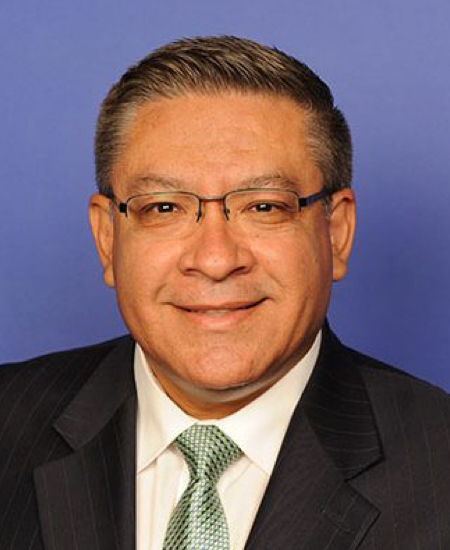
Photo of Salud O. Carbajal
D United States House · District 24 · California On the 2026 ballot

Rep. Salud O. Carbajal

Compare
Total votes
2,837
all sessions
Attendance
100%
12 missed
Higher than 78% of chamber peers
With party
98%
of cast votes
Near the chamber average
Bipartisan score
1%
crosses aisle rarely
Near the chamber average
Sponsored
1,968
bills & resolutions
Higher than 92% of chamber peers
Committees
8
assignments
1,968 bills and resolutions

Sponsored bills

Total
1,968
Primary
95
Co-sponsor
1,873
This page
1,968
matching current filters
Co-sponsor HRES 966
In committee · Indiana House · Co-sponsor
Recognizing the admirable contributions of Senate President Pro Tempore Monique Limón.

Maddy summaryHRES 966 is a ceremonial resolution passed by the U.S. House of Representatives to formally recognize California State Senator Monique Limón's historic appointment as the first Latina and first mother to serve as Senate President Pro Tempore. The resolution highlights her background as a first-generation college graduate, former educator, and long-time state legislator representing districts in Santa Barbara. It does not create new laws or policy changes; instead, it serves as a formal acknowledgment of her leadership and service to California. The resolution was submitted for her upcoming swearing-in on January 5, 2026.

In committee Dec 18, 2025 1 co-sponsor
Co-sponsor HRES 963
In committee · Indiana House · Co-sponsor
Condemning antisemitism in all its forms, including the proliferation and amplification of antisemitic content on artificial intelligence (AI) platforms, urging robust, transparent safeguards for AI, and recognizing stakeholders working to counter this threat.

Maddy summaryHRES 963 is a non-binding House resolution condemning antisemitism amplified by AI platforms and urging tech companies to implement safeguards. It directly affects AI developers and social media companies by requiring them to adopt transparent safety measures, prevent algorithmic amplification of antisemitic content, and publicly report on antisemitic content prevalence and removal efforts. Key provisions include promoting "safety-by-design" standards, enabling researcher access to study antisemitic content dynamics, and supporting digital literacy programs to counter AI-generated hate. The resolution emphasizes aligning these efforts with constitutional protections while recognizing stakeholders working to combat antisemitism online.

In committee Dec 18, 2025 1 co-sponsor
Co-sponsor HR 6842
In committee · Indiana House · Co-sponsor
Disaster Survivors Tax Relief and Recovery Act

Maddy summaryThis bill provides tax relief to individuals affected by qualifying disasters. It allows taxpayers to use their previous year's earned income to calculate tax credits like the Earned Income Tax Credit if their 2025 income was reduced by a disaster. The bill temporarily removes limits on charitable contributions for disaster relief, permits penalty-free withdrawals up to $100,000 from retirement plans, and adjusts rules for claiming personal casualty losses related to disasters. These provisions apply to individuals whose principal homes were in designated disaster areas during specific periods. The bill aims to help disaster survivors recover financially by easing tax burdens related to their losses.

In committee Dec 18, 2025 1 co-sponsor
Co-sponsor HR 6857
In committee · Indiana House · Co-sponsor
Protecting Students on Campus Act of 2025

Maddy summaryHR 6857 requires all colleges and universities receiving federal funds to prominently display a link to the Department of Education’s civil rights complaint portal on their website homepage and to post annual Title VI awareness materials in high-traffic campus locations (like student centers) and on campus websites. The bill mandates these institutions to annually report discrimination complaints (based on race, color, or national origin) to the Department of Education’s Inspector General. It also requires the Department to provide monthly congressional briefings on complaint volumes and resolution timelines, while the Inspector General must audit institutions with the highest complaint rates and study why some complaints go to schools versus the federal office. This directly affects every federally funded higher education institution in the U.S. by changing how they handle and report civil rights complaints.

In committee Dec 18, 2025 1 co-sponsor
Co-sponsor HR 6856
In committee · Indiana House · Co-sponsor
Peace Through Strength Against Russia Act of 2025

Maddy summaryThe "Peace Through Strength Against Russia Act of 2025" proposes to significantly expand and strengthen U.S. sanctions against the Russian Federation and its supporters. The bill mandates blocking property and restricting visas for Russian government officials, state-owned financial institutions, and entities supporting Russia's defense industrial base or war efforts in Ukraine, including those involved in kidnapping Ukrainian children. Key provisions prohibit U.S

In committee Dec 18, 2025 1 co-sponsor
Co-sponsor HR 6086
In committee · Indiana House · Co-sponsor
Aviation Funding Solvency Act

Aviation Funding Solvency Act This bill provides continuing appropriations to the Federal Aviation Administration (FAA) if (1) an appropriations bill for the FAA has not been enacted before a fiscal year begins, or (2) a law making continuing appropriations for the FAA is not in effect. Specifically, the bill provides appropriations from the Aviation Insurance Revolving Fund at the rate of operations that was provided for the prior fiscal year to continue programs, projects, and activities that were funded in the preceding fiscal year. The FAA may use the balance of the fund, minus $1 billion. If the FAA determines that the amounts from the fund are insufficient to continue all programs, projects, or activities, then the FAA must prioritize compensation payments for employees of the Air Traffic Organization (e.g., air traffic controllers). The bill provides the appropriations until the date on which either (1) specified appropriations legislation for the fiscal year becomes law, or (2) a bill making continuing appropriations becomes law. Finally, the bill permanently extends the FAA Non-premium War Risk Insurance Program. This program provides aviation insurance without a premium to eligible air carriers at the request of the Department of Defense or another federal agency, provided that the agency agrees to indemnify the FAA from all losses covered under the insurance. Eligible air carriers include those whose operations are under a federal contract and are necessary for national security or to carry out U.S. foreign policy.

In committee Dec 18, 2025 1 co-sponsor
Co-sponsor HCONRES 61
Failed · Indiana House · Co-sponsor
Directing the President, pursuant to section 5(c) of the War Powers Resolution, to remove United States Armed Forces from hostilities with presidentially designated terrorist organizations in the Western Hemisphere.

Maddy summaryHCONRES 61 directs the President to withdraw U.S. military forces from hostilities against any terrorist organization designated by the president in the Western Hemisphere. This bill specifically applies to military operations involving U.S. armed forces in the region targeting such groups. The key provision requires the withdrawal unless Congress has passed a formal declaration of war or specific authorization for that military action. The resolution invokes Section 5(c) of the War Powers Resolution to compel this change in military deployment.

Failed Dec 17, 2025 1 co-sponsor
Co-sponsor HR 6783
In committee · Indiana House · Co-sponsor
San Gabriel Mountains, Foothills, and Rivers Protection Act of 2025

Maddy summaryThe San Gabriel Mountains, Foothills, and Rivers Protection Act of 2025 designates specific wilderness areas in California's Angeles National Forest, including Condor Peak (8,207 acres), additions to San Gabriel Wilderness (2,032 acres), additions to Sheep Mountain Wilderness (11,938 acres), and Yerba Buena Wilderness (6,694 acres). It also designates segments of Little Rock Creek and its tributaries as wild, scenic, or recreational rivers under the Wild and Scenic Rivers Act and requires a three-year study of additional San Gabriel River segments. The bill includes provisions for fire management activities, ensures tribal access for cultural and religious practices, and permits continued operation of certain water facilities in designated wilderness areas. These designations protect natural areas from development while maintaining opportunities for recreation, conservation, and tribal cultural activities.

In committee Dec 17, 2025 1 co-sponsor
Co-sponsor HR 6797
In committee · Indiana House · Co-sponsor
Bipartisan IVF for Military Families Act

Maddy summaryThis bill requires TRICARE to cover fertility-related care, including in vitro fertilization (IVF), for active-duty military members and their dependents starting October 2027. It mandates up to three IVF cycles per year with single embryo transfers by default (unless medically necessary), eliminates cost-sharing barriers after an infertility diagnosis, and prohibits coverage for genetic screening, cloning, or artificial wombs. The law defines "infertility" based on medical guidelines and specifies covered treatments like egg/sperm retrieval, embryo preservation, and fertility medications. It does not apply to former service members or their dependents.

In committee Dec 17, 2025 1 co-sponsor
Co-sponsor HR 6766
In committee · Indiana House · Co-sponsor
Essential Caregivers Act of 2025

Essential Caregivers Act of 2025   This bill prohibits certain health care facilities from limiting the access of essential caregivers to residents of those facilities, including during designated emergency periods.   Specifically, the bill generally prohibits Medicare skilled nursing facilities, Medicaid nursing facilities, Medicaid intermediate care facilities, and associated inpatient rehabilitation facilities from restricting the access of essential caregivers to residents of the facilities, including during emergency periods in which visitation rights are otherwise restricted. During emergency periods, facilities may restrict access for an initial period of up to seven days and for one additional maximum seven-day period (if the additional period is approved by the state health department). Facilities may restrict access for a total of 7 days (or 14 days with the approval of the state health department) during an emergency period. Essential caregivers must agree to comply with any safety protocols set by the facility, which may be no more stringent for caregivers compared to those for staff. Caregivers who fail to comply with these requirements may be denied access, subject to an appeals process.

In committee Dec 16, 2025 1 co-sponsor
Showing 211 to 220 of 1,968 bills
Previous 1 … 21 22 23 … 197 Next