

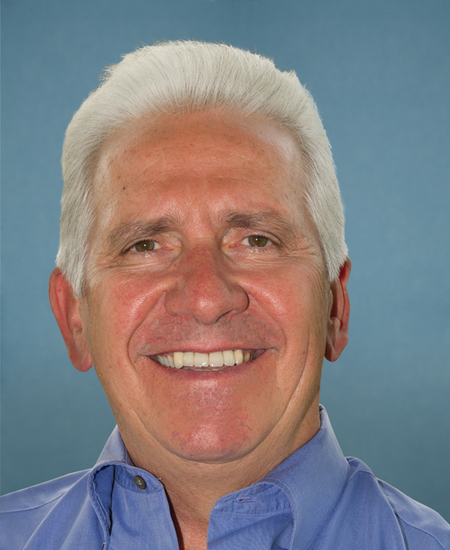
Photo of Jim Costa
D United States House · District 21 · California On the 2026 ballot

Rep. Jim Costa

Compare
Total votes
2,837
all sessions
Attendance
95%
129 missed
Near the chamber average
With party
93%
of cast votes
Lower than 94% of chamber peers
Bipartisan score
3%
crosses aisle rarely
Higher than 93% of chamber peers
Sponsored
1,733
bills & resolutions
Higher than 83% of chamber peers
Committees
5
assignments
1,733 bills and resolutions

Sponsored bills

Total
1,733
Primary
78
Co-sponsor
1,655
This page
1,733
matching current filters
Co-sponsor HR 5271
In committee · Indiana House · Co-sponsor
Pakistan Freedom and Accountability Act

Maddy summaryThis bill directs the U.S. President to identify Pakistani officials responsible for undermining democracy and human rights within 180 days of enactment, then impose Global Magnitsky sanctions on them. It targets senior government, military, or security officials found to have committed gross human rights violations or interfered with democratic processes, such as during Pakistan’s 2024 elections or through constitutional changes. Sanctions would include asset freezes and travel bans, with exceptions for humanitarian aid, UN obligations, and national security activities. The bill expires on September 30, 2030, and aims to pressure Pakistan to uphold democratic norms, human rights, and judicial independence.

In committee Sep 10, 2025 1 co-sponsor
Primary HR 5259
In committee · Indiana House · Lead sponsor
Permanent OPTN Fee Authority Act

Maddy summaryThis bill authorizes the permanent collection of registration fees from organizations in the Organ Procurement and Transplantation Network (OPTN), such as transplant centers and organ procurement organizations, for each transplant candidate they list. The fees must be used exclusively to support OPTN operations and cannot be diverted to other purposes. The bill requires the Secretary to publicly post quarterly fee amounts and how they are spent on the OPTN website, and mandates a GAO review within two years to assess fee usage. It does not change organ allocation or transplant processes, only the funding mechanism for the network itself.

In committee Sep 10, 2025 0 co-sponsors
Primary HR 5227
In committee · Indiana House · Lead sponsor
Unleashing Low-Cost Rural AI Act

Maddy summaryThis bill directs the U.S. Department of Energy to conduct a study on how artificial intelligence (AI) and data center growth affects energy resources, with specific focus on rural and remote areas. The study will examine infrastructure needs, alternative energy sources (like solar, wind, and hydro), impacts on energy costs and reliability, and ways to speed up permitting for these facilities. It requires a report to Congress within 180 days of enactment. The bill does not create new regulations or funding but aims to inform future energy planning for AI/data center development.

In committee Sep 9, 2025 0 co-sponsors
Co-sponsor HR 5217
In committee · Indiana House · Co-sponsor
Rural Behavioral Health Improvement Act of 2025

Maddy summaryThis bill amends the Social Security Act to remove an exclusion for rural facilities primarily treating mental health conditions from Medicare coverage. It specifically changes Section 1861(aa)(2) by deleting the phrase "or a facility which is primarily for the care and treatment of mental diseases," allowing these facilities to qualify for Medicare reimbursement. The change directly affects rural behavioral health centers specializing in mental health care that were previously excluded. The amendment takes effect on January 1, 2027, enabling these facilities to access federal Medicare funding for services.

In committee Sep 8, 2025 1 co-sponsor
Co-sponsor HR 5199
In committee · Indiana House · Co-sponsor
Modernizing Rural Physician Assistant and Nurse Practitioner Utilization Act of 2025

Maddy summaryThis bill changes federal rules for rural healthcare facilities that employ physician assistants (PAs) and nurse practitioners (NPs). It requires these facilities (not run by a physician) to have arrangements consistent with state laws governing PA/NP practice, ensuring services follow state regulations. The policy directly affects rural clinics and hospitals seeking federal reimbursement for PA/NP services. The changes take effect January 1, 2027, aligning federal requirements with existing state oversight of these healthcare providers.

In committee Sep 8, 2025 1 co-sponsor
Co-sponsor HR 5198
In committee · Indiana House · Co-sponsor
Rural Health Clinic Location Modernization Act of 2025

Maddy summaryHR 5198, the Rural Health Clinic Location Modernization Act of 2025, changes Medicare eligibility rules for rural health clinics by updating the definition of "urban area" used to determine clinic qualification. It replaces the current "urbanized area" standard with a clearer definition: any urban area (per Census Bureau data) having a population of 50,000 or more. This adjustment directly affects clinics seeking Medicare certification, ensuring they meet consistent geographic criteria for rural designation. The change takes effect January 1, 2027, aiming to simplify qualification rules without altering Medicare coverage or benefits.

In committee Sep 8, 2025 1 co-sponsor
Co-sponsor HR 5150
In committee · Indiana House · Co-sponsor
Protecting Agricultural Borrower Information Act

Maddy summaryThis bill protects farmers and ranchers who apply for or receive loans or payments through the Farm Service Agency (FSA) by restricting how their personal information is shared. It prohibits FSA employees from disclosing borrower details to certain government employees (like special government employees or staff detailed to FSA under specific rules), except for anonymized statistics or with the borrower's voluntary consent. Violations could result in fines up to $10,000 or imprisonment. The law directly affects agricultural borrowers by strengthening privacy safeguards around their financial data in FSA programs.

In committee Sep 8, 2025 1 co-sponsor
Co-sponsor HR 1510
In committee · Indiana House · Co-sponsor
Due Process Continuity of Care Act

Maddy summaryHR 1510, the Due Process Continuity of Care Act, expands Medicaid eligibility to cover individuals in jail or custody while awaiting trial or disposition of charges, at a state's option. This allows states to provide Medicaid benefits to this population without requiring them to be convicted first. The bill provides $50 million in planning grants to states to develop implementation plans, including assessing healthcare needs, recruiting providers (especially for behavioral health and substance use treatment), and creating electronic billing systems for correctional facilities and outpatient providers. States must also consult with stakeholders like jails, providers, and Medicaid advocates before finalizing their plans.

In committee Sep 8, 2025 1 co-sponsor
Co-sponsor HR 5145
In committee · Indiana House · Co-sponsor
Bipartisan Premium Tax Credit Extension Act

Maddy summaryHR 5145, the Bipartisan Premium Tax Credit Extension Act, extends enhanced federal subsidies for health insurance premiums through 2026. It directly affects individuals purchasing coverage through health insurance marketplaces who qualify for premium tax credits. The bill extends the period for increased credit amounts (through 2026 instead of 2025) and maintains the rule allowing tax credits for households earning above 400% of the federal poverty level. These changes apply to tax years beginning after December 31, 2025.

In committee Sep 4, 2025 1 co-sponsor
Co-sponsor HR 5097
In committee · Indiana House · Co-sponsor
To amend the Agricultural Marketing Act of 1946 to direct the Secretary of Agriculture to establish a program under which the Secretary will award grants to specialty crop producers to acquire certain equipment and provide training with respect to the use of such equipment.

Maddy summaryHR 5097 establishes a new grant program under the Agricultural Marketing Act of 1946 to help specialty crop producers in the U.S. adopt mechanized and automated equipment. The bill directs the Secretary of Agriculture to award grants covering equipment like drones, sorting machines, precision irrigation systems, and robotic tools, plus required training for their use. Recipients must contribute at least 50% of the costs through non-Federal matching funds. This program directly affects commercial specialty crop growers by providing financial support to modernize operations and improve efficiency.

In committee Sep 2, 2025 1 co-sponsor
Showing 221 to 230 of 1,733 bills
Previous 1 … 22 23 24 … 174 Next