

Maddy summaryThe Buy Green Act of 2024 establishes a $1.5 trillion Clean Energy Fund to promote environmentally responsible purchasing across federal, state, tribal, and local government operations. The bill requires federal agencies, states, tribes, and local governments to prioritize purchasing "covered products" that meet specific environmental criteria, including energy efficiency, reduced lifecycle emissions, and use of low-carbon materials. It creates grant programs for states and local governments (with 40% of funds targeting frontline, vulnerable, and disadvantaged communities) and for industry to retrofit facilities and develop environmentally responsible manufacturing capabilities, while setting minimum wage requirements and labor protections for workers in covered activities. The legislation mandates that 20% of funds must go to small businesses and covered small businesses, and establishes an Oversight Advisory Board to monitor compliance with environmental and labor standards.
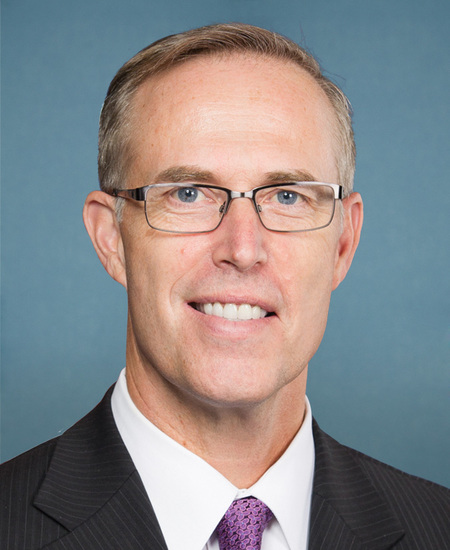
Rep. Jared Huffman
Sponsored bills
Maddy summaryThe ProTECT Act of 2024 bans the hunting, taking, or importing of hunting trophies from species listed as "threatened" under the Endangered Species Act. It directly affects hunters, importers, and businesses involved in trading trophies of threatened species, which currently face fewer protections than endangered species. The bill extends existing prohibitions - previously limited to endangered species - to explicitly cover threatened species, including banning permits for such activities and defining "trophy" to include processed animal parts. This creates a uniform ban on trophy hunting and trade for all listed threatened species, closing a gap in current law.
Maddy summaryHR 7438 directs the U.S. Treasury to mint commemorative coins for the 2026 FIFA World Cup, including 100,000 $5 gold coins, 500,000 $1 silver coins, and 750,000 half-dollar coins. The coins will be sold to the public at face value plus surcharges ($35, $10, and $5 per coin, respectively), with all surcharge revenue paid to FWC2026 US, Inc. for U.S. soccer programs. These funds must support soccer initiatives, particularly in underserved communities and youth development, as specified in the bill. The coins are legal tender but will only be issued during 2026, with no net cost to the U.S. government.
Maddy summaryThe Coastal Habitat Conservation Act of 2023 authorizes the U.S. Fish and Wildlife Service to work with partners to protect and restore coastal habitats that support Federal trust species like migratory birds, endangered species, and marine mammals. The bill establishes a Coastal Program that provides technical assistance and financial support for coastal habitat planning, assessment, protection, restoration, and enhancement projects on public and private lands. It requires annual reporting on program progress, including quantitative data on protected, restored, and enhanced coastal landscapes, and authorizes $16.957 million annually for fiscal years 2024-2028. This legislation affects coastal states and territories along the Atlantic, Pacific, and Arctic Oceans, the Gulf of Mexico, the Great Lakes, and U.S. territories.
Maddy summaryThe CASC Act establishes a National Climate Adaptation Science Center and nine Regional Climate Adaptation Science Centers to provide scientific expertise for managing natural resources, cultural resources, and ecosystem services in response to climate change. These centers will conduct research, provide education and training, and offer advisory services to Federal agencies, States, Indian Tribes, Tribal organizations, Native Hawaiian organizations, and other partners. The National Center will coordinate with regional centers, develop research priorities, and conduct five-year merit reviews to ensure high-quality climate adaptation science. The bill requires centers to work with diverse partners including Tribal Colleges and Universities, Historically Black Colleges and Universities, and minority-serving institutions to ensure inclusive climate adaptation science.
Maddy summaryThis bill requires U.S. representatives at 12 major international financial institutions (including the World Bank, Asian Development Bank, and Inter-American Development Bank) to vote against fossil fuel projects and support clean energy transitions. It mandates that U.S. contributions to these institutions be reduced if they fund new fossil fuel capacity (like oil/gas projects or pipelines), with the withheld funds held in an escrow account until institutions stop such funding. The bill also prohibits U.S. agencies (like USAID and the Export-Import Bank) from providing any foreign assistance for fossil fuel activities or related infrastructure. These changes directly affect how U.S. taxpayer funds are allocated to global development projects managed by these institutions.
Maddy summaryHR 10311, the Franchisee Freedom Act, allows franchisees harmed by franchisor violations of federal rules (specifically part 436 of title 16, CFR) to directly sue franchisors in court. It provides remedies including actual damages, contract rescission, and attorney fees. Lawsuits can be filed in either federal district court or state court where the franchisee resides. This bill directly affects franchisees who have been harmed by franchisor noncompliance with the specified federal regulations.
Maddy summaryHR 10314, the National Resilience and Recovery Fund Act, establishes a new trust fund in the U.S. Treasury to support disaster resilience and recovery efforts. The fund will be financed by taxes on crude oil and natural gas production from the Gulf of Mexico, environmental taxes on petroleum, and windfall profits taxes on oil producers. Funds will be allocated to four specific federal programs: Hazard Mitigation Grant Program, Building Resilient Infrastructure and Communities, Safeguarding Tomorrow Revolving Loan Fund, and Flood Mitigation Assistance. The bill also clarifies tax definitions for crude oil and sets a 10-cent-per-barrel tax rate for the National Resilience and Recovery Fund financing.
Maddy summaryHR 10303, the DAMS for Beavers Act, creates a federal grant program to fund nonlethal projects that reduce property damage caused by beavers while maintaining their habitat. The program awards competitive grants to eligible entities like tribes, state agencies, local governments, nonprofits, and property owners, requiring all funded projects to use only nonlethal methods (such as fencing, flow devices, or tree protection) for beaver damage mitigation. Grantees must maintain nonlethal approaches for the project duration, with limited exceptions for health/safety or flood control needs, and the federal government covers up to 75% of project costs. The bill authorizes $3 million annually from 2025-2029 and mandates annual reports to Congress on funded projects and program effectiveness.
Maddy summaryHR 6751 authorizes the U.S. Mint to produce commemorative coins honoring Roberto Clemente, a Hall of Fame baseball player and humanitarian, including 50,000 $5 gold coins, 400,000 $1 silver coins, and 750,000 half-dollar coins. The coins must feature Clemente's image and inscriptions like "Roberto Clemente" and "2027," with all sales including a surcharge ($5-$35 per coin) paid to the Roberto Clemente Foundation. The foundation, which supports youth sports, education, and disaster relief programs, will use these funds for its mission, while the U.S. Treasury must recover all production costs. The coins will be sold exclusively in 2027, with no net cost to the government.