

Integrity, Notification, and Fairness in Online Retail Marketplaces for Consumers Act or the INFORM Consumers Act This bill requires online marketplaces (e.g., Amazon) to collect and verify certain contact and financial information from third-party sellers whose transactions and related revenues exceed specified thresholds. Subject to certain exceptions, online marketplaces must clearly and conspicuously disclose the contact information of certain high-volume third-party sellers to consumers and must also provide consumers with methods to report suspicious activity on the marketplace. The bill provides the Federal Trade Commission and state attorneys general with the authority to enforce these requirements.
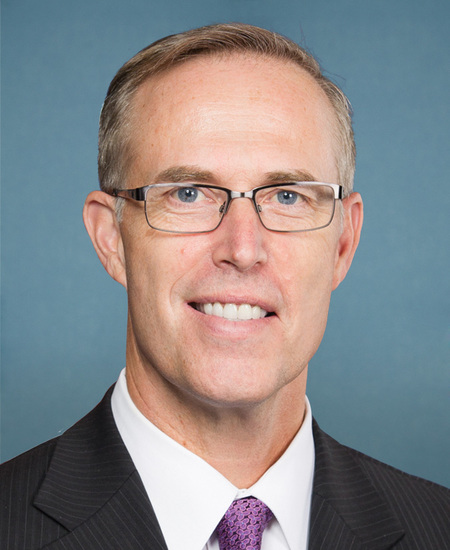
Rep. Jared Huffman
Sponsored bills
Lymphedema Treatment Act This bill provides for Medicare coverage of lymphedema compression treatment items. Specifically, the bill provides for coverage of standard and custom fitted gradient compression garments and other approved items that are prescribed by a physician or other specified health care professional to treat lymphedema.
Continuity for Operators with Necessary Training Required for ATC Contract Towers Act of 2021 or the CONTRACT Act of 2021 This bill exempts certain air traffic controllers from a required reduction in their retirement annuity payment on account of earnings from certain work performed while entitled to such annuity. Under current law, retired Federal Aviation Administration air traffic controllers receive an annuity payment during the period between the mandatory retirement age of 56 and the Social Security minimum age of 62. Such annuity payment is required to be reduced by a certain percentage of any excess earnings during this period. The bill exempts from such reduction in annuity payments an air traffic controller who participates in the Air Traffic Control Contract Program (a public-private partnership for air traffic control services) following mandatory retirement.
Saline Lake Ecosystems in the Great Basin States Program Act of 2021 This bill requires the U.S. Geological Survey (USGS) to establish a Saline Lake Ecosystems in the Great Basin States Assessment and Monitoring Program. Under the program, the USGS must assess, monitor, and conserve saline lake ecosystems in the Great Basin as well as the wildlife that depend on those ecosystems.
Keeping Ecosystems Living and Productive Act or the KELP Act This bill directs the National Oceanic and Atmospheric Administration (NOAA) to award grants to carry out projects related to the conservation, restoration, or management of kelp forest ecosystems. NOAA shall award grants for projects that address greatest relative regional declines in kelp forest ecosystems; focus on, among other things, long term ecosystem resilience, kelp forest seeding and connectivity, or urchin removal and other actions to reestablish trophic structure; or are identified by federal or state restoration and management plans as focal areas for recovery of kelp forests and associated species.
Safeguarding America's Future and Environment Act or the SAFE Act The bill requires the development of an integrated national approach to help fish, wildlife, and plants adapt to extreme weather changes and climate change. Specifically, the bill requires the President to establish an interagency National Fish, Wildlife, and Plants Climate Adaptation Strategy Joint Implementation Working Group. The working group must adopt the 2013 National Fish, Wildlife, and Plants Climate Adaptation Strategy, which addresses the effects of extreme weather and climate change on fish, wildlife, and plants. After the Committee on Earth and Environmental Sciences releases a periodic scientific assessment required under the U.S. Global Change Research Program, the working group must use sound science to review and revise the strategy to incorporate new information and advances in the development of strategies to help fish, wildlife, and plants adapt. Each federal agency must integrate the strategy into agency plans, environmental reviews, and programs. The Department of the Interior must establish a National Climate Change and Wildlife Science Center to assess and develop scientific information, tools, strategies, and techniques to support the working group and other interested parties in addressing the effects of extreme weather and climate change. Interior must establish an Advisory Committee on Climate Change and Natural Resource Sciences to advise the working group.
Global Amphibian Protection Act of 2021 This bill establishes a Highly Endangered Amphibian Species Conservation Fund and requires the Department of the Interior to use the fund to carry out a grant program for the conservation of highly endangered amphibian species. Highly endangered amphibian species means any amphibian species categorized on the International Union for Conservation of Nature (IUCN) Red List of Threatened Species as endangered, critically endangered, or extinct in the wild. The term also means any other amphibian species categorized on such list as data deficient or under a threat category lower than endangered if Interior determines that (1) the most recent IUCN Red List assessment indicates that the population is decreasing, or (2) such species is facing new or emerging threats. The bill establishes the fund as a separate account in the Multinational Species Conservation Fund.
Revitalizing the Economy of Coal Communities by Leveraging Local Activities and Investing More Act of 2021 or the RECLAIM Act of 2021 This bill revises requirements concerning the Abandoned Mine Reclamation Fund, including by expanding the eligible uses of the fund. Specifically, the bill allows the fund to be used to provide support for economic revitalization, diversification, and development in economically distressed mining communities through the reclamation and restoration of land and water resources adversely affected by abandoned coal mines. In addition, it requires specified amounts to be annually distributed from the fund through FY2026 to states and Indian tribes for reclaiming and restoring lands and waters so affected.
Surface Mining Control and Reclamation Act Amendments of 2021 This bill reauthorizes the Department of the Interior to collect fees on the production of coal through FY2036, expands the eligible uses of the Abandoned Mine Reclamation Fund, and revises requirements concerning the fund. Under current law, operators of active coal mines must pay such fees through FY2021. Revenue from the fees are deposited into the Abandoned Mine Reclamation Fund, which is used for the reclamation of abandoned coal mines. The bill authorizes Interior to reimburse states and tribal governments from the fund for the emergency restoration, reclamation, abatement, control, or prevention of adverse effects of coal mining practices. It also increases the minimum amount of funds from $3 million to $5 million that Interior must award to states and Indian tribes that have approved abandoned mine reclamation programs.
This bill authorizes the Department of Commerce to award competitive grants to Indian tribes to further achievement of tribal coastal zone objectives. Specifically, these tribal coastal zone objectives include protecting, restoring, or preserving areas in the zone that hold important ecological, cultural, or sacred significance for the tribes or traditional, historic, and aesthetic values essential to the tribes; preparing and implementing a special area management plan and technical planning for important coastal areas; and implementing any coastal or shoreline stabilization measure for the purpose of public safety, public access, or cultural or historical preservation.