

National Plan to End Parkinson's Act This bill requires the Department of Health and Human Services (HHS) to carry out a project to prevent and cure Parkinson's disease (a progressive brain disorder that causes unintended or uncontrollable movements) and related conditions. Among other components of the project, HHS must (1) implement and periodically update a national plan to coordinate and guide efforts to prevent and cure the disease; (2) improve diagnosis, treatment, and care of those with the disease; and (3) address health and other disparities related to the disease. HHS must also conduct annual assessments on the preparation for and response to the increased burden of Parkinson's disease. In addition, the bill establishes a council, comprised of federal and nonfederal stakeholders, to advise HHS on and make recommendations concerning the prevention and cure of Parkinson's disease. The bill's provisions terminate at the end of calendar year 2035.
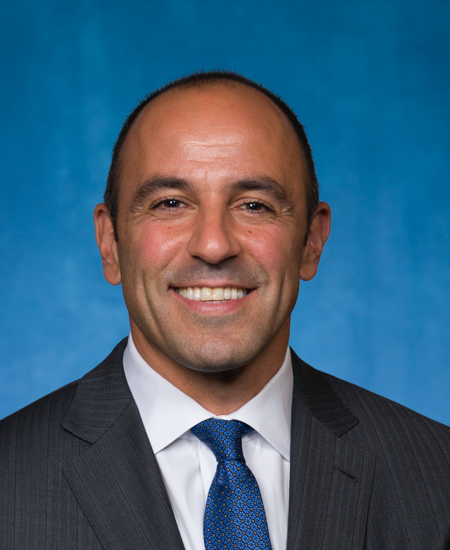
Rep. Jimmy Panetta
Sponsored bills
Energy Sector Innovation Credit Act of 2021 This bill adds new tax credits for investment in qualified emerging technology energy property and for the production of electricity from emerging energy technology. The bill defines qualified emerging energy property as property that is constructed, reconstructed, erected, or acquired by the taxpayer and is (1) a facility for the production of electricity from emerging energy technology, (2) carbon capture equipment, or (3) energy storage technology. The bill also adds a new tax credit for the production of electricity from clean hydrogen. The bill defines clean hydrogen as hydrogen that is produced through a production method for which the rate of the greenhouse gas emission is greater than zero and not greater that 2,500g CO2-e per kilogram of hydrogen produced, or is equal to or less than zero.
Housing Access Improvement Act This bill increases from 20% to 50% the amount of funding for the Housing Choice Voucher program that a public housing agency (PHA) may use for project-based vouchers. (This program subsidizes rent for low-income recipients.) Under current law, a PHA must use at least 80% of its funding for tenant-based vouchers (which subsidize recipients' rental of any private apartment that meets program guidelines) and may use up to 20% of its funding for project-based vouchers (which attach to a specific rental unit that the landlord commits to make available for voucher recipients for a contracted term).
Shirley Chisholm Congressional Gold Medal Act This bill provides for the posthumous presentation of a Congressional Gold Medal in commemoration of Shirley Chisholm, in recognition of her activism, independence, and groundbreaking achievements in politics, election as the first African American woman in Congress, and campaign to be the first African American to gain the nomination of a major political party for President of the United States. Following its award, the gold medal shall be given to the Smithsonian Institution where it shall be available for display and research.
Naomi Schwartz Safe Parking Program Act of 2021 This bill directs the Department of Housing and Urban Development to establish a grant program for safe parking programs operated by local governments, tribes, nonprofit organizations, and certain organizations that assist the homeless. Safe parking programs provide homeless individuals living in vehicles with (1) a safe place to park overnight to facilitate a transition to stable housing, and (2) services including rehousing assistance and case management.
Right to Contraception Act This bill sets out statutory protections for an individual's right to access and a health care provider's right to provide contraception and related information. Contraception refers to an action taken to prevent pregnancy, including the use of contraceptives (i.e., a device or medication used to prevent pregnancy), fertility-awareness based methods, and sterilization procedures. Generally, the bill prohibits measures that single out and impede access to contraception and related information. However, a party may defend against a claim that a measure violates the bill's prohibitions by demonstrating, through clear and convincing evidence, that the measure significantly advances access to contraception and cannot be achieved through less restrictive means. The Department of Justice, individuals, or health care providers may bring a lawsuit to enforce this bill, and states are not immune from suits for violations.
Formula Act This bill provides through December 31, 2022, duty-free treatment to infant formula. During this time period, articles of infant formula shall not be subject to (1) any additional safeguard duties that may be imposed under subchapter IV of chapter 99 of the Harmonized Tariff Schedule; or (2) any other import quotas, tariff-rate quotas, additional duties, or any other duties, fees, exactions, or charges that otherwise would apply to such articles. Importers shall provide the applicable and anticipated tariff classifications for articles of infant formula on applicable customs entry documents.
Reproductive Health Travel Fund Act of 2022 This bill authorizes the Department of Health and Human Services to award grants to pay for travel, childcare, and other expenses of an individual seeking access to abortion services. Eligible grant recipients must be nonprofit or community-based organizations that assist individuals seeking abortion services through programs that are unbiased and medically and factually accurate. The grants may not be used to pay for abortion procedures.
No Tax Breaks for Union Busting (NTBUB) Act This bill denies employers a tax deduction for any expenditures incurred for attempting to influence their employees with respect to labor organizations or labor organization activities, such as elections, labor disputes, and collective actions. The bill requires employers to report on their attempts to influence their employees with respect to labor organizations and their activities.
Maddy summaryThe National Park Foundation Reauthorization Act of 2022 extends and increases funding for the National Park Foundation. It amends federal law to authorize $15 million annually (up from $5 million) for the Foundation through 2030 (extending from 2023). This bill directly affects the National Park Foundation by providing a longer-term, higher level of federal appropriations for its operations. The key change is a specific funding authorization adjustment in Title 54 of the U.S. Code, with no new program requirements or policy changes.