Helping Ensure Life- and Limb-Saving Access to Podiatric Physicians Act or the HELLPP Act This bill adds podiatrists as covered physicians under the Medicaid program. Additionally, the bill revises certain documentation requirements related to Medicare coverage of therapeutic shoes for individuals with diabetes. Finally, the bill subjects payments made to a Medicaid provider or supplier to a continuing levy for federal taxes owed by the provider or supplier.
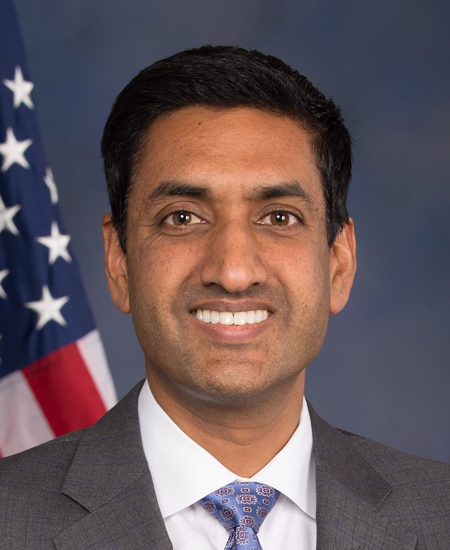
Rep. Ro Khanna
Sponsored bills
This resolution expresses support for the designation of the National Day of Awareness for Missing and Murdered Indigenous Women and Girls.
Stop Corporate Inversions Act of 2021 This bill revises rules for the taxation of inverted corporations (i.e., U.S. corporations that acquire foreign companies to reincorporate in a foreign jurisdiction with income tax rates lower than the United States). The bill provides that a foreign corporation that acquires the properties of a U.S. corporation or partnership after May 8, 2014, shall be treated as an inverted corporation and thus subject to U.S. taxation if, after such acquisition (1) it holds more than 50% of the stock of the new entity (expanded affiliated group), or (2) the management or control of the new entity occurs primarily within the United States and the new entity has significant domestic business activities.
Affordable Housing for Homeless Veterans Act of 2021 This bill reauthorizes and modifies a program of the Department of Veterans Affairs (VA) that provides housing assistance to homeless veterans. Specifically, the bill authorizes the VA to enter into agreements with specified entities (e.g., nonprofit organizations or tribal entities) through September 30, 2025, to assist homeless veterans and their families in acquiring shelter or permanent housing. Under the bill, the VA may enter into agreements where an entity that is buying, leasing, or receiving property agrees to sell or rent the property directly to homeless veterans or veterans at risk of homelessness.
VA Supply Chain Resiliency Act This bill addresses the Department of Veterans Affairs (VA) supply chain processes, particularly during emergency periods. The bill requires the VA to submit a report containing a description of the items and quantities of items that are critical with respect to the VA's ongoing response to the COVID-19 (i.e., coronavirus disease 2019) pandemic and future epidemic, pandemic, emergency, national emergency, or natural disaster scenarios. The VA and the Department of Defense (DOD) must enter into an agreement to provide for the participation of the VA in the Warstopper Program of the Defense Logistics Agency (DLA) of DOD. The Warstopper Program was established to satisfy requirements for sudden and sustained increases in production of critical industrial and medical items. Under such an agreement, the DLA must ensure the maintenance and stability of the items the VA identifies as critical in its report (and that the VA and DOD determine are appropriate for the program), establish guidance for the participation of the VA in the program, and use existing and new contracts and agreements to reserve the supply of critical items. Finally, the VA must ensure it does not exclusively rely on holding regional, physical inventories of critical items in order to respond to greater than expected needs during epidemic, pandemic, emergency, national emergency, or natural disaster situations.
Transform, Heal, and Renew by Investing in a Vibrant Economy Act or the THRIVE Act This bill establishes a program to address the economy, racial justice, and climate change. The President must establish a board to advise the President and the heads of federal departments and agencies regarding the implementation of this bill. The President, in consultation with the board, must establish a 10-year plan to create a society that enables and supports greater racial, Indigenous, gender, environmental, and economic justice; work opportunities; healthy communities; a stable climate; and healthy ecosystems. In addition, the President, in consultation with the board, must implement a program that provides support to public or private entities that carry out qualified programs. The programs must meet certain labor, equity, and environmental conditions and support infrastructure, including to expand access to pollution-free, renewable, and affordable energy; care workers and social infrastructure (e.g., health care infrastructure); expanded access to housing; efforts to protect and restore biodiversity or natural habitats and efforts to remediate pollution in communities harmed by environmental, economic, or socioeconomic injustice; agriculture, including agricultural workers; or the development and transformation of the U.S. industrial base, including by expanding manufacturing of clean technologies.

This resolution commemorates the centennial of the establishment of the state of Jordan, expresses admiration and gratitude for the friendship of the Jordanian people, and looks forward to continued cooperation with Jordan on shared national priorities.
Ban Conflicted Trading Act This bill prohibits a Member of Congress or certain congressional officers or employees from (1) purchasing or selling specified investments, (2) entering into a transaction that creates a net short position in a security, or (3) serving as an officer or member of any board of any for-profit entity.
Mark Takai Atomic Veterans Healthcare Parity Act This bill includes veterans who participated in the cleanup of Enewetak Atoll in the Marshall Islands between January 1, 1977, and December 31, 1980, as radiation-exposed veterans for purposes of the Department of Veterans Affairs presumption of service-connection for specified cancers. Under a presumption of service-connection, specific conditions diagnosed in certain veterans are presumed to have been caused by the circumstances of their military service. Health care benefits and disability compensation may then be awarded.
This concurrent resolution (1) affirms, on the 400th anniversary of the arrival of the first slave ship, that the nation owes a debt of remembrance not only to those who lived through the injustices of slavery but also to their descendants; and (2) urges the establishment of a U.S. Commission on Truth, Racial Healing, and Transformation to properly acknowledge, memorialize, and be a catalyst for progress, including toward permanently eliminating persistent racial inequities.