

Maddy summaryHR 7281, the Justice for Shireen Act, requires the FBI and State Department to submit a public report within 30 days of enactment. The report must identify those responsible for journalist Shireen Abu Akleh’s death, detail any U.S. defense materials, funds, or services involved, and include relevant unredacted documents. It mandates the report be unclassified and published online simultaneously for public access. This bill directly affects federal agencies by imposing specific reporting obligations, with no direct impact on citizens or changes to existing laws. The focus is solely on documenting the circumstances of Abu Akleh’s death through a mandated government review.
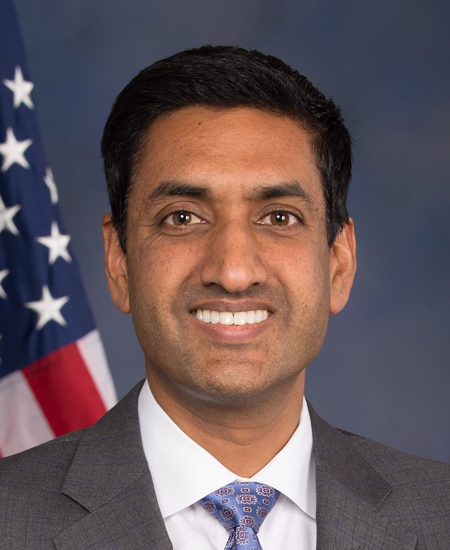
Rep. Ro Khanna
Sponsored bills
Maddy summaryThis bill requires most employers (those with 50+ employees for 20+ weeks annually) to display a clear notice about veterans' benefits in visible workplace areas. The notice, developed by the Labor and Veterans Affairs Departments, includes the Veterans Crisis Line, how to apply for benefits, and state-specific veteran resources. Employers must post the notice starting one year after the bill's enactment, with the notice updated twice yearly and made available online. A 180-day information campaign will also inform employers about the requirement.
Maddy summaryHJRES 144 is a congressional disapproval resolution targeting a specific rule issued by the Department of Veterans Affairs (VA) on December 31, 2025, which addressed "Reproductive Health Services" (90 Fed. Reg. 61310). This resolution directs Congress to disapprove the VA rule under Chapter 8 of Title 5, U.S. Code, meaning the rule would have no legal effect if passed. The bill directly affects the VA's implementation of reproductive health services for veterans, as it seeks to nullify the agency's existing policy. This is a procedural measure, not a substantive policy change, aimed solely at blocking the VA's rule through congressional action.
Maddy summaryHCONRES 68 would require the President to remove U.S. military forces from Venezuela unless Congress has explicitly authorized their use through a declaration of war or a specific law. This applies to any U.S. Armed Forces currently stationed in Venezuela without such authorization. The resolution is based on the War Powers Resolution, which mandates congressional oversight of military deployments. It directs the immediate withdrawal of unapproved forces without adding new time limits or conditions.
Maddy summaryThe Language Access for All Act of 2026 requires federal agencies to ensure meaningful access to government services for people with limited English proficiency (LEP). Agencies must translate vital documents into languages commonly spoken in the U.S. (based on Census data), provide multilingual digital tools, interpretation services, and use bilingual staff as an alternative to professional interpreters. Each agency must create a language access plan within one year, detailing how it will serve LEP populations - including during emergencies - and annually certify compliance with technical standards. Noncompliance is treated as discrimination under civil rights law, with enforcement by the Department of Justice.
Maddy summaryThis bill establishes a Senior Advisor for National Security within the USDA to coordinate national security efforts related to food and agriculture. It requires the USDA Secretary to submit biennial reports to Congress and the National Security Council identifying vulnerabilities such as foreign control of agricultural data, supply chain disruptions, cybersecurity risks, and dependence on foreign-sourced inputs. The bill mandates improved interagency coordination, including sharing personnel with defense and intelligence agencies, and requires the USDA to assess gaps in security efforts and propose solutions. The primary direct effect is on the USDA's internal operations and reporting structure, not on agricultural policies or farmers.
Maddy summaryHR 7138 disallows tax deductions for mortgage interest and depreciation on single-family homes (1-4 units) owned by large investment entities with over $100 million in assets, while imposing a 100% excise tax on sales or transfers of such properties. The bill directly affects institutional landlords (e.g., large real estate investment firms), excluding government entities, nonprofits, and federally assisted housing. Revenue from the tax will fund low-income housing programs via the Housing Trust Fund. It also prohibits Fannie Mae, Freddie Mac, and Ginnie Mae from purchasing or guaranteeing mortgages for these properties. The provisions apply 18 months after enactment.
Maddy summaryThis concurrent resolution expresses Congress's formal stance on U.S. relations with Greenland and Denmark. It affirms U.S. respect for Denmark's sovereignty over Greenland, requires Congressional authorization for any military use involving Greenland (to comply with treaty obligations), and calls for strengthening cooperation through partnership rather than coercion. The resolution directly addresses concerns about recent statements suggesting U.S. interest in acquiring Greenland, emphasizing that Greenland’s future must be determined by its people. It underscores that Arctic security depends on alliance-based cooperation, not unilateral actions, and reiterates Congress’s constitutional role in authorizing military force.
Maddy summaryThis non-binding resolution expresses the House's support for creators and digital workers (over 10 million Americans earning income via platforms) who face challenges like misclassification as independent contractors, opaque revenue terms, and limited access to benefits. It calls for transparent revenue-sharing agreements, portable health care and retirement options, clearer platform algorithm policies, and protections against unfair account actions. The resolution does not create new laws but urges platforms and policymakers to address these issues. It focuses on concrete concerns like income volatility and lack of labor protections for this growing workforce.
Maddy summaryHRES 996 is a resolution introduced by multiple House members to impeach Kristi Lynn Arnold Noem, the Secretary of Homeland Security, for alleged violations of law and the Constitution. It outlines three articles of impeachment: obstructing congressional oversight by denying access to detention facilities and withholding funds, violating public trust through warrantless arrests and excessive force (including tear gas on children), and self-dealing by awarding federal contracts to associates without competitive bidding. If approved by the House, this resolution would formally charge Noem, triggering a Senate trial to determine her removal from office. The resolution itself does not enact new policy but initiates the constitutional impeachment process against a sitting Cabinet official.