

Tyler Clementi Higher Education Anti-Harassment Act of 2021 This bill addresses harassment at institutions of higher education (IHEs). Specifically, the bill requires each IHE to include in its annual security report a statement of policy regarding harassment on the basis of a student's actual or perceived race, color, national origin, sex (including sexual orientation, gender identity, pregnancy, childbirth, a medical condition related to pregnancy or childbirth, and a sex stereotype), disability, or religion. In addition, the Department of Education may award grants to IHEs to initiate, expand, or improve programs to (1) prevent the harassment of students; (2) provide counseling or redress services to students who have been harassed or accused of subjecting other students to harassment; or (3) educate and train students, faculty, or staff to prevent harassment or address harassment if it occurs.
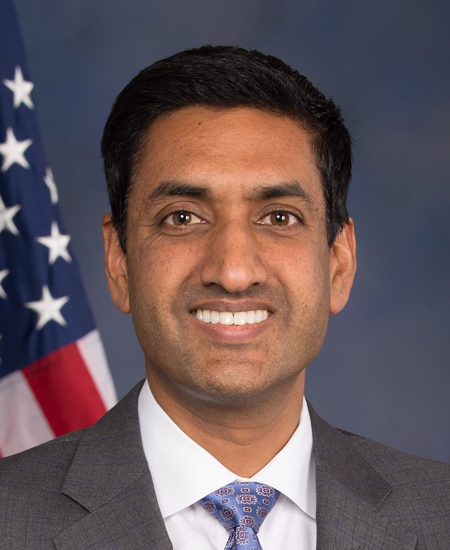
Rep. Ro Khanna
Sponsored bills
Fossil Free Finance Act This bill requires large bank holding companies to develop and implement emission reduction plans. Such a plan must include strategies for a company to equitably reduce and eventually eliminate financed greenhouse gas emissions by January 1, 2050, and to discontinue specified fossil fuel projects and financing. The bill also prohibits the use of carbon offsets in such a plan, sets forth technological requirements for reductions, and requires the prioritization of specified social impacts. Plans must be submitted to the Board of Governors of the Federal Reserve System for approval every two years.
Manufacturing Reinvestment Corporation Act This bill establishes the Manufacturing Reinvestment Corporation within the Department of Commerce. The corporation must set national strategic objectives for the manufacturing industry with an emphasis on equity and inclusion. Based on specified criteria, the corporation also must establish and make grants to 30 local Manufacturing Renaissance Councils to support the corporation's objectives. Each council must have a governing board comprised of at least nine members, which include community stakeholder organizations, local governments, educational institutions, and manufacturing companies. Each council must use grants from the corporation for economic development programs in the community, education and training, and wraparound services such as child care and mental health services. Additionally, the bill provides for the composition of the corporation's board of directors as well as the appointment of an executive director and other employees. The corporation must report annually about its national strategy and finances. The bill requires financial audits of the corporation and of each grantee and contractor.
U.S. Virtual Currency Market and Regulatory Competitiveness Act of 2021 This bill directs the Commodity Futures Trading Commission to report on virtual currency markets and U.S. competitiveness.
Virtual Currency Consumer Protection Act of 2021 This bill directs the Commodity Futures Trading Commission to report on the potential for price manipulation in virtual currency markets.
John R. Lewis Voting Rights Advancement Act of 2021 This bill establishes new criteria for determining which states and political subdivisions must obtain preclearance before changes to voting practices may take effect. Preclearance is the process of receiving preapproval from the Department of Justice (DOJ) or the U.S. District Court for the District of Columbia before making legal changes that would affect voting rights. A state and all of its political subdivisions shall be subject to preclearance of voting practice changes for a 10-year period if 15 or more voting rights violations occurred in the state during the previous 25 years; 10 or more violations occurred during the previous 25 years, at least 1 of which was committed by the state itself; or 3 or more violations occurred during the previous 25 years and the state administers the elections. A political subdivision as a separate unit shall also be subject to preclearance for a 10-year period if three or more voting rights violations occurred there during the previous 25 years. States and political subdivisions that meet certain thresholds regarding minority groups must preclear covered practices before implementation, such as changes to methods of election and redistricting. Further, states and political subdivisions must notify the public of changes to voting practices. Next, the bill authorizes DOJ to require states or political subdivisions to provide certain documents or answers to questions for enforcing voting rights. The bill also outlines factors courts must consider when hearing challenges to voting practices, such as the extent of any history of official voting discrimination in the state or political subdivision.
Working Dog Commemorative Coin Act This bill directs the Department of the Treasury to mint and issue 50,000 $5 gold coins, 500,000 $1 silver coins, and 750,000 half-dollar clad coins in commemoration of the service that working dogs provide to society. The designs of the coins minted under this bill shall be emblematic of the contributions of working dogs to society, including in detection, military service, therapy and assistance. Treasury may issue coins only during the one-year period beginning on January 1, 2023. All sales of coins shall include a surcharge, which shall be paid to America's VetDogs for general expenses associated with the fulfillment of its mission.
Medicare Negotiation and Competitive Licensing Act of 2021 This bill establishes several requirements relating to the prices of prescription drugs. Specifically, the bill requires the Centers for Medicare & Medicaid Services (CMS) to negotiate with pharmaceutical companies regarding prices for drugs covered under Medicare. (Current law prohibits the CMS from doing so.) If the CMS is unable to negotiate the price of a drug, such drug is subject to competitive licensing in order to further its sale under health insurance programs, notwithstanding existing government-granted exclusivities. The negotiated prices also apply to other federal health care programs, private health insurance, and the uninsured; pharmacies that charge more than the negotiated price for uninsured individuals are subject to civil penalties. Manufacturers must also comply with specified reporting requirements relating to prices and licensing, subject to civil penalties. The bill also institutes an excise tax on drugs for which the price spikes beyond a certain limit, subject to specified exemptions, as well as on drugs for which the price exceeds the negotiated price.
William Collins Jet Fuel Exposure Recognition Act This bill requires the Department of Veterans Affairs (VA), for purposes of wartime disability compensation and VA health care, to presume that covered veterans were exposed to toxic substances, chemicals, and airborne hazards during military service, unless there is affirmative evidence that the veterans were not exposed to such substances in connection with their service. Under the bill, covered veterans are those who worked for a cumulative period of at least two years in active service in a military occupational specialty that involved consistent exposure to jet fuel. In adjudicating claims for compensation for a service-connected disability related to jet fuel exposure with evidence of a disability and a presumption of toxic exposure during active service, the VA must (1) provide a medical examination and request a medical opinion for service-connection; and (2) direct the medical provider to consider the exposure of the veteran to toxic substances during all military deployments and the synergistic effect of all combined toxic substances through inhalation, dermal exposure, and ingestion. Every other year for a period of eight years, the VA must make publicly available a report related to the effect of jet fuel used by the Armed Forces on the health of individuals. In evaluating claims for compensation for service-connected disabilities, the VA must take into consideration the findings of such reports.
Improving Medicare Coverage Act This bill temporarily expands eligibility for Medicare. It also temporarily establishes a premium and cost-sharing assistance program for low-income beneficiaries. Specifically, the bill lowers the age of eligibility for Medicare from 65 to 60. The Centers for Medicare & Medicaid Services must establish procedures to provide for automatic enrollment of qualifying individuals. Enrollment must be completed within 11 months of the bill's enactment. The bill also establishes a program under Medicare to assist low-income Medicare beneficiaries with premiums, coinsurance, deductibles, and other costs. Currently, such assistance is provided through Medicare Savings Programs, which are administered by state Medicaid programs. The bill also establishes a related special enrollment period under Medicare, expands eligibility for assistance to beneficiaries with income up to 200% of the federal poverty line, and provides for joint eligibility determinations with respect to the bill's program and the low-income subsidy program under the Medicare prescription drug benefit. The bill's provisions generally take effect six months after the bill's enactment and terminate five years later.