

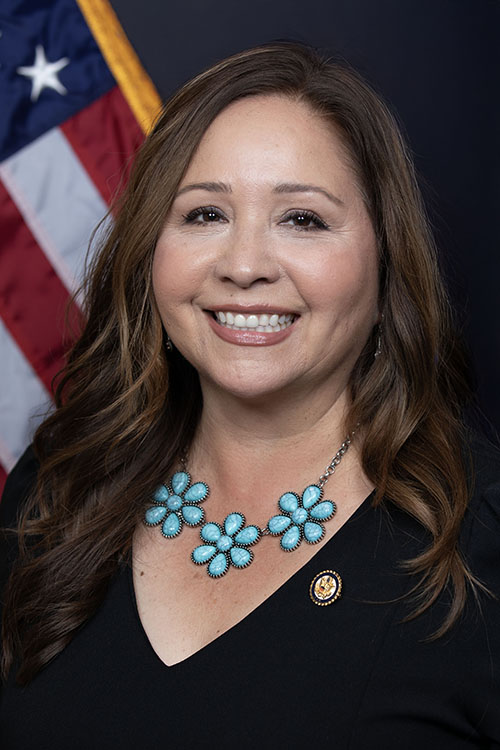
Photo of Adelita S. Grijalva
D United States House · District 7 · Arizona On the 2026 ballot

Rep. Adelita S. Grijalva

Compare
Total votes
392
all sessions
Attendance
99%
5 missed
Near the chamber average
With party
96%
of cast votes
Near the chamber average
Bipartisan score
2%
crosses aisle rarely
Near the chamber average
Sponsored
507
bills & resolutions
Higher than 82% of chamber peers
Committees
6
assignments
507 bills and resolutions

Sponsored bills

Total
507
Primary
16
Co-sponsor
491
This page
507
matching current filters
Co-sponsor HRES 1361
In committee · Indiana House · Co-sponsor
Expressing support for the recognition of July 3 through July 10, 2026, as "National Extreme Heat Awareness Week", a national event educating the public on the dangers of extreme heat and the risks of extreme heat events to public safety, infrastructure, agriculture, and much more, and supporting the goals of a National Extreme Heat Awareness Week.

Maddy summaryThis resolution expresses support for designating July 3 through July 10, 2026, as "National Extreme Heat Awareness Week" to educate the public on the dangers of extreme heat. The bill highlights how high temperatures threaten public safety, infrastructure, and agriculture, noting that heat is the leading weather-related cause of death in the United States. It encourages federal, state, and private entities to hold ceremonies and activities during this week to raise awareness about preventing heat-related illnesses and promoting community preparedness.

In committee Jun 11, 2026 1 co-sponsor
Co-sponsor HR 9309
In committee · Indiana House · Co-sponsor
PRIDE Act of 2026

Maddy summaryThe PRIDE Act of 2026 expands the Office of Minority and Women Inclusion to include LGBTQI+ individuals and businesses. It amends existing financial and housing laws to require the office to consider gender identity and sexual orientation when enforcing regulations and supporting small businesses. The bill formally defines LGBTQI+ as lesbian, gay, bisexual, transgender, queer, or intersex and sets a standard where more than 50 percent of a business's ownership and profits must accrue to LGBTQI+ individuals to qualify as LGBTQI+-owned. This change directly affects the Department of the Treasury's oversight of financial institutions and the Small Business Administration's lending programs. By updating the legal definitions within the Dodd-Frank Act and related housing legislation, the bill ensures that federal support and compliance measures explicitly cover the LGBTQI+ community.

In committee Jun 11, 2026 1 co-sponsor
Co-sponsor HR 9300
In committee · Indiana House · Co-sponsor
Postsecondary Student Success Act of 2026

Maddy summaryThe Postsecondary Student Success Act of 2026 creates a competitive grant program to help colleges improve graduation rates for high-need students, including those from low-income backgrounds, first-generation families, and military-connected individuals. To receive funding between 2027 and 2032, eligible institutions must submit plans detailing how they will use evidence-based strategies, such as better advising, accelerated learning options, and improved transfer pathways, to support student retention and completion. The law requires that at least 20 percent of the available funds go to projects using the most rigorously tested methods and mandates that 2 percent be reserved specifically for Tribal Colleges and Universities. Additionally, the Department of Education must evaluate the effectiveness of these programs and report the results to Congress within 18 months of the bill's enactment.

In committee Jun 11, 2026 1 co-sponsor
Co-sponsor HR 9289
In committee · Indiana House · Co-sponsor
Keep Public Funds in Public Schools Act of 2026

Maddy summaryThe Keep Public Funds in Public Schools Act of 2026 eliminates a federal tax credit that allowed parents to deduct contributions to scholarship granting organizations from their income. By removing these specific tax breaks, the bill prevents the use of public tax dollars to support private school vouchers and scholarship programs. This change directly affects families who currently rely on these tax incentives to fund education outside the public school system. The provisions take effect for taxable years beginning after December 31, 2026.

In committee Jun 11, 2026 1 co-sponsor
Co-sponsor HR 9286
In committee · Indiana House · Co-sponsor
Broadband Deployment and Economic Impact Study Act of 2026

Maddy summaryThis bill directs the Assistant Secretary of Commerce for Communications and Information to conduct a comprehensive study on various broadband internet technologies, including fiber-optic cables, satellite systems, and mobile wireless networks. The study will examine specific factors such as workforce needs, deployment costs, internet speed and latency, equipment lifespan, and monthly subscription prices for consumers. The findings will be compiled into a report submitted to Congress within one year of the bill's enactment to inform future policy decisions regarding broadband infrastructure.

In committee Jun 11, 2026 1 co-sponsor
Co-sponsor HR 9265
In committee · Indiana House · Co-sponsor
To amend the Richard B. Russell National School Lunch Act to require participation in the summer EBT program as a condition of participating in the school lunch program, and for other purposes.

Maddy summaryThis bill requires states and tribal organizations that run school lunch programs to also participate in the Summer EBT program, which provides food assistance to children during summer breaks. For the summers of 2024 through 2026, participation in the summer program remains voluntary for these entities. Starting in summer 2027, joining the summer program becomes mandatory for any state or tribal organization that already participates in the school lunch program. The legislation also updates administrative rules to ensure states submit management plans for these programs by specific deadlines each year.

In committee Jun 11, 2026 1 co-sponsor
Co-sponsor HJRES 195
In committee · Indiana House · Co-sponsor
Providing for congressional disapproval under chapter 8 of title 5, United States Code, of the rule submitted by the Department of Health and Human Services relating to "Restoring Flexibility in the Child Care and Development Fund (CCDF)".

Maddy summaryThis joint resolution seeks to reject a specific rule issued by the Department of Health and Human Services regarding the Child Care and Development Fund. By invoking a statutory process, the bill aims to prevent the rule from taking effect, which would stop the Department from implementing the proposed changes to child care funding flexibility. The measure directly impacts the administration of federal child care assistance programs and affects families and organizations relying on the CCDF. If passed, the original regulations published in May 2026 would be nullified and have no legal force.

In committee Jun 10, 2026 1 co-sponsor
Co-sponsor HR 5408
Passed · Indiana House · Co-sponsor
Faster Labor Contracts Act

Maddy summaryHR 5408, the Faster Labor Contracts Act, requires employers to begin negotiating a first contract with a newly certified union within 10 days of written request. If no agreement is reached within 90 days, the parties must seek mediation, and if unresolved after 30 days of mediation, the dispute moves to binding arbitration by a three-member panel. The arbitration decision, based on factors like employer finances, industry standards, and cost of living, becomes binding for two years. This bill directly affects newly certified unions and their employers during initial contract negotiations, aiming to reduce delays that currently average 465 days.

Passed Jun 10, 2026 1 co-sponsor
Co-sponsor HR 9231
In committee · Indiana House · Co-sponsor
No Toxic Chemicals in Food Packaging Act of 2026

Maddy summaryThe No Toxic Chemicals in Food Packaging Act of 2026 prohibits the use of specific chemicals, including PFAS, certain phthalates, and bisphenols, in materials that come into contact with food. This law directly affects manufacturers and distributors of food packaging by requiring the FDA to consider potential health risks to vulnerable populations, such as children and pregnant women, when evaluating alternative substances. While the federal restrictions do not take effect for two years after enactment, the bill explicitly preserves the right of states and local governments to pass stricter regulations on food additives.

In committee Jun 9, 2026 1 co-sponsor
Co-sponsor HR 9216
In committee · Indiana House · Co-sponsor
Double the Wage for Overtime Act of 2026

Maddy summaryThis bill, known as the Double the Wage for Overtime Act of 2026, aims to change how overtime pay is calculated for employees covered by the Fair Labor Standards Act. It directly affects workers who currently earn less than $23,660 annually, as it would require employers to pay them two times their regular hourly rate instead of one and a half times for hours worked beyond 40 in a week. The law takes effect 180 days after it is signed, ensuring a transition period before the new pay requirements begin. By raising the overtime multiplier, the legislation seeks to increase earnings for hourly workers who work extra hours.

In committee Jun 9, 2026 1 co-sponsor
Showing 101 to 110 of 507 bills
Previous 1 … 10 11 12 … 51 Next