

Maddy summaryHR 1919, the "Anti-CBDC Surveillance State Act," prohibits the Federal Reserve from developing, testing, or issuing any central bank digital currency (CBDC) or similar digital assets. It specifically bans the Fed from offering direct financial products to individuals, maintaining individual accounts, or issuing CBDCs directly or indirectly through intermediaries like banks. The bill also blocks the Fed from using any digital asset for monetary policy and clarifies that physical currency's privacy protections remain intact. This policy directly affects the Federal Reserve System's ability to create or manage digital monetary tools.
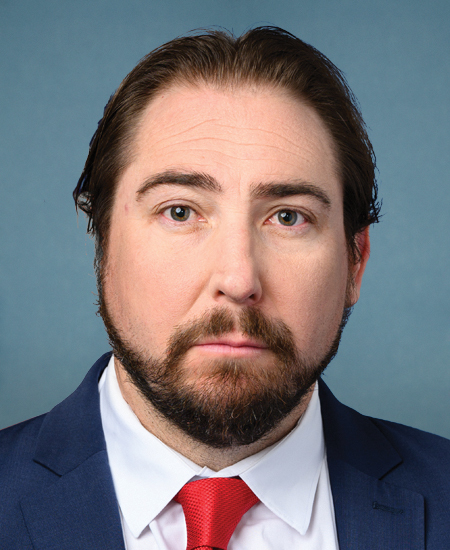
Rep. Elijah Crane
Sponsored bills
Maddy summaryHR 4382 authorizes the U.S. Mint to produce commemorative coins for the 2028 Los Angeles Olympics/Paralympics and 2034 Salt Lake City Winter Olympics/Paralympics. It specifies gold, silver, and half-dollar coin designs with defined mintage limits (e.g., up to 100,000 $5 gold coins for each event), all bearing inscriptions like "2028" or "2034" and standard coin features. A surcharge ($5-$50 per coin) is added to sales, with all funds directed to the respective Olympic committees to support event hosting and legacy programs like youth sports. The bill ensures no net cost to the government by requiring surcharge revenues to cover all design, production, and marketing expenses before funds are disbursed.
Maddy summaryHR 4370, the SAMS Act of 2025, codifies five existing executive orders into law to strengthen U.S. mineral supply chains. It gives legal force to orders focused on securing critical minerals (like lithium and rare earths) for national security and economic resilience, directly affecting federal agencies implementing these strategies. Key provisions require agencies to follow these established policies - addressing reliance on foreign mineral sources, supporting domestic mining, and prioritizing national security in mineral processing - without creating new regulations. The bill does not alter current mineral policies but formally enshrines them as binding federal requirements.
Maddy summaryHRES 570 is a House resolution commending Petty Officer 3rd Class Scott Ruskan for rescuing 165 people during catastrophic July 2025 flooding in central Texas. The resolution honors Ruskan, a Coast Guard Aviation Survival Technician from Air Station Corpus Christi, for his role as the sole triage coordinator during the disaster. It recognizes his "exceptional courage" and "selflessness" in saving lives during the Guadalupe River flooding that caused extensive damage and loss of life. As a ceremonial resolution, it does not create new laws or policies but formally expresses the House's gratitude for Ruskan's service.
Maddy summaryHRES 571 is a symbolic resolution passed by the U.S. House of Representatives to commemorate the one-year anniversary of the July 13, 2024, attempted assassination of President Donald J. Trump in Butler, Pennsylvania. It condemns two assassination attempts against the President (in Butler and West Palm Beach), honors victims Corey D. Comperatore (who died shielding his family), David Dutch, and James Copenhaver (who were critically injured), and expresses gratitude to first responders. The resolution also condemns incitement of violence against political officials and calls for unity against political violence. As a non-binding resolution, it does not create new laws or policies but formally states the House’s position on these events.
Maddy summaryHR 275 requires the Department of Homeland Security (DHS) to publish monthly reports on individuals classified as "special interest aliens" who attempt unlawful entry into the U.S. These reports, due by the seventh day of each month, must include the total number, nationalities or countries of origin, geographic regions of encounters, and whether entries occurred at ports, between ports, or inland. The reports must also identify if encounters involve "covered nations" as defined under existing law. This bill directly affects DHS, which must implement the reporting, and Congress, which receives the data for oversight. The law focuses on transparency around national security-related immigration encounters without altering immigration policy.
Maddy summaryHR 4201, the TPS Reform Act of 2025, changes how Temporary Protected Status (TPS) is granted to immigrants from foreign countries facing crises. It requires Congress, not the executive branch, to pass a specific law designating a country for TPS, based on strict criteria like ongoing armed conflict, major natural disasters, or extraordinary conditions preventing safe return. The law sets clear time limits: initial designations last up to 18 months, with extensions capped at 12 months, and mandates Congress to find that crisis conditions continue for any extension. This directly affects immigrants from designated countries who would otherwise be allowed to live and work temporarily in the U.S. due to unsafe conditions in their home countries. The bill also shifts administration from the Attorney General to the Secretary of Homeland Security.
Maddy summaryThis bill requires the U.S. government to treat any World Health Organization (WHO) pandemic prevention or response agreement as a treaty needing Senate approval with a two-thirds vote. It directly affects U.S. foreign policy decisions regarding WHO agreements, ensuring the Senate must consent before such treaties take effect. The bill mandates that any WHO pandemic agreement - like the one adopted at the 2025 World Health Assembly - must follow the constitutional treaty process, not be implemented as a less formal executive agreement. This policy change aims to address concerns about WHO's pandemic management and independence, as highlighted by congressional findings.
Maddy summaryHR 4200, the End DED Act, prohibits federal funding for the Deferred Enforced Departure (DED) program, which provides temporary immigration protections to individuals from specific countries. It directly affects approximately 100,000 people currently covered under DED from nine nations (including Haiti, El Salvador, and Venezuela), who would lose their work authorization and travel privileges if the program is defunded. The bill’s key provision bans all federal funds from being used to implement or administer DED or any successor program. This addresses congressional concerns that DED - a policy created solely by executive action without statutory authority - undermines Congress’s constitutional power over immigration, which it delegated to Temporary Protected Status (TPS) instead.
Maddy summaryThe ARMS Act requires the Transportation Security Administration (TSA) to implement annual, risk-informed covert testing at all Category X airports (the largest, busiest U.S. airports) to identify security vulnerabilities in passenger and baggage screening. It mandates at least three covert test scenarios yearly per airport, with root cause analysis within 90 days of identifying vulnerabilities, and a 150-day timeline for deciding whether to mitigate them. The TSA must publicly report annual pass/fail rates and mitigation progress (without revealing security details) and submit classified and unclassified reports to Congress with its budget request. This law focuses on systematically assessing and addressing aviation security gaps through data-driven testing and transparent reporting.