

Maddy summaryThis bill amends VA regulations to require the Department of Veterans Affairs to cover both the purchase price and shipping costs for adaptive vehicles delivered to veterans. It directly affects veterans who receive VA-funded adaptive vehicles under Section 3902 of Title 38, U.S. Code. The key change updates the payment mechanism so veterans no longer bear the cost of shipping the vehicle to their location. This policy change simplifies the process by ensuring full delivery costs are covered in a single VA payment.
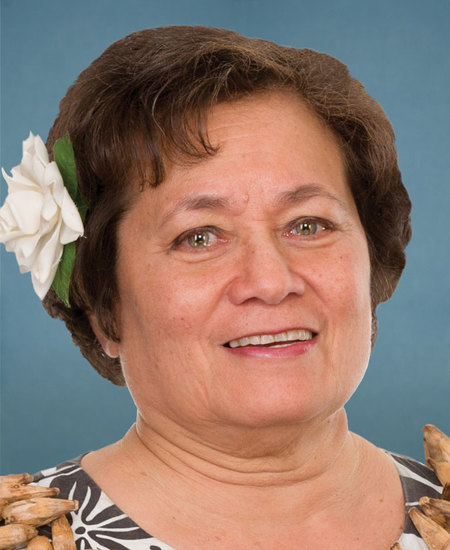
Rep. Aumua Amata Coleman Radewagen
Sponsored bills
Maddy summaryThis bill amends a definition in federal law to explicitly include the Northern Mariana Islands as a "State" for the purpose of criminal justice funding programs. It corrects the reference in the Omnibus Crime Control and Safe Streets Act of 1968 by removing outdated language and inserting "Northern Mariana Islands;" after the territory's name. This change ensures the Northern Mariana Islands qualifies for federal criminal justice support programs under the same definition as states. The bill does not create new programs or change funding levels; it only updates the legal definition to align with current territorial status. (Procedural bill, summarized in 2 sentences.)
Maddy summaryThis bill prohibits U.S. port operators from entering contracts for ownership, leasing, or operation of ports covered by maritime security plans with entities owned by China, Russia, North Korea, or Iran - either directly or if any portion is owned by those countries. It applies to major U.S. ports managing international cargo and passenger traffic that require federal security plans under existing law. The law bans such contracts for all port facilities subject to these security requirements. This directly affects port authorities and private operators managing critical infrastructure under federal security mandates.
Maddy summaryThis symbolic resolution expresses congressional support for designating September 29, 2024, as "Veterans of Foreign Wars of the United States Day" to honor the organization's 125th anniversary. It requests the President issue a proclamation encouraging government agencies and the public to observe the day with ceremonies, though it creates no new laws or policy changes. The resolution recognizes the VFW's historical service to veterans but does not directly affect any individuals or programs.
Maddy summaryHR 7159, the Pacific Partnership Act, mandates the U.S. government to develop a comprehensive strategy for engagement with Pacific Island nations. It requires the President, by January 1, 2026, and every four years thereafter, to submit a detailed strategy to Congress outlining U.S. diplomatic, defense, and economic goals in the region, including assessments of threats like natural disasters, illegal fishing, and foreign military activity. The strategy must detail plans to address these threats, coordinate with Pacific Island governments and regional organizations like the Pacific Islands Forum, and outline required resources and staffing. This bill directly affects U.S. foreign policy operations and shapes how the federal government engages with Pacific Island nations on shared security, economic, and environmental priorities.
Maddy summaryHR 6606 amends the Export Control Reform Act of 2018 to add a new policy statement protecting U.S. trade secrets. The bill specifically requires the Secretary to consider safeguarding trade secrets related to export-controlled items or cases of economic espionage (under 18 U.S.C. § 1831) when implementing export controls. This change directly affects companies and entities handling sensitive technologies subject to U.S. export regulations. The amendment clarifies an existing policy goal within the law but does not create new regulations or enforcement mechanisms. It is a procedural update to the statutory policy framework.
Maddy summaryHRES 1056 is a non-binding House resolution recognizing recent trilateral cooperation among the United States, Japan, and South Korea. It formally acknowledges specific collaborative efforts, including resumed summitry, joint military exercises, shared missile warning systems, economic partnerships, and coordinated responses to regional challenges like North Korea and crises in Sudan and Israel. The resolution does not create new policies or funding but expresses congressional support for strengthening this alliance framework. It highlights the importance of continued cooperation across diplomatic, security, and economic domains to promote stability in the Western Pacific. The resolution was introduced by multiple House members and referred to the Foreign Affairs Committee.
Maddy summaryThis joint resolution formally apologizes to the people of the Marshall Islands for the harm caused by U.S. nuclear testing and radioactive waste disposal during the Cold War, which exposed civilians to radiation, damaged health, and contaminated land. It commits the U.S. to providing climate adaptation assistance for radioactive waste impacts (like rising seas threatening the Runit Dome), urges the Secretary of Energy to complete groundwater studies at the Runit Dome, and secures healthcare for veterans involved in cleanup efforts. The resolution directly affects Marshall Islanders (who endured radiation exposure and health impacts), U.S. veterans who participated in radiological cleanup, and the U.S.-Marshall Islands relationship under the Compact of Free Association. It does not create new legal obligations but reaffirms the U.S. commitment to the Freely Associated States.
Maddy summaryThis bill requires the Department of Defense to pay prime contractors 5% of the value of subcontracts awarded to qualifying small businesses in Guam, American Samoa, and the Northern Mariana Islands. To qualify, a business must be at least 51% owned by U.S. citizens, have its main office in one of these territories, and employ at least 50% of its staff there. Prime contractors must apply for the payment after entering such subcontracts, and annual reports will track participation, economic impact, and recommendations for improvement. The policy applies to new contracts starting from the bill's enactment date.
Maddy summaryHR 9274, the SHAWL Act, establishes two new Smithsonian museums: the National Museum of the American Latino and the American Women’s History Museum. It authorizes both museums to be located within the National Mall’s "Reserve" area, overriding prior restrictions, and requires federal agencies managing potential sites to transfer jurisdiction to the Smithsonian after notifying congressional committees. The bill mandates that both museums accurately represent diverse cultures, histories, and viewpoints within Latino and women’s communities through exhibits and programs, requiring input from a broad range of community experts. It also requires the Smithsonian to submit biennial reports to Congress detailing compliance with these representation requirements.