

Public Service Freedom to Negotiate Act of 20 21 This bill provides minimum collective bargaining rights and procedures for public employees and prohibits strikes by certain public safety workers. The Federal Labor Relations Authority (FLRA) shall determine for each state whether the laws of such state substantially provide for each of the minimum standard collective bargaining rights and procedures specified by this bill, including the right of public employees and supervisory employees to self-organize, form or join a labor organization, or collectively bargain. The FLRA must issue rules and take actions to establish and administer bargaining rights and procedures for those states that do not substantially provide for them. No employers, emergency services employees, or law enforcement officers may engage in a lockout, strike, or any other organized job action that is likely to result in a measurable disruption of the delivery of emergency or public safety services. Furthermore, no labor organization may be the cause of a violation of such prohibition.
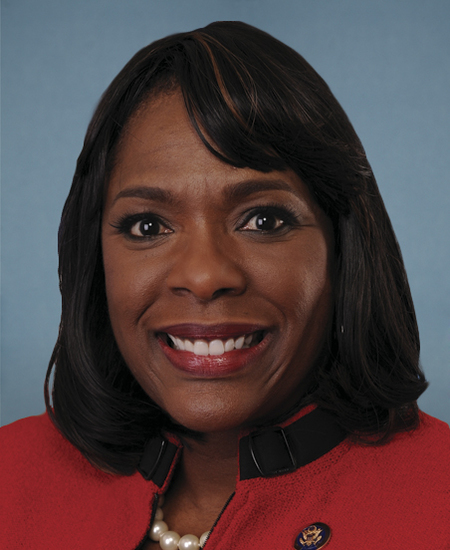
Rep. Terri A. Sewell
Sponsored bills
This resolution recognizes the opportunity for Black Maternal Health Week to raise national awareness of the state of Black maternal health in the United States.
Gay and Trans Panic Defense Prohibition Act of 2021 This bill generally prohibits a federal criminal defendant from asserting, as a defense, that the nonviolent sexual advance of an individual or a perception or belief of the gender, gender identify or expression, or sexual orientation of an individual excuses or justifies conduct or mitigates the severity of an offense.
Help Empower Americans to Respond Act of 2021 or the HEAR Act This bill establishes a new criminal offense for the import, sale, manufacture, transfer, or possession of a firearm silencer or firearm muffler. The bill does not prohibit certain conduct with respect to a firearm silencer or firearm muffler, including the following: importation, sale, manufacture, transfer, or possession related to certain law enforcement efforts, or authorized tests or experiments; and importation, sale, transfer, or possession related to securing nuclear materials. In addition, the bill requires the Department of Justice to establish and implement a buy-back program to purchase firearm silencers and firearm mufflers. States and local governments may use Edward Byrne Memorial Justice Assistance Grant Program funds to compensate individuals who surrender firearm silencers and firearm mufflers under this buy-back program.
Law Enforcement Protection Act of 2021 This bill includes armor-piercing, concealable weapons in the definition of firearm under the National Firearms Act.
Voter Empowerment Act of 2021 This bill expands voter registration and voting access. Specifically, the bill expands voter registration by requiring states to (1) make available online voter registration, (2) establish automatic voter registration systems, (3) permit same-day voter registration, and (4) accept voter registration applications from individuals under age 18. Further, the bill limits removing voters from voter rolls and prohibits interference with voter registration or voting. Next, the bill requires states to allow individuals with disabilities to use absentee registration procedures and to vote by absentee ballot in federal elections. The bill also prohibits voter caging (the practice of sending mail to addresses on voter rolls, compiling a list of the undeliverable mail, and using the list to remove registered voters from voter rolls). Next, the bill expands voting access by requiring states to allow early voting and voting by mail without additional conditions. It also requires states to provide secured drop boxes at which individuals may drop off their completed absentee ballots. In addition, the bill declares that the right of a U.S. citizen to vote in any federal election shall not be denied or abridged because that individual has been convicted of a criminal offense unless, at the time of the election, such individual is serving a felony sentence. Finally, the bill permanently reauthorizes the Election Assistance Commission (EAC). It also directs the EAC to make grants to states for specified activities, including to implement automatic voter registration systems.
Dignity for Detained Immigrants Act of 2021 This bill directs the Department of Homeland Security (DHS) to establish standards for facilities holding aliens in its custody, phases out using non-DHS facilities for such purposes, and contains other related provisions. The standards shall comply with the American Bar Association's Civil Immigration Detention Standards. The DHS Office of Inspector General (OIG) shall conduct periodic unannounced inspections of each facility and shall take various actions against noncompliant facilities, including imposing fines, cancelling contracts, and closing facilities. DHS shall report to Congress any death of an alien in its custody within 24 hours and conduct an investigation within 30 days that identifies policy changes that could reduce the likelihood of such a death. DHS is prohibited from entering into contracts for third parties to operate detention facilities or alternatives to detention programs and shall terminate existing contracts within three years of the bill's enactment. The bill establishes that OIG facility inspection reports and contracts for an outside entity to operate a detention facility are records available to the public under the Freedom of Information Act. DHS shall maintain certain information relating to detained aliens, including the alien's location and whether the alien was separated from family. The bill provides for various requirements and procedures related to detaining aliens, including (1) prohibiting DHS from detaining children, (2) imposing a presumption that an alien should be released, and (3) establishing that aliens in custody shall be subject to the least restrictive conditions. The bill also abolishes mandatory detention for asylum seekers.
Equal Access to Abortion Coverage in Health Insurance Act of 2021 or the EACH Act of 2021 This bill requires federal health care programs to provide coverage for abortion services and requires federal facilities to provide access to those services. The bill also permits qualified health plans to use funds attributable to premium tax credits and reduced cost sharing assistance to pay for abortion services.
PrEP Assistance Program Act This bill establishes a grant program to provide pre-exposure prophylaxis (PrEP) and related services to individuals at no cost. PrEP is medication given to individuals at risk of HIV to reduce their likelihood of contracting the virus. The Department of Health and Human Services must award the grants to state, tribal, and local governments; certain health clinics; and community-based organizations.
This resolution expresses support for the designation of National Vitiligo Awareness Day. (Vitiligo is a chronic condition that results in the loss of pigment in patches on the skin, hair, eyes, and inside of the mouth; the condition may lead to discomfort, itching, and pain.)