

Sustaining Our Democracy Act This bill establishes and provides funds through FY2032 for the State Election Assistance and Innovation Trust Fund for purposes of promoting election activities. Specifically, the bill establishes the Democracy Advancement and Innovation Program, through which the Office of Democracy Advancement and Innovation (also established by this bill) shall make allocations to states for carrying out democracy promotion activities. These activities include improving the administration of federal elections, recruiting and training nonpartisan election officials and poll workers, and increasing voting access. The bill requires each state, in order to receive allocated funds, to (1) submit a plan for approval that describes how the state will distribute resources and carry out democracy promotion activities, and (2) establish uniform and nondiscriminatory state-based administrative complaint procedures. The bill prohibits states from using funds for certain activities, including any activity that diminishes the ability of any eligible voter to participate in the electoral process.
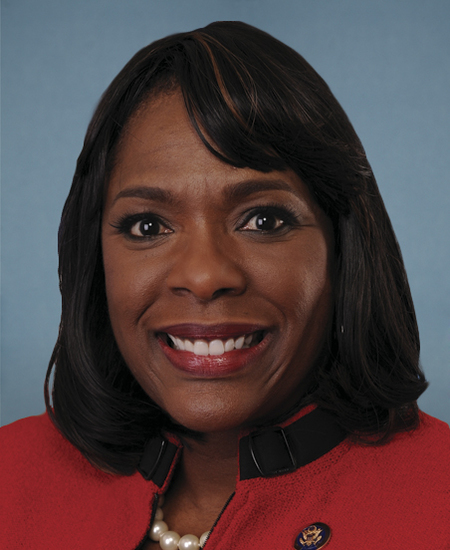
Rep. Terri A. Sewell
Sponsored bills
Maddy summaryHR 301 would amend U.S. law to officially designate "Lift Every Voice and Sing" as the national hymn of the United States. This change would add the song's full composition (words and music) to Title 36 of the U.S. Code, replacing the current designation of "The Star-Spangled Banner" as the sole national anthem for formal recognition purposes. The bill directly affects federal law and official government ceremonies where the national hymn is performed, though it does not alter the status of "The Star-Spangled Banner" as the national anthem. The policy change is purely procedural, establishing a new official designation without impacting any other laws or rights.
Freight Rail Assistance and Investment to Launch Coronavirus-Era Activity and Recovery Act of 2022 or the Freight RAILCAR Act of 2022 This bill provides a new tax credit through 2024 for 10% of freight railcar fleet modernization expenses (i.e., railcar replacement and modernization expenses for meeting fuel efficiency and performance standards). The bill provides that no more than 2,000 freight railcars per taxpayer may be taken into account for purposes of determining the credit in a taxable year. The Department of the Treasury must report to Congress on the credit to provide information on the number of times the credit was claimed and the number of railcars scrapped or built as a result of the credit.
Domestic Terrorism Prevention Act of 2022 This bill establishes new requirements to expand the availability of information on domestic terrorism, as well as the relationship between domestic terrorism and hate crimes. It authorizes domestic terrorism components within the Department of Homeland Security (DHS), the Department of Justice (DOJ), and the Federal Bureau of Investigation (FBI) to monitor, analyze, investigate, and prosecute domestic terrorism. The domestic terrorism components of DHS, DOJ, and the FBI must jointly report on domestic terrorism, including white-supremacist-related incidents or attempted incidents. DHS, DOJ, and the FBI must review the anti-terrorism training and resource programs of their agencies that are provided to federal, state, local, and tribal law enforcement agencies. Additionally, DOJ must make training on prosecuting domestic terrorism available to its prosecutors and to assistant U.S. attorneys. It creates an interagency task force to analyze and combat white supremacist and neo-Nazi infiltration of the uniformed services and federal law enforcement agencies. Finally, it directs the FBI to assign a special agent or hate crimes liaison to each field office to investigate hate crimes incidents with a nexus to domestic terrorism.
Relief for Restaurants and other Hard Hit Small Businesses Act of 2022 This bill addresses support for restaurants, arts and entertainment venues, and small businesses impacted by the COVID-19 pandemic. The bill provides an additional $42 billion in FY2021 for the Restaurant Revitalization Fund and gives priority to previous applicants who have not received a grant. The Small Business Administration (SBA) must provide to applicants an explanation for denied applications, establish a reconsideration process for denied applications, and institute an audit and oversight plan with respect to grant recipients. Additionally, the bill establishes the Hard Hit Industries Award Program for small businesses that suffered a pandemic-related revenue loss of 40% or more. Aggregate grant amounts are capped at $1 million. Funds may be used for expenses including mortgage, rent, and utility payments and payroll. SBA must prioritize entities that have experienced significant pandemic-related revenue loss, with first priority going to those that experienced a loss of at least 80%, and second priority going to those that experienced a loss of at least 60%. Finally, the bill extends to March 11, 2023 (or a later date as determined by the SBA), the time frame during which Shuttered Venue Operators Grant recipients may use grant funds to cover their expenses.
Bipartisan Background Checks Act of 2021 This bill establishes new background check requirements for firearm transfers between private parties (i.e., unlicensed individuals). Specifically, it prohibits a firearm transfer between private parties unless a licensed gun dealer, manufacturer, or importer first takes possession of the firearm to conduct a background check. The prohibition does not apply to certain firearm transfers or exchanges, such as a gift between spouses in good faith.
Maddy summaryHRES 1141 is a symbolic resolution designating the week of May 23-27, 2022, as "Educator Mental Health Awareness Week." It expresses congressional support for recognizing the mental health challenges faced by teachers and school staff, particularly during the pandemic. The resolution highlights statistics showing heightened stress, depression, and anxiety among educators, as reported in 2021 surveys. It urges awareness of educator well-being but does not create new programs, funding, or legal requirements. The resolution serves only as a non-binding statement of support.
Maddy summaryThe Kidney Health Connect Act of 2022 allows Medicare to cover telehealth visits for kidney disease patients at renal dialysis facilities, removing previous geographic restrictions. It specifically eliminates the requirement that patients must have a face-to-face visit with a doctor during the same month to receive telehealth services at these facilities. This change directly affects Medicare beneficiaries receiving dialysis treatment, making it easier for them to access remote care from their regular dialysis centers. The bill modifies Medicare rules to treat dialysis facilities as valid telehealth originating sites without location limitations.
Virginia Graeme Baker Pool and Spa Safety Reauthorization Act of 2022 This bill reauthorizes through FY2027 and expands swimming pool safety grants and education and awareness programs.
Violence Against Women Reauthorization Act of 2021 This bill modifies and reauthorizes through FY2026 programs and activities under the Violence Against Women Act that seek to prevent and respond to domestic violence, sexual assault, dating violence, and stalking. The bill also authorizes new programs, makes changes to federal firearms laws, and establishes new protections to promote housing stability and economic security for victims of domestic violence, sexual assault, dating violence, and stalking.