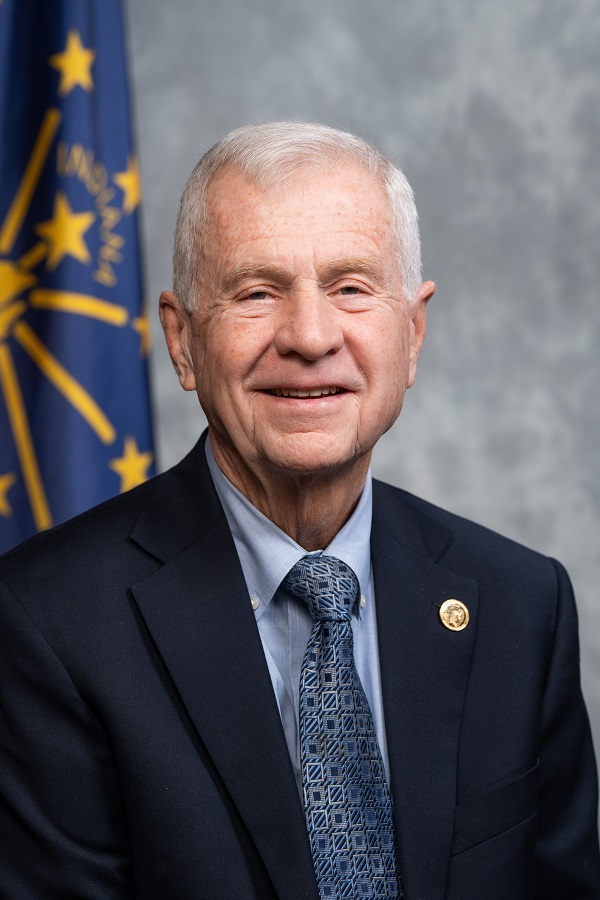
Photo of Ed Charbonneau
R Indiana Senate · District 5

Sen. Ed Charbonneau

Compare
Total votes
2,574
all sessions
Attendance
97%
68 missed
Higher than 83% of chamber peers
With party
99%
of cast votes
Higher than 97% of chamber peers
Bipartisan score
1%
crosses aisle rarely
Among the lowest in the chamber
Sponsored
791
bills & resolutions
Higher than 78% of chamber peers
Committees
5
assignments
791 bills and resolutions

Sponsored bills

Total
791
Primary
425
Co-sponsor
366
This page
791
matching current filters
Primary SB 168
In committee · Indiana Senate · Lead sponsor
340B drug program report.

Requires an entity authorized to participate in the federal 340B Drug Pricing Program to annually report specified data to the Indiana department of health (department). Requires the department to submit a report of the aggregated data to the legislative council and post the report on the department's website.

In committee Jan 8, 2024 0 co-sponsors
Primary HB 1513
Signed into law · Indiana House · Lead sponsor
FSSA matters.

Changes the name of the bureau of developmental disabilities services to the bureau of disabilities services. Removes certain members from the 211 advisory committee. Repeals Medicaid copayment provisions that: (1) require the office of the secretary of family and social services (office) to apply a copayment for certain Medicaid services; (2) require a recipient to make a copayment upon the receipt of services and for a provider not to voluntarily waive a copayment; (3) set forth exemptions from copayment requirements; and (4) require the provider to charge the maximum allowable copayment. Allows for an enrollment fee, a premium, a copayment, or a similar charge to be imposed as a condition of an individual's eligibility for the healthy Indiana plan and the children's health insurance program. Removes a prohibition on the office from: (1) requiring certain providers to submit non-Medicaid revenue information in the provider's annual historical financial report; and (2) only requesting balance sheets from certain providers that apply directly to the provider's facility. Allows the office to implement an end of therapy reclassification methodology in a successor of the RUG-IV, 48-Group model for payment of nursing facility services.

Signed into law May 4, 2023 0 co-sponsors
Primary HB 1050
Signed into law · Indiana House · Lead sponsor
Various motor vehicle matters.

Adds an exception to the disposition of surplus personal property by a governmental body. Expands the definition of "alternative fuel" to include hydrogen, hythane, electricity, or any other fuel used to propel a motor vehicle on a highway that is not subject to certain taxes. Provides for the taxation of motor carriers using alternative fuels other than butane or propane. Provides that a carrier subject to certain imposed motor vehicle taxes is exempt from submitting to the department of state revenue (department) quarterly reports of the operations of commercial motor vehicles giving rise to the carrier's tax liability as the department may require under certain circumstances. Provides that a carrier that is exempt from the quarterly reporting requirements: (1) must continue to file a quarterly return to obtain a promotional use credit; (2) is required to keep books and records; and (3) is exempt from certain requirements regarding an annual permit, a cab card, and an emblem. Provides that a person who is living in Indiana and has been granted parole is included in the definition of "Indiana resident". Defines "lawful status". Repeals the term "credential". Defines "physical credential". Provides that the bureau of motor vehicles (bureau) may issue a driver's license, permit, or identification card to certain individuals granted parole in the United States under 8 U.S.C. 1182(d)(5). Provides that the bureau may issue rules, including emergency rules, to provide a driver's license, permit, or identification card to certain individuals granted parole, as well as registrations and certificates of title for motor vehicles of certain individuals granted parole. Provides for when a credential issued by the bureau must be in the form of a physical credential or a mobile credential. Provides for the form of the mobile credential. Provides that, beginning July 1, 2023, and each year thereafter, the bureau is required to provide the executive director of the legislative services agency the name of a special group for whom: (1) 10 years have elapsed since the special group was admitted into the special group recognition license plate program; or (2) 10 years have elapsed since the previous review of the special group by the interim study committee on roads and transportation. Provides that if a special group was subject to a decennial review before July 1, 2023, then the next review occurs in the year which is a multiple of 10 years after the year of the special group's admittance to the special group recognition license plate program. Prohibits a consolidated city from installing a sign prohibiting a turn at a steady red signal. Specifies the calculation for the amount of the supplemental fee for hybrid and electric vehicles. Requires a person who drives a vehicle approaching a disabled stationary vehicle with flashing hazard warning signals to do either of the following, while proceeding with due caution: (1) Yield the right-of-way by making a lane change into a lane not adjacent to that of the disabled stationary vehicle, if possible with due regard to safety and traffic conditions, if on a highway having at least four lanes with not less than two lanes proceeding in the same direction as the approaching vehicle. (2) Reduce the speed of the vehicle to a speed at least 10 miles per hour less than the posted speed limit, maintaining a safe speed for road conditions, if changing lanes would be impossible or unsafe. Provides that a person who does not yield the right-of-way or reduce the speed of the person's vehicle commits a Class B infraction. Provides that the term "driver training school" does not include a business enterprise that educates or trains a person or prepares a person to operate a commercial motor vehicle. Allows a driver training school to administer a driving skills test to an individual who holds a valid learner's permit. Provides that certain entities are immune from civil liability for an act or omission occurring during a motorcycle operator safety course that results in an injury or property damage. Provides that administrative procedures of the bureau do not apply to a hearing requested by a nonresident regarding the suspension of the driving privileges of the nonresident for failure to meet the terms of a citation. Provides that a document preparation fee that is less than $200 is permitted and does not constitute an unfair practice. Provides civil immunity for a dealer in an action regarding the resale of a buyback vehicle if the dealer had a reasonable good faith belief the vehicle was not a buyback vehicle. Provides for the process for suspending the Indiana driving privileges of a minor who is an Indiana resident for failing to appear or answer a traffic summons. Makes conforming changes.


Signed into law May 4, 2023 0 co-sponsors
Primary SB 1
Signed into law · Indiana Senate · Lead sponsor
Behavioral health matters.

Provides that, subject to certain procedures and requirements, the office of the secretary of family and social services may apply to the United States Department of Health and Human Services: (1) for a Medicaid state plan amendment, a waiver, or an amendment to an existing waiver to require reimbursement for eligible certified community behavioral health clinic services; or (2) to participate in the expansion of a community mental health services demonstration program. Requires the division of mental health and addiction to establish and maintain a help line: (1) to provide confidential emotional support and referrals to certain resources to individuals who call the help line; and (2) that is accessible by calling a toll free telephone number. Establishes the Indiana behavioral health commission (commission) and sets forth the commission's membership. Changes the name of the "9-8-8 crisis hotline center" to "9-8-8 crisis response center". Makes conforming changes.

Signed into law May 4, 2023 0 co-sponsors
Primary SB 400
Signed into law · Indiana Senate · Lead sponsor
Health care matters.

Requires the state employee health plan, policies of accident and sickness insurance, and health maintenance organization contracts to provide coverage for wearable cardioverter defibrillators. Specifies requirements for credentialing a provider for the Medicaid program, an accident and sickness insurance policy, and a health maintenance organization contract. Establishes a provisional credential until a decision is made on a provider's credentialing application and allows for retroactive reimbursement. Provides that a hospital's quality assessment and improvement program must include a process for determining and reporting the occurrence of serious reportable events. Provides that the medical staff of a hospital may make recommendations on the granting of clinical privileges and the appointment or reappointment of an applicant to the governing board for a period not to exceed 36 months. Requires a hospital with an emergency department to have at least one physician on site and on duty who is responsible for the emergency department. Requires the legislative services agency to conduct an analysis of licensing fees and provide a report to the budget committee. Allows the commissioner of the department of insurance (commissioner) to issue an order to discontinue a violation of a law (current law specifies orders or rules). Requires the commissioner to consider specified information before approving or disapproving a premium rate increase. Requires a domestic stock insurer to file specified information with the department of insurance. Prohibits the state employee health plan from requiring prior authorization for certain specified services. Changes prior authorization time requirements for urgent care situations. Adds an employee benefit plan that is subject to the federal Employee Retirement Income Security Act of 1974 and a state employee health plan to the definition of "health payer" for the purposes of the all payer claims data base (data base). Allows the department of insurance to adopt rules on certain matters concerning the data base. Requires a health plan to post certain information on the health plan's website. Prohibits an insurer and a health maintenance organization from altering a CPT code for a claim or paying for a CPT code of lesser monetary value unless: (1) the CPT code submitted is not in accordance with certain guidelines and rules, or the terms and conditions of a participating provider's agreement or contract with the insurer or health maintenance organization; or (2) the medical record of the claim has been reviewed by an employee or contractor of the insurer or health maintenance organization. Requires an insurer and a health maintenance organization to provide a contracted provider with a current reimbursement rate schedule at specified times. Urges the study by an interim committee of: (1) prior authorization exemptions for certain health care providers; and (2) whether Indiana should adopt an interstate mobility of occupational licensing. Requires a collaborating physician or physician designee to review certain patient encounters performed by a physician assistant within 14 business days. Requires a health plan to offer a health care provider the option to request a peer to peer review by a clinical peer concerning an adverse determination on a prior authorization request.

Signed into law May 4, 2023 0 co-sponsors
Primary SB 7
Signed into law · Indiana Senate · Lead sponsor
Physician noncompete agreements.

Provides that beginning July 1, 2023, a primary care physician and an employer may not enter into a noncompete agreement. Provides that beginning July 1, 2023, a physician noncompete agreement is not enforceable if any of the following circumstances occur: (1) The employer terminates the physician's employment without cause. (2) The physician terminates the physician's employment for cause. (3) The physician's employment contract has expired and the physician and employer have fulfilled the obligations of the contract. Specifies a process by which a physician or employer may pursue mediation to determine a reasonable price to purchase a release from a noncompete agreement.

Signed into law May 4, 2023 0 co-sponsors
Primary SB 4
Signed into law · Indiana Senate · Lead sponsor
Public health commission.

Defines "core public health services" for purposes of public health laws. Adds members to the executive board of the Indiana department of health (state department). Removes a provision allowing the state department to establish branch offices. Provides that the state department may provide services to local health departments. Requires each local board of health to establish a local public health services fund to receive state funding. Provides a method of allocation of state funding to local boards of health, subject to state appropriations. Specifies the percentage of how additional funding may be expended on core public health services. Allows the local health department to enter into contracts or approve grants for core public health services. Allows the state department to issue guidance to local health departments. Requires the state department to make annual local health department reports available to the public. Changes the qualification requirements for a local health officer and requires certain training. Requires the state department to identify state level metrics and county level metrics and requires certain local health departments to report to the state department activities and metrics on the delivery of core public health services. Requires the state department to annually report on the metrics to the budget committee and publish information concerning the metrics on the Internet. Requires that a local health department post a position or contract for the provision or administration of core public health services for at least 30 days. Requires a local health department to provide certain education before administering a vaccine. Requires a multiple county health department to maintain at least one physical office in each represented county. Provides that a new city health department cannot be created after December 31, 2022, but allows current city health departments to continue to operate. Creates the Indiana trauma care commission. Allows a school corporation that cannot obtain an ophthalmologist or optometrist to perform the modified clinical technique vision test to conduct certain specified vision screenings. Requires the school to send to the parent of a student any recommendation for further testing by the vision screener. Allows for standing orders to be used for emergency stock medication in schools. Allows the state health commissioner or designee to issue a statewide standing order, prescription, or protocol for emergency stock medication for schools. Removes the distance requirement for an access practice dentist to provide communication with a dental hygienist. Repeals provisions concerning the Indiana local health department trust account.

Signed into law May 4, 2023 0 co-sponsors
Primary SB 8
Signed into law · Indiana Senate · Lead sponsor
Prescription drug rebates and pricing.

Requires a pharmacy benefit manager to provide a report to the department of insurance at least every six months. Provides that the report must include the: (1) overall aggregate amount charged to a health plan for all pharmaceutical claims processed by the pharmacy benefit manager; and (2) overall aggregate amount paid to pharmacies for claims processed by the pharmacy benefit manager. Requires that, for individual health insurance coverage, the defined cost sharing for a prescription drug be calculated at the point of sale and based on a price that is reduced by an amount equal to at least 85% of all rebates in connection with the dispensing or administration of the prescription drug. Requires that, for group health insurance coverage, an insurer: (1) pass through to a plan sponsor 100% of all rebates concerning the dispensing or administration of prescription drugs to the covered individuals of the plan sponsor; (2) provide a plan sponsor, at the time of contracting, the option of calculating defined cost sharing for covered individuals of the plan sponsor at the point of sale based on a price that is reduced by some or all of the rebates received concerning the dispensing or administration of the prescription drug; and (3) disclose specified information to the plan sponsor. Allows the department of insurance to enforce the provisions and impose a civil penalty.

Signed into law May 4, 2023 0 co-sponsors
Primary HB 1445
Signed into law · Indiana House · Lead sponsor
Audit of Medicaid program prescription drug costs.

Amends the requirements for a physician to provide office based opioid treatment. Provides that the attorney general may issue a request for proposal to audit the prescription drug programs within the state employee health plan and the Medicaid program. Provides that the attorney general may evaluate and determine whether to include specified metrics in the request for proposal. Provides that the audit look back period must be the previous five state fiscal years. Provides that the results of the audits must be provided to the interim study committee on public health, behavioral health, and human services before September 1, 2024. Provides that a practitioner is not required to obtain information about a patient from the Indiana scheduled prescription electronic collection and tracking program (INSPECT) data base or through the patient's integrated health record before prescribing certain medications if the patient is enrolled in a hospice program.

Signed into law May 4, 2023 0 co-sponsors
Co-sponsor HB 1046
Signed into law · Indiana House · Co-sponsor
Transportation matters.

Provides that a transit development district may be established in a municipality that is located in a county that is a member of the development authority and has operated regularly scheduled commuter bus services to Chicago, Illinois, with prior financial assistance from the development authority, and shuttle bus services that transport riders to a train station or a regular train stop along the Chicago to South Bend line. Provides for a public transportation corporation located in a county having a population of more than 185,000 and less than 200,000 to expand service beyond the boundary of the county to an adjacent county if the counties have entered into an interlocal cooperation agreement to expand service.

Signed into law May 4, 2023 1 co-sponsor
Showing 231 to 240 of 791 bills
Previous 1 … 23 24 25 … 80 Next