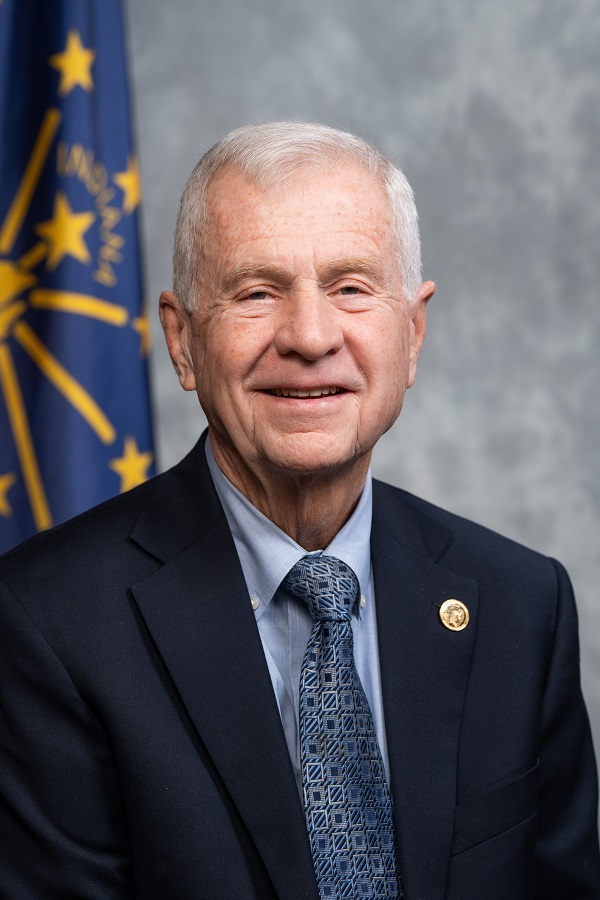
Photo of Ed Charbonneau
R Indiana Senate · District 5

Sen. Ed Charbonneau

Compare
Total votes
2,574
all sessions
Attendance
98%
37 missed
Higher than 84% of chamber peers
With party
98%
of cast votes
Higher than 97% of chamber peers
Bipartisan score
1%
crosses aisle rarely
Lower than 99% of chamber peers
Sponsored
791
bills & resolutions
Higher than 78% of chamber peers
Committees
5
assignments
791 bills and resolutions

Sponsored bills

Total
791
Primary
425
Co-sponsor
366
This page
791
matching current filters
Co-sponsor SR 1
Introduced · Indiana Senate · Co-sponsor
Honoring Senator Joe Zakas upon his retirement from the Indiana State Senate.

Maddy summaryThis is a ceremonial Senate Resolution (SR 1) honoring Senator Brandt Hershman for his retirement after serving District 7 in the Indiana State Senate since 2000. The resolution formally expresses the Senate's gratitude for his service, highlighting his leadership roles (including Majority Floor Leader and Committee Chair) and his work on tax policy improvements. The key mechanism is directing the Senate Secretary to send a copy of the resolution to Senator Hershman and his wife. It does not create new laws or affect any policy, as it is purely a symbolic gesture of appreciation.

1 co-sponsor
Co-sponsor HB 1277
Signed into law · Indiana House · Co-sponsor
Health and human services matters.

Amends the duties of the office of the secretary of family and social services (office) concerning Medicaid home and community based services waivers (waiver). Requires: (1) a provider of waiver services to provide certain documentation to a waiver recipient; (2) a waiver recipient to review the documentation and report errors or inconsistencies; and (3) the recipient's case manager to provide assistance to the recipient in reviewing the documentation and reporting any errors or inconsistencies. Requires certain Medicaid recipients to choose the recipient's provider of integrated health care coordination. Provides that integrated health care coordination provided by a provider of assisted living services is not duplicative of certain other services. Establishes a time frame in which the bureau of disabilities services must review and approve or deny requests for an increase in service units provided to certain individuals with a disability. Requires the office to apply to the federal government for: (1) a new Medicaid waiver to provide assisted living services; and (2) an amendment to a specific Medicaid home and community based services waiver to establish an individual cost limit of not more than the institutional cost of nursing facility services. Specifies that provisions concerning reimbursement for assisted living services for individuals who are aged and disabled and receiving services under a Medicaid waiver apply to the new assisted living Medicaid waiver. Provides that, beginning July 1, 2027, an individual is no longer a member of the covered population upon receiving nursing facility services for 100 consecutive days. Provides that on the one hundredth day, the individual is not a member of the covered population and shall receive Medicaid services under a fee for service program. Provides that a provision prohibiting the office from reducing reimbursement for home health services expires June 30, 2027. Requires the office to collaborate with certain entities to develop a new reimbursement methodology for home health services. Specifies that public notice of at least six months (rather than one year) must be provided before a health facility service reimbursement that results in a reduction in reimbursement may be changed. Amends the definition of "bulk drug substance" for provisions concerning drug compounding. Provides that a claim by the estate recovery unit of the office of Medicaid policy and planning (estate recovery unit) is forever barred unless the estate recovery unit files a claim in the court in which the decedent's estate is being administered not later than nine months after the date of death of the decedent.

Signed into law Mar 12, 2026 1 co-sponsor
Primary HB 1200
Signed into law · Indiana House · Lead sponsor
Bureau of motor vehicles.

Allows additional license plates issued by the bureau of motor vehicles (bureau) to be designed as a personalized license plate. Provides that a motor vehicle may be equipped with an appropriate, functioning rear view camera that provides the driver a view of the highway for a distance of at least 200 feet to the rear of the vehicle instead of a mirror. Prohibits the Indiana department of transportation from implementing variable speed limits or using electronic variable speed limit signs. Amends the information required to be provided by an applicant for a driver's license or permit. Amends the required age an individual must be to obtain a driver's license from 16 years and 90 days of age to 16 years of age. Requires an individual to demonstrate sufficient proficiency of the English language to operate a commercial motor vehicle. Provides that an individual commits a Level 6 felony if the individual: (1) represents that a false record is a valid commercial driver's license; or (2) does not have proper documentation while driving with a commercial driver's license issued by any jurisdiction other than a state, territory, or possession of the United States. Provides that a business enterprise may not educate, train, or otherwise prepare an individual to operate a commercial motor vehicle if certain circumstances exist. Makes certain changes to the requirements for the issuance of a nondomiciled commercial driver's license and allows for the revocation of an individual's nondomiciled commercial driver's license in certain circumstances. Allows an applicant for a driver's license or permit to take an examination of the individual's ability to read and understand highway signs and the individual's knowledge of Indiana traffic laws by satisfactorily completing an online examination approved by the bureau. Amends the time that an expired driver's license of an individual temporarily residing outside Indiana because of service in the armed forces remains valid. Changes the time for an individual who is 75 years of age or older and renewing a physical credential to provide proof to the bureau that the individual passed an eyesight examination from 30 days to 60 days. Removes the limitation that a renewal identification card cannot be issued by electronic service if the card expired more than 180 days prior to the date of the application for renewal. Provides that an advertisement that violates the prohibition on advertising certain illegal products must be removed from public circulation not later than October 1, 2026. Amends certain requirements for township capital improvement plans.


Signed into law Mar 12, 2026 0 co-sponsors
Co-sponsor SB 140
Signed into law · Indiana Senate · Co-sponsor
Public safety.

Amends the definition of "threat" in the intimidation statute to include posting a person's personal information on a social media platform with the intent to cause: (1) bodily injury to the person; (2) damage to the person's property; or (3) the commission of a crime against the person. Increases the penalty for intimidation if committed against a legislator.

Signed into law Mar 12, 2026 1 co-sponsor
Primary SB 91
Signed into law · Indiana Senate · Lead sponsor
Syringe exchange program.

Maddy summarySB 91 extends the expiration date of the state's syringe exchange program to July 1, 2036. This directly affects people who use syringe exchange services, primarily to prevent the spread of blood-borne diseases like HIV and hepatitis. The bill changes the program's current expiration date to a new end date in 2036, ensuring continued funding and operation. It does not alter the program's existing structure or eligibility requirements.

Signed into law Mar 10, 2026 0 co-sponsors
Primary SB 222
Signed into law · Indiana Senate · Lead sponsor
Family and social services administration matters.

Adds the 9-8-8 crisis response center and a mobile crisis team as first responders. Requires certified peers to be trained and certified by the division of mental health and addiction or an approved nationally accredited certification body. Amends the definition of "qualified provider" concerning the Medicaid program. Requires the office of the secretary of family and social services to limit presumptive eligibility determinations to qualified providers and sets forth requirements. Requires rules to be adopted concerning the implementation and administration of certification requirements for specified entities and amends standards. Allows a home health agency that meets certain conditions to continue to provide services to a Medicaid recipient and receive Medicaid reimbursement while the home health agency's application for Medicare enrollment is pending if the home health agency submitted the application or initiated the enrollment process before April 1, 2026. Changes the name of the division of disability and rehabilitative services to the division of disability, aging, and rehabilitative services. Repeals the division of aging and moves existing statutes and administrative rules to other locations. Renames the bureau of aging and in-home services to the bureau of better aging (bureau) and designates the bureau to perform certain duties once performed by the division of aging. Eliminates the requirement of a preferred drug list report. Extends the expiration of the micro facility pilot program. Authorizes the legislative services agency to prepare any legislation necessary to conform with the changes made.

Signed into law Mar 5, 2026 0 co-sponsors
Primary SB 262
Signed into law · Indiana Senate · Lead sponsor
INSPECT program.

Sets forth the circumstances in which a dispenser is not required to transmit certain information to the INSPECT program (program). Requires an opioid treatment program to, before reporting patient information to the program, comply with federal regulations in obtaining patient consent. Allows the board of pharmacy to disclose prescription drug monitoring program data to a representative of the Indiana department of health and the office of the secretary of family and social services for specified purposes.

Signed into law Mar 5, 2026 0 co-sponsors
Primary SB 282
Signed into law · Indiana Senate · Lead sponsor
Compounding drugs; registration of medical spas.

Sets forth drug compounding requirements. Requires specified agencies to prepare a report concerning drug compounding and the risks and benefits of compounding. Beginning January 1, 2027, requires the registration of medical spas under the medical licensing board of Indiana (board). Requires the board to establish and maintain a public data base concerning registered medical spas. Requires a medical spa to designate a responsible practitioner that meets certain requirements and specifies duties of the responsible practitioner. Requires a medical spa to notify the board after a serious adverse event. Allows the board to investigate a responsible practitioner concerning an alleged violation and forward any substantiated claim to the governing board of the responsible practitioner. Prohibits a medical spa from providing health care services and cosmetic and lifestyle treatments in a location other than the medical spa. Requires a medical spa to comply with certain advertising requirements.

Signed into law Mar 5, 2026 0 co-sponsors
Primary SB 225
Signed into law · Indiana Senate · Lead sponsor
Health matters.

Amends the definition of "ambulatory outpatient surgical center" to remove the requirement that a surgical procedure is permitted to be performed only by a physician, dentist, or podiatrist who has certain hospital privileges. Prohibits a hospital, debt collector, or other third party from pursuing medical debt collection if the hospital is noncompliant with specified statutes. Requires the Indiana department of health (state department) to determine on a semiannual basis whether a hospital is in compliance with the statutes and notify a hospital concerning the state department's compliance determination. Authorizes the attorney general to suspend the authority of a hospital to pursue medical debt collection when the state department has made a final determination that the hospital is noncompliant. Creates an affirmative defense for a debtor if the collection attempt occurred while the hospital was noncompliant. Requires a hospital to provide the state department with 60 days written notice if the hospital plans to: (1) close and permanently terminate all hospital operations; or (2) completely eliminate a service line for longer than 90 days. Allows for a waiver of the notification requirements in specified circumstances.

Signed into law Mar 5, 2026 0 co-sponsors
Primary SB 180
Signed into law · Indiana Senate · Lead sponsor
Various health care matters.

Eliminates a requirement that home health aide competency evaluation program training include at least 75 hours of training and 16 hours of classroom training before supervised practical training. Amends the educational requirements for dental hygienists. Amends the requirements for administration of nitrous oxide by a dental hygienist. Allows the state board of dentistry to establish additional requirements for an applicant who has failed the licensure examination at least three times. Amends the licensure and temporary permit requirements for respiratory care practitioners. Provides that a current or former police officer or firefighter (first responder) may recover medical benefits from the first responder's employer for an employment related injury or illness without first proceeding with a worker's compensation claim. Provides that if a first responder pursues a worker's compensation claim for medical benefits and the claim is withdrawn or denied, the first responder is not precluded from recovering medical benefits from the employer. Repeals the penalty in Title 16 concerning the crime of transferring contaminated semen. (Current statute contains a transferring of contaminated body fluids crime in Title 35 remains in law.)

Signed into law Mar 5, 2026 0 co-sponsors
Showing 1 to 10 of 791 bills
1 2 3 80 Next