Maddy summaryThis is a commemorative Senate Resolution (SR 2) honoring Senator Mark Messmer for his service in the Indiana Senate upon his retirement. It formally recognizes his contributions through a symbolic gesture adopted by the full Senate via voice vote on February 3, 2025. The resolution does not create new laws or affect policy; it is a procedural acknowledgment of his retirement.
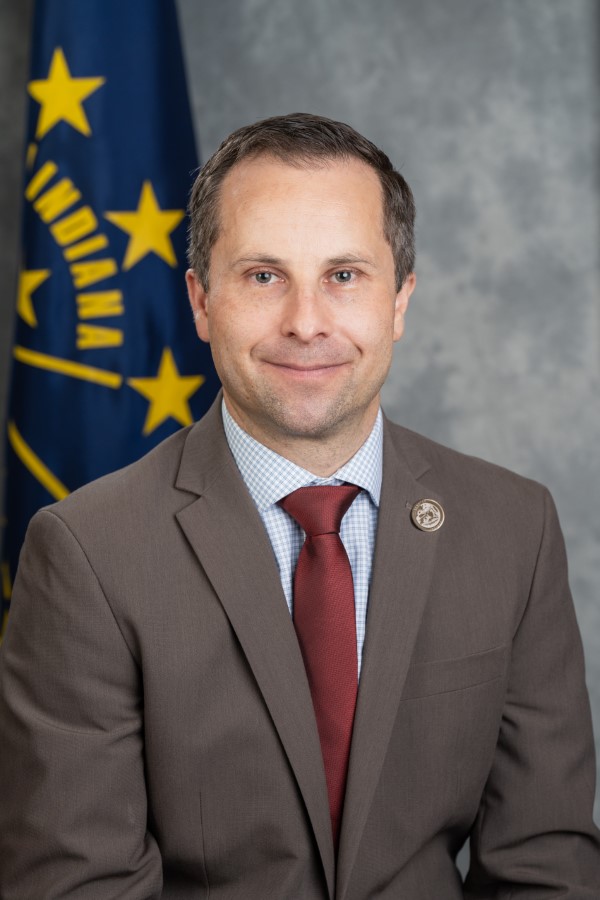
Sen. Spencer Deery
Sponsored bills
Provides that a carbon sequestration project that stores carbon dioxide generated outside a county and transported to the carbon sequestration project located in another county may not be undertaken unless the project is approved by the appropriate county legislative body or plan commission.
Maddy summaryThis Senate Resolution honors Senator David Vinzant upon his retirement from the Senate. It was adopted unanimously by the Senate on January 27, 2025, as a formal recognition of his service. The resolution does not create new policies or affect any constituents - it serves solely as a ceremonial tribute.
Specifies that an application for a carbon dioxide transmission pipeline certificate of authority must include: (1) a risk assessment; and (2) a carbon dioxide injection estimate. Provides that when determining compensation in certain eminent domain proceedings, the perceived risk of certain hazardous conditions must be taken into account. Establishes a carbon sequestration pilot project fee program, and specifies certain conditions in relation to the fee money. Provides that a transfer of ownership in regard to a carbon sequestration pilot project does not relieve a prior operator from liability for any negligence or willful misconduct that occurred before the transfer. Requires the department of natural resources to inspect a carbon sequestration pilot project. Alters the threshold of consent one must obtain in order to use eminent domain or integration in relation to carbon sequestration.
Provides that a person may not advertise a product containing marijuana or a marijuana business by any medium within the borders of Indiana. Provides that the attorney general may seek civil penalties, an injunction, and other costs for violations. Provides that civil penalties shall be deposited in the state general fund.
Provides that a pharmacy shall not require a pharmacist to work longer than 13 hours per work day, and requires a pharmacy to allow at least eight hours between consecutive shifts. Requires a pharmacy to provide certain pharmacists with a break with certain conditions. Allows a Category I pharmacy to allow certain individuals to pick up prescription refills while a pharmacist is unavailable under certain circumstances. Provides that if a pharmacist is on break or unavailable when a person requests to speak to the pharmacist, the person must be informed of the reason for the pharmacist being unavailable and given certain options.
Provides that not later than: (1) September 1, 2025, in the case of a state agency other than a state educational institution or a school corporation; (2) September 1, 2026, in the case of a state agency that is a state educational institution; or (3) September 1, 2027, in the case of a state agency that is a school corporation; a state agency shall partner with each nonprofit loan center (NLC) operating in Indiana to become a participating employer in the NLC's nonprofit loan center program (NLC program) by offering voluntary payroll deductions for eligible full-time employees to make payments toward the balance of a nonprofit loan center loan (NLC loan) made by a nonprofit loan center lender (NLC lender). Provides that after becoming a participating employer in an NLC program, a state agency shall allow an eligible employee to: (1) voluntarily request and establish payroll deductions for an NLC loan at any time; and (2) revoke the employee's authorization for payroll deductions for an NLC loan at any time; including any time that falls outside a designated open enrollment period for benefits. Defines an "NLC loan" as a loan that meets certain requirements with respect to the principal amount, loan term, finance charge, authorized fees, method of repayment, and other loan terms. Authorizes the state comptroller to authorize the electronic transfer of funds from the state treasury to a designated NLC lender in payment of an NLC loan on behalf of an eligible employee who has voluntarily given the state comptroller written authorization to make the transfer. Specifies that: (1) a loan made under the bill's provisions; or (2) a person that makes a loan under the bill's provisions; is subject to the requirements of the Uniform Consumer Credit Code chapter governing consumer loans. Provides that a depository institution may make a loan under the same terms and conditions that apply with respect to a nonprofit loan center loan to an employee of: (1) a state agency; or (2) any other employer; as long as the loan is made in compliance with any applicable law. Allows a wage assignment to be made for the purpose of making payment to a depository institution in repayment of a loan that is made to the employee by the depository institution under the same terms and conditions that apply with respect to an NLC loan. Authorizes the electronic transfer of funds from the state treasury on behalf of an employee of a state agency in payment of a loan made by a depository institution to the employee under the same terms and conditions that apply to an NLC loan.

Requires certain instruction or discussion to: (1) incorporate the universal principles of the Declaration of Independence, the Bill of Rights, and the Constitution of the United States; and (2) foster a national identity, heritage, and culture established by an aspiration to certain shared principles (shared principles). Prohibits certain instruction or discussion from fostering a national identity, heritage, or culture that is contrary to shared principles. Creates a process for a parent or community member to request that a governing body investigate instruction or discussion that the person believes is not aligned to shared principles.
Adds conditions related to soil productivity and use of land for an agricultural purpose that must be found by a designating body before land classified as agricultural land for property tax purposes may be included within an area sought to be designated as an economic revitalization area.
Establishes the ground water and aquifer preservation task force to recommend water regulations to the legislative council. Creates a two year moratorium on the establishment of certain major ground water withdrawal facilities during the period beginning May 1, 2025, and ending June 30, 2027. Provides an exception to the moratorium.