

Establishes the residential emergency services to offer (home) repairs to the elderly (RESTORE) program and fund. Provides that a qualified applicant may be awarded a grant from the Indiana housing and community development authority (authority) to make emergency repairs to a qualified residence. Provides that the authority shall administer the program and fund. Makes an appropriation.
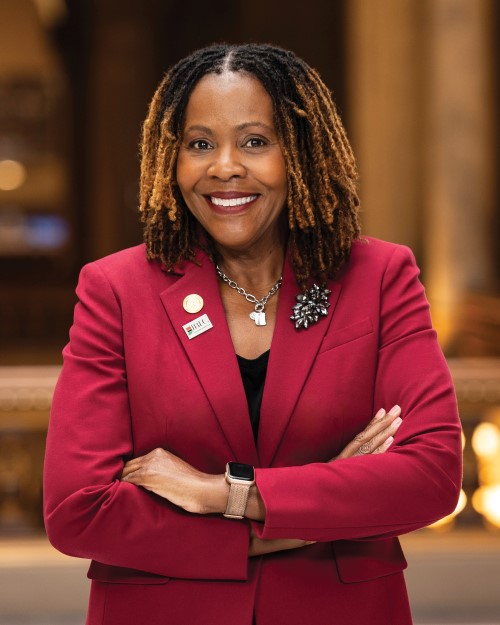
Rep. Robin Shackleford
Sponsored bills
Specifies that an individual's incarceration, hospitalization, or other temporary cessation in substance or chemical use may not be used as a factor in determining the individual's eligibility for coverage in: (1) a state employee health care plan; (2) Medicaid; (3) the healthy Indiana plan; (4) a policy of accident and sickness insurance; or (5) a health maintenance health care contract. Requires an opioid treatment program to: (1) provide a patient of the facility appropriate referrals for continuing care before releasing the patient from care by the facility; and (2) counsel female patients concerning the effects of the program treatment if the female is or becomes pregnant and provide to the patient birth control if requested by the patient. Requires the division of mental health and addiction (division) to annually perform an audit of 20% of an opioid treatment program facility's patient plans to ensure compliance with federal and state laws and regulations. Requires the division to establish a mental health and addiction program to reduce the stigma of mental illness and addiction. Requires hospitals to establish emergency room treatment protocols concerning treatment of a patient who is overdosing, has been provided an overdose intervention drug, or is otherwise identified as having a substance use disorder.
Establishes the comprehensive student support program (program) for the purposes of: (1) funding the formation and staffing of school based and district level comprehensive student support teams; (2) improving staffing ratios for student support personnel; (3) supporting the creation, expansion, and work of multidisciplinary school teams to address the school environment, school safety, school improvement, and crisis intervention and emergency preparedness; and (4) professional development for student support personnel. Establishes the comprehensive student support program state board (board). Provides that the board administers the program. Establishes the comprehensive student support program fund for the purpose of funding the program, and annually appropriates to the fund $1,000,000 from cigarette tax revenue, registration fees, fines, and penalties deposited in the state general fund.
Establishes the healthy food incubator program (program) and healthy food incubator fund (fund) under the administration of the Indiana housing and community development authority (IHCDA). Provides that the purpose of the fund is to provide financing in the form of loans or grants for projects that increase the availability of fresh and nutritious food in underserved communities. Defines an "underserved community" as a census tract determined to be an area with low supermarket access: (1) by the United States Department of Agriculture; or (2) as identified through a methodology used by another healthy food initiative. Provides that the IHCDA may contract with one or more nonprofit organizations or community development financial institutions to administer the program through a public-private partnership. Provides that an applicant for a grant or a loan under the program must: (1) demonstrate the capacity to successfully implement the project and the ability to repay the loan; and (2) agree to satisfy certain conditions. Requires the IHCDA to monitor projects receiving financing under the program and submit a report annually to the legislative council that includes the number and types of jobs created, and the health initiatives associated with the program. Continuously appropriates money in the fund. Makes an appropriation to the fund.
Requires a director of a nonprofit organization that works to prevent domestic violence or assists victims of domestic violence who is convicted of a crime of domestic violence to report the conviction to: (1) the executive director or the president of the nonprofit organization; and (2) every member of the board of directors of the nonprofit organization. Provides a sentencing enhancement if a person commits an act that resulted in the death of a police officer while the police officer was investigating a crime of domestic violence or responding to a domestic violence complaint. Requires each school to provide a curriculum for males and females starting in grade 5 regarding domestic violence, controlling behaviors, abuse, and dating etiquette.
Requires the medical licensing board of Indiana to adopt rules requiring a physician and a physician assistant who apply for a license or renewal to complete continuing education addressing the topic of implicit bias. Requires the Indiana state board of nursing to adopt rules requiring a nurse who applies for a license or renewal to complete continuing education addressing the topic of implicit bias. Establishes certain requirements for an implicit bias continuing education course. Provides that the Indiana professional licensing agency must maintain on the agency's website a schedule of or link to implicit bias continuing education courses that are available.
Makes an appropriation of available federal funds to the office of small business and entrepreneurship for purposes related to minority owned small businesses.
Provides that an order for protection issued ex parte or upon notice and a hearing, or a modification of an order for protection issued ex parte or upon notice and a hearing, is effective: (1) for two years after the date of issuance; or (2) indefinitely after the date of issuance if the respondent is a sex or violent offender and is required to register as a lifetime sex or violent offender and the petitioner was the victim of the crime that resulted in the requirement that the respondent register as a lifetime sex or violent offender. Requires a respondent who is subject to an indefinite order for protection to request a hearing in objection to the order of protection within 30 days of the order being issued. Allows any party to request a hearing on a two year order for protection at any time. Provides that a person may only request one judicial review hearing on a protection order.
Repeals the statute specifying Medicaid eligibility for qualified pregnant women. Increases the Medicaid income eligibility requirements for pregnant women. Removes the Medicaid limitation for pregnant women of medical assistance coverage only for pregnancy related services. Provides that the extension of postpartum Medicaid coverage for pregnant women shall be determined by the office of the secretary of family and social services and must be at least 60 days but not more than 12 months beginning on the last day of the pregnancy.
Consolidates Medicaid telehealth language. Provides that "health care services" does not include certain case management services, care management services, service coordination services, or care coordination services for purposes of telehealth. Adds occupational therapist assistants, school psychologists, specified developmental therapists, peers, clinical fellows, students and graduates of certain professional programs, physical therapist assistants, and certain community mental health center providers to the definition of "practitioner" for purposes of practicing telehealth. Allows behavior health analysts to temporarily perform telehealth during the time when the professional licensing agency is preparing to implement licensure for the profession.