

Authorizes a county fiscal body to adopt an ordinance to provide a credit against property tax liability for qualified individuals. Defines a "qualified individual" for purposes of the credit. Provides that the ordinance may designate: (1) all of the territory of the county; or (2) one or more specific geographic territories within the county; as a neighborhood enhancement district in which qualified individuals may apply for the credit. Provides that the amount of the credit in a particular year is equal to the amount by which an individual's property tax liability increases by more than the percentage of increase specified by the county fiscal body from the prior year. Provides that the credit does not affect the allocation of taxes to a referendum fund. Requires a qualified individual who desires to claim the credit to file a certified statement with the county auditor. Provides that the county auditor shall apply the credit in succeeding years after the certified statement is filed unless the auditor determines that the individual is no longer eligible for the credit or the county fiscal body rescinds the ordinance. Provides a penalty for wrongly receiving the credit that is the same as the penalty for wrongly receiving the homestead standard deduction. Provides that an individual may not receive both a county option circuit breaker tax credit and an over 65 property tax credit in the same year. Provides that an ordinance must specify that the credit does not apply for property taxes first due and payable after December 31, 2027. Sunsets the county option on January 1, 2028.
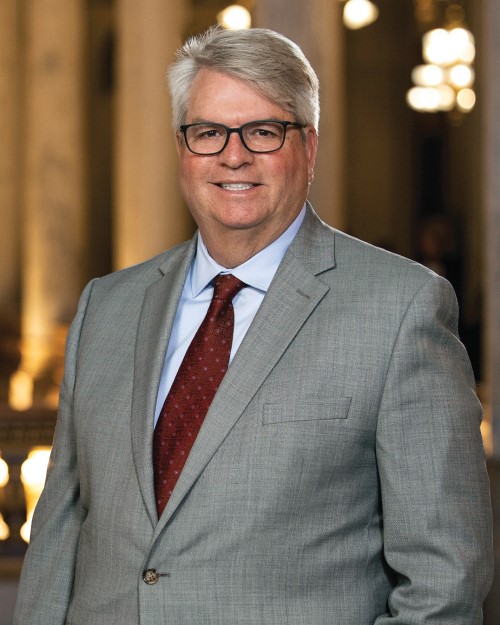
Rep. Phil GiaQuinta
Sponsored bills
A CONCURRENT RESOLUTION celebrating the achievements and contributions of Hoosier environmental leader Tim Maloney on his retirement.
A CONCURRENT RESOLUTION urging the Indiana Department of Transportation to rename the bridge on State Highway 27 over I-70 as the "Officer Seara Burton Memorial Bridge".
Specifies that the distribution of funds from an opioid litigation settlement is subject to a bankruptcy court order or bankruptcy settlement. Provides that an annual distribution of less than $5,000 payable to a city or town pursuant to an opioid litigation settlement agreement must be paid instead to the county. (Under current law, the threshold is $1,000.) Specifies that amounts owed by the state for attorney's fees and costs incurred in connection with opioid litigation must be deducted from the opioid settlement distribution payable to the state. Permits a city, county, or town that receives an opioid litigation settlement payment to transfer all or part of the payment to another city, county, or town to be used for the benefit of both communities. Permits a city, county, or town that receives an opioid litigation distribution to sell the right to receive the distribution. Excludes from the agency settlement fund any amount owed for outside counsel attorney's fees, costs, or expenses.
Recognizing the efforts of Humane Fort Wayne and Humane Indiana in Munster to help rescue beagles from animal testing.
Allows a municipality to create an outdoor refreshment area (area) in which persons may consume alcoholic beverages purchased within the area with the approval of the alcohol and tobacco commission (commission). Allows minors within the area. Prohibits an area located within 200 feet of a school or church unless the school or church does not object. Makes it a Class C misdemeanor for a person to do any of the following: (1) Carry an alcoholic beverage into an area that was not purchased from a participating retailer or vendor. (2) Carry an alcoholic beverage into an area without wearing a wristband identification. (3) Carry an alcoholic beverage outside the area. Makes it a Class C misdemeanor for a participating retailer or vendor to: (1) sell a person more than one alcoholic beverage at a time or an alcoholic beverage that exceeds the volume limitations; or (2) allow a person who is not wearing a wristband identification to enter an area with an alcoholic beverage.
Requires the general assembly to establish a commission to draw congressional and legislative districts not later than July 1, 2027. This proposed amendment has not been previously agreed to by a general assembly.
Repeals the provision that requires the county surveyor to make a survey of certain land, if an assessor and a landowner fail to agree on the amount of land included in assessments involving rights-of-way, levees, and public drainage ditches. Provides that a survey must be done if an assessor and a landowner fail to agree on the amount of land in those circumstances, and: (1) requires the landowner to provide written notice of the disagreement to the assessor; (2) requires the survey to be completed within six months from the date of the landowner's notice; (3) allows the landowner to elect to choose the surveyor to conduct the survey (if the landowner does not choose a surveyor, the county surveyor is required to conduct the survey); and (4) specifies the party who is required to pay for the survey. Provides that the attorney general, upon written request of a county assessor, may authorize the chief administrative officer of the office of judicial administration to hire private counsel to represent the county assessor: (1) in a judicial review initiated by the county assessor for review of a final determination of the Indiana board of tax review regarding the assessment or exemption of tangible property; and (2) in a judicial review seeking relief from the tax court to establish that the Indiana board of tax review rendered a decision that was: (A) an abuse of discretion; (B) arbitrary and capricious; (C) contrary to substantial or reliable evidence; or (D) contrary to law (the office of the attorney general may not represent the assessor in these actions under current law).
A CONCURRENT RESOLUTION to convene a Joint Session of the 123rd General Assembly of the State of Indiana.
A CONCURRENT RESOLUTION to convene a Joint Session of the 123rd General Assembly of the State of Indiana.