Defending Our Defenders Act This bill establishes federal criminal offenses involving the murder of federal, state, or local law enforcement officers. Violators are subject to life in prison or death. The bill sets forth aggravating factors (e.g., intent to ambush or prior history of promoting violence against a law enforcement officer) to be considered in determining whether to impose the death penalty.
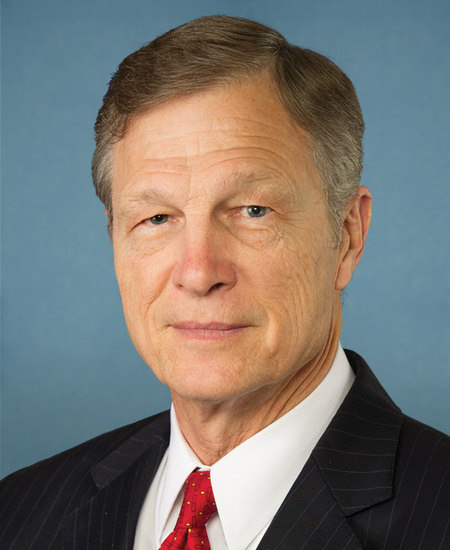
Rep. Brian Babin
Sponsored bills
Border Visibility and Security Act This bill directs the Department of Homeland Security (DHS) to install surveillance technology and take other actions with respect to the U.S.-Mexico border. DHS shall deploy the most practical and effective technology available to achieve situational awareness and operational control of the border. Such technology may include radar surveillance systems, tunnel detection technology, and unmanned aerial vehicles. DHS is authorized to waive legal requirements as necessary in order to implement the necessary surveillance technology along the border. DHS shall also (1) construct a navigable road along at least 700 miles of the southwest border, (2) permanently eradicate certain foliage that grows along the Rio Grande river, and (3) report to Congress a comprehensive strategy about the barriers and technologies needed to secure operational control along the border. Drug cartel funds that have been criminally forfeited to the U.S. government shall be reserved for security measures along the U.S.-Mexico border.
Iran Sanctions Relief Review Act of 2021 This bill restricts the President's authority to unilaterally undertake certain actions with respect to Iran and increases congressional oversight of those actions. Specifically, the President must report to Congress before terminating or waiving sanctions related to Iran or taking a licensing action that significantly alters U.S. foreign policy with respect to Iran. Each report must (1) describe the proposed action and its rationale, and (2) indicate whether or not the action is intended to significantly alter foreign policy concerning Iran. If the intention is to alter that policy, the report must provide additional information about the policy objectives and anticipated effects of the action. After the President submits a report, the bill provides Congress with a 30-day period to review it; this period is extended to 60 days for reports submitted between July 10 and September 7. During this period, Congress may enact a joint resolution approving or disapproving the action. During the review period, the President may not take the action unless Congress passes a joint resolution of approval; if Congress enacts a joint resolution of disapproval, the bill prohibits the President from taking the action. The bill also outlines procedures for the introduction and consideration of these types of joint resolutions.
State Border Security Reimbursement Act of 2021 This bill requires the federal government to reimburse eligible states for their border security expenses. To be eligible, a state must have expended more than $2.5 billion on border security and enforcement in the 10 years before this bill's enactment. If such a state provides an accounting of all of its nonfederally funded border security expenses any time up to 180 days after this bill's enactment, the federal government shall reimburse the full amount.
Stop Forced Organ Harvesting Act of 2021 This bill establishes specified measures to combat forced organ harvesting and the international trafficking in persons for the purpose of removing their organs. These measures include (1) establishing property-blocking and visa-blocking sanctions, (2) prohibiting exports of certain surgery devices to entities that are identified as being responsible for forced organ harvesting or related human trafficking, and (3) requiring the Department of State to report on these practices.
Foreign Influence Transparency Act This bill addresses foreign influence in higher education and in certain other academic, religious, and artistic pursuits. Current law exempts from foreign agent registration requirements a person engaging in activities in furtherance of religious, scholastic, academic, or scientific pursuits or of the fine arts. The bill specifies that this exemption applies only to those activities that do not promote the political agenda of a foreign government. Under current law, an institution of higher education (IHE) must disclose to the Department of Education (ED) a gift or contract that is from a foreign source and is valued at $250,000 or more, considered alone or in combination with all other gifts from or contracts with the foreign source. The bill instead requires an IHE to disclose such a gift or contract that is valued at $50,000 or more, considered alone or in combination with all other gifts or contracts. An IHE must include in its disclosure report the contents of any such contract and make the contents available for public disclosure. Additionally, an IHE that enters into an agreement with a Confucius Institute (i.e., a cultural institute directly or indirectly funded by the Chinese government) must immediately make available the full text of the agreement to the public, ED, and Congress. Finally, the bill prohibits an IHE that does not comply with these disclosure requirements from enrolling foreign students under the Student and Exchange Visitor Program.

Sarah's Law This bill requires U.S. Immigration and Customs Enforcement (ICE) to detain an alien who is unlawfully present in the United States and has been charged with a crime that resulted in the death or serious bodily injury of another person. ICE shall make reasonable efforts to obtain information about the identity of any victims of the crimes for which such alien was charged or convicted. ICE shall provide the victim, or a relative or guardian of a deceased victim, with information about such alien, including name, date of birth, nationality, immigration status, criminal history, and a description of any related removal efforts.
Timely Access to Cancer Treatment Act of 2021 or the TACT Act of 2021 This bill requires insurance plans to authorize, and pharmacies contracted with the plans to dispense, anti-cancer oral medications within certain time frames. Specifically, within 24 hours after receiving a prescription, a pharmacy must inform the health care provider and plan enrollee whether it will dispense the medication. If the pharmacy will dispense the medication, it must do so within 72 hours after receiving the prescription. If the pharmacy is unable to dispense the medication, it must notify in writing the prescribing health care provider, the insurance plan, and the plan enrollee. A plan that requires prior authorization for anti-cancer oral medication must make that determination within 72 hours after receiving the request for authorization. Further, if a pharmacy provides notification that it is unable to dispense the medication, the health insurance plan must allow the enrollee to select a different pharmacy to dispense the medication, even if that pharmacy does not have a contract with the plan. In such a case, the plan may not require additional prior authorization or cost sharing. The Government Accountability Office must evaluate and report on the implementation of these requirements.
This resolution calls on the Office for Civil Rights within the Department of Education and state attorneys general to assist elementary and secondary schools in complying with existing civil rights laws and investigate and enforce such laws. In addition, the resolution condemns the practice of requiring teachers to receive education in critical race theory as a condition of certification.
Contents of Our Character Act of 2021 This bill prohibits agencies from using federal funds to conduct or promote specified workplace training related to race or sex.