

Maddy summaryHRES 772 is a symbolic House resolution expressing support for National Public Lands Day (observed September 27, 2025). It encourages U.S. citizens to visit public lands on this fee-free day, recognizing their cultural, spiritual, and economic value. The resolution cites existing statistics on public lands' economic contributions (e.g., $252 billion in economic output from Bureau of Land Management lands in 2024) but does not create new policies or alter fees. As a procedural resolution, it has no binding effect and serves only to promote awareness of existing public land access.
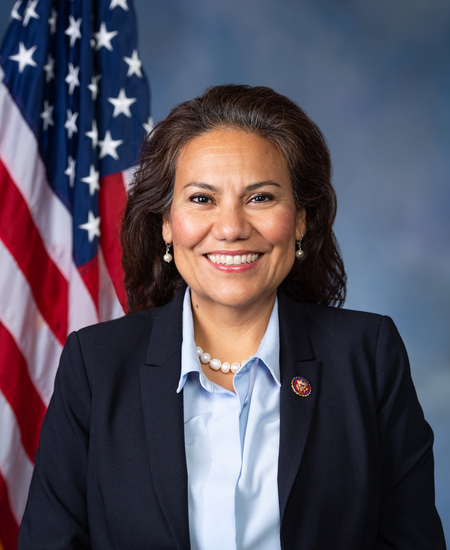
Rep. Veronica Escobar
Sponsored bills
Maddy summaryThis bill prevents federal agencies from terminating employees during a government shutdown caused by a lapse in discretionary funding. It prohibits removals of civil service employees at any agency affected by a funding gap, and if an employee is wrongfully removed, they can return to their job with back pay once funding resumes. The law directly protects all federal employees covered by the civil service system during shutdowns. It applies automatically to any funding lapse, requiring automatic reinstatement without needing separate legal action.
Maddy summaryThis bill allows individuals applying for government benefits to deduct certain insurance costs from their reported income when determining eligibility. It covers auto insurance for vehicle owners, home/renter insurance, and flood insurance for primary residences. These deductions apply to both federal programs (like SNAP or Medicaid) and state/local programs receiving federal funding. The change directly affects people seeking assistance by reducing their counted income for benefit calculations.
Maddy summaryThe SAVES Act (HR 2605) creates a 5-year pilot program where the Department of Veterans Affairs (VA) awards competitive grants to nonprofit organizations to provide service dogs to veterans with specific disabilities. It directly affects veterans with covered conditions like blindness, mobility impairments, PTSD, traumatic brain injury, or other disabilities deemed appropriate for service dog assistance by the VA. Key provisions include: grants capped at $2 million per nonprofit (with $10 million annually authorized), no fees charged to veterans, VA-provided lifetime veterinary insurance for the dogs, and requirements for nonprofits to train veterans and maintain humane animal standards. The program aims to expand access to service dogs as a support tool for veterans managing qualifying disabilities.
Maddy summaryThis resolution (HRES 757) is a symbolic gesture by the U.S. House of Representatives to support designating September 22, 2025, as "National Hispanic Nurses Day" and to formally recognize the National Association of Hispanic Nurses (NAHN) as the leading organization representing Hispanic nurses. It does not create new laws or policies but expresses official congressional support for honoring Hispanic nurses' contributions to healthcare equity and cultural competence. The resolution acknowledges NAHN's role since 1975 in advancing health outcomes for Hispanic communities and reducing disparities. As a non-binding resolution, it has no direct legal effect but aims to raise public awareness of Hispanic nurses' work.
Maddy summaryHRES 761 is a symbolic House resolution expressing support for designating September 23, 2025 (Bruce Springsteen’s birthday) as "Bruce Springsteen Day" to honor his musical contributions. It does not create new laws or affect any individuals or groups - it simply recognizes his impact on American music, New Jersey culture, and his work highlighting working-class experiences. The resolution cites his career achievements, including 21 studio albums, 20 Grammy Awards, and his role in addressing social themes through music. This is a non-binding gesture of appreciation, not a policy change.
Maddy summaryThis resolution condemns the use of federal regulatory agencies (like the FCC) or lawsuits to suppress lawful speech critical of political parties or the President, specifically referencing concerns about tactics mirroring authoritarian practices. It does not create new laws but formally warns that such actions undermine First Amendment protections and democratic norms. The resolution directly affects media organizations, journalists, and public discourse by calling on government agencies to avoid using their power for political retaliation. It reaffirms the House’s commitment to protecting free expression and urges officials to refrain from pressuring media to silence criticism.
Maddy summaryHRES 734 is a symbolic resolution designating the third week of September as "Latino Conservation Week." It recognizes the Latino community's longstanding engagement in outdoor recreation and conservation activities, such as hiking, stewardship events, and environmental justice efforts on public lands. The resolution affirms that including Latino voices strengthens public lands protection and climate resilience, highlighting their role as a growing force in the outdoor economy. It does not create new laws or funding but formally supports the annual observance initiated by the Hispanic Access Foundation.
Maddy summaryHRES 746 is a non-binding resolution passed by the U.S. House of Representatives condemning all political violence - including attacks on elected officials, candidates, and public figures - and rejecting rhetoric that dehumanizes opponents. It specifically urges law enforcement to investigate and prosecute such violence, calls on public officials and media to avoid inflammatory language, and references recent incidents like the 2025 assassination of activist Charlie Kirk and targeted shootings of Minnesota legislators. The resolution does not create new laws but formally expresses the House’s commitment to protecting public servants and promoting peaceful political discourse. It directly affects the House’s public stance and serves as a call to action for officials, media, and communities to foster civil engagement.
Maddy summaryThe Tyler Clementi Higher Education Anti-Harassment Act of 2025 requires U.S. colleges and universities participating in federal financial aid programs to create and distribute clear anti-harassment policies covering harassment based on race, color, national origin, sex (including sexual orientation and gender identity), disability, or religion. These policies must explicitly prohibit harassment in all settings - including online, on campus, off-campus housing, and during school-sponsored activities - and outline reporting procedures and support services for victims. The bill also establishes a $50 million annual grant program to fund schools developing prevention programs, victim support services, or staff/student training on recognizing and addressing harassment. Grants are competitive, require annual reporting on effectiveness, and must be used to improve existing efforts without replacing existing civil rights laws like Title IX.