

Supporting State and Local Leaders Act This bill repeals the prohibition against granting state and local governments a tax credit for paid sick and paid family and medical leave.
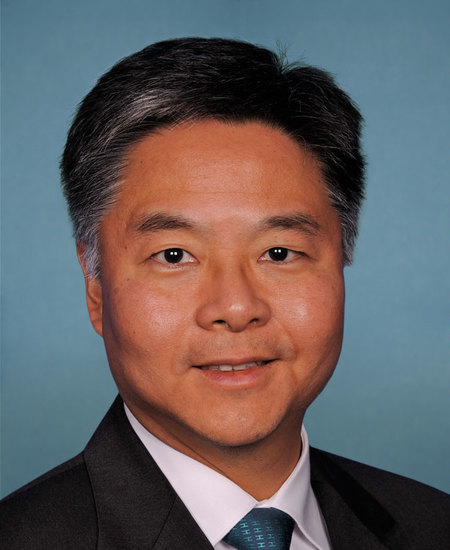
Rep. Ted Lieu
Sponsored bills
Designates the facility of the United States Postal Service located at 24930 Washington Avenue in Murrieta, California, as the "Riverside County Iraq and Afghanistan Veterans Memorial Post Office."
Family and Medical Insurance Leave Act or the FAMILY Act This bill entitles every employee to a family and medical leave insurance (FMLI) monthly benefit payment of two-thirds of the employee's regular pay, limited to a maximum of $4,000, for not more than 60 days of qualified caregiving. The bill establishes the Office of Paid Family and Medical Leave within the Social Security Administration to administer the FMLI program. An FMLI benefit payment must be coordinated with any periodic benefits received under a state or local temporary disability insurance or family leave program. The bill imposes a tax on employers, employees, and self-employed individuals to fund FMLI benefits. It also establishes the Federal Family and Medical Leave Insurance Trust Fund to hold tax revenues.
Scientific Integrity Act This bill revises provisions regarding the release of scientific research results by federal agencies. Each agency that funds, conducts, or oversees scientific research must (1) adopt and enforce a scientific integrity policy that includes requirements such as that scientific conclusions are not based on political considerations, and (2) submit such policy to the Office of Science and Technology Policy (OSTP) for approval. Each agency must make such policy available to the public and submit such policy to Congress. Agencies and the OSTP must periodically review the policies. The Government Accountability Office shall review implementation of the policies. Each agency shall (1) appoint a Scientific Integrity Officer, (2) establish a process for dispute resolution consistent with the scientific integrity policy, and (3) establish a specified training program for current and new employees.
Safe And Friendly for the Environment Streets Act or the SAFE Streets Act This bill revises the Highway Safety Improvement Program to create special rules for vulnerable road users. The bill defines vulnerable road user as a nonmotorist such as a pedestrian, pedalcylcist, bicyclist, other cyclist, or person on personal conveyance. Specifically, the bill requires states and metropolitan planning organizations (MPOs) with above the median rate of vulnerable road user fatalities and serious injuries to dedicate at least 75% of funds under the program for projects to improve safety for such users, and states and MPOs to create vulnerable road user safety assessments that include locations and corridors where serious injuries and fatalities occur and strategies to reduce safety risks for such users in the corridors.
This resolution identifies women's cardiovascular health as an important health care issue and supports gender-specific cardiovascular health research, prevention, and treatment.
Child and Animal Abuse Detection and Reporting Act This bill requires the Children’s Bureau of the Administration for Children and Families to disseminate information through the National Clearinghouse on Child Abuse and Neglect Information about the incidence of cases of child abuse that involve abuse to animals.
Keep Our Promise to America's Children and Teachers Act or the Keep Our PACT Act This bill provides funding through FY2031 for grant programs operated by local educational agencies to provide supplementary educational and related services to low-achieving students and other students who attend elementary and secondary schools with relatively high concentrations of students from low-income families. Additionally, the bill permanently reauthorizes the grant program to assist states and outlying areas in providing special education and related services to children with disabilities.
Temporary Reciprocity to Ensure Access to Treatment Act or the TREAT Act This bill temporarily authorizes the interstate provision of in-person and telehealth services. This authorization applies during, and for at least 180 days after, the COVID-19 (i.e., coronavirus disease 2019) emergency. Specifically, subject to scope of practice and other requirements, a health care professional may provide health services in any U.S. jurisdiction based on that individual's authorization to practice in any one state or territory. The bill also provides certain related powers to health care professional regulatory bodies, such as medical boards. Specifically, a regulatory body may investigate and take disciplinary actions against a professional who provides services pursuant to this bill to a patient in that body's jurisdiction.
CARES Windfall for the Wealthiest Repeal Act This bill restores and makes permanent the limitation on excess businesses losses of noncorporate taxpayers. It also allows taxpayers a carryback of their net operating losses arising in 2019 and 2020.