

Amends the Military Veterans Assistance Act. Expands the Act to allow for the formation of multi-county Veterans Assistance Commissions. Provides that veteran service organizations located in 2 or more adjacent counties having a population of 60,000 or less may enter into an agreement to come together and jointly form a multi-county Veterans Assistance Commission to serve the adjacent counties in accordance with the Act. Provides that a multi-county Veterans Assistance Commission may also be formed under an agreement between an existing county Veterans Assistance Commission and a veteran service organization located in an adjacent county that is without a veterans assistance commission and has a population of 60,000 or less. Requires an agreement to form and maintain a multi-county Veterans Assistance Commission to set forth: (i) the distribution of funding with respect to each member county; (ii) the location of the Commission's office; (iii) the type of services provided; (iv) the superintendent selection or appointment process; (v) Commission rules and policies; and (vi) the composition of delegates and alternates on the Commission. Provides that multi-county Veterans Assistance Commissions shall have the same powers and duties under the Act as Veterans Assistance Commissions that serve one county. Makes corresponding changes in the Counties Code, the Illinois Public Aid Code, the Drug Court Treatment Act, the Veterans and Servicemembers Court Treatment Act, and the Mental Health Court Treatment Act. Effective immediately.
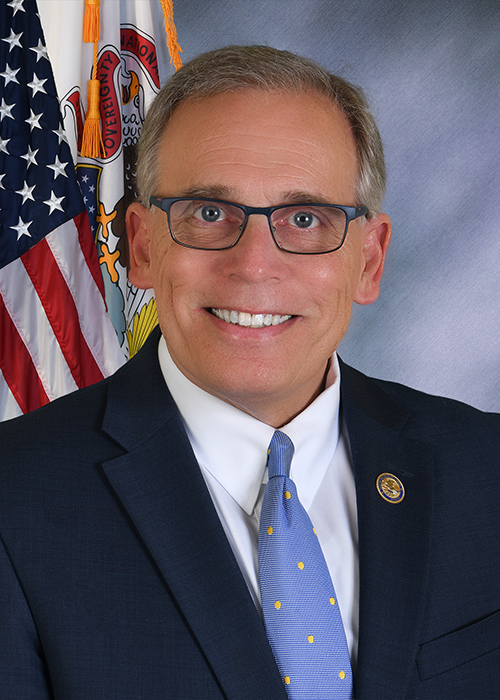
Sen. Dave Syverson
Sponsored bills
Creates the Reducing Barriers to Start Act. Beginning January 1, 2026, this State shall encourage the elimination of all first-year business fees relating to any license or registration for any new business or person establishing a new business, including home-based businesses, whose principal place of business is in this State.
Amends the Business Corporation Act of 1983. Provides that, in the case of a domestic or foreign corporation, no payment is required for a franchise tax that would have been due and payable on and after January 1, 2029. Provides that all amounts remaining in the Corporate Franchise Tax Refund Fund shall be transferred to the General Revenue Fund no later than December 31, 2030. Makes changes in provisions concerning the statute of limitations. Repeals provisions concerning franchise taxes payable by domestic and foreign corporations on January 1, 2030. Effective immediately.
Amends the Nursing Home Care Act and the Assisted Living and Shared Housing Act. Requires the Department of Public Health to hold semiannual joint training sessions for surveyors, nursing home providers, and assisted living establishment providers. Provides that the Department shall include the State long-term care ombudsman, or the State long-term care ombudsman's designee, and representatives of each nursing home provider association and assisted living provider association in the State in the planning process to create the topics and content of the joint training sessions as well as the coordination and presentations for the joint training sessions. Provides that, at least annually, a joint training session shall include, but not be limited to, regional citation patterns relating to complaints, standards, and outcomes in the nursing home and assisted living survey process. Requires the Department to develop standardized training for establishments to prevent common citations in the assisted living survey process.
Maddy summarySB 3140 increases penalties for violating court-issued orders of protection by upgrading the offense to a Class 3 felony (from Class 4) for individuals with prior convictions for domestic battery, violation of protection orders, or related offenses like stalking or aggravated battery against family members. This change directly affects repeat offenders who disregard court orders designed to protect victims of domestic violence. The bill mandates a minimum 24-hour jail term for second or subsequent violations, in addition to potential fines or restitution. It applies to violations occurring after the offender was served notice of the order or gained actual knowledge of its terms.
Amends the Code of Criminal Procedure of 1963. Provides that notwithstanding the pretrial release and denial of pretrial release provisions of the Code, if the defendant is charged with any of the following offenses, then the burden is on the defendant to show by clear and convincing evidence that the defendant's pretrial release does not pose a real and present threat to the safety of any person or persons or the community, based on the specific articulable facts of the case: (1) a violation of an order of protection issued under the Code or the Illinois Domestic Violence Act of 1986, a stalking no contact order under the Stalking No Contact Order Act, or of a civil no contact order under the Civil No Contact Order Act; or (2) domestic battery or aggravated domestic battery under the Criminal Code of 2012.
Amends the Department of Commerce and Economic Opportunity Law of the Civil Administrative Code of Illinois. Repeals provisions concerning the Energy Transition Assistance Fund. Amends the Illinois Power Agency Act. Removes provisions concerning the renewable portfolio standard. Amends the Public Utilities Revenue Act. Repeals provisions concerning the imposition of tax on invested capital and on distribution of electricity and provisions concerning annual return, collection, and payment. Repeals the Electricity Excise Tax Law. Amends the Public Utilities Act. In provisions concerning nondiscrimination, removes the authority of the Illinois Commerce Commission to permit or require electric and natural gas utilities to file a tariff establishing low-income discount rates after the completion of the Commission's study assessing the necessity, design, and implementation of low-income discount rates. Provides that no public utilities in the State shall charge any fees or surcharges for energy storage programs on a customer's electric bill. Repeals provisions concerning energy efficiency and demand-response measures; an energy efficiency analysis; and the Energy Transition Assistance Fund.
Amends the School Code. Requires a school board to create a policy that prohibits all school personnel from using a showering or bathing facility accessible to a student during school hours. Sets forth provisions concerning policy requirements and school personnel duties and prohibitions. Provides that school personnel that violate the policy may be subject to corrective action. Requires the school board to review the policy annually and update the policy as needed to comply with any changes to the law, best practices, or feedback from school personnel.
Amends the Department of Professional Regulation Law of the Civil Administrative Code of Illinois. Provides that, by no later than January 1, 2027, the Department of Financial and Professional Regulation shall develop, obtain, arrange for, or contract with a vendor to provide an automated continuing education tracking system that can be used by the Department to track compliance with any continuing education requirements for the renewal of a license. Provides that the amendatory Act applies to an application for renewal of a license that is received by the Department on or after January 1, 2027. Effective immediately.
Amends the Counties Code. In provisions concerning energy storage systems, provides that the farmland drainage plan that a facility owner must file with a county shall include, among other things, plans to repair any subsurface drainage affected during construction or deconstruction using procedures outlined in the agricultural impact mitigation agreement (rather than outlined in the decommissioning plan) and procedures for the repair and restoration of surface drainage affected during construction or deconstruction. Provides that a county shall (rather than may) require a facility owner to provide a decommissioning plan to the county. Makes changes to the requirements of a decommissioning plan. Provides that a county shall (rather than may) require the facility owner to submit to the county (i) a commercial operation a commissioning report meeting specified requirements of specified publications of the National Fire Protection Association; (ii) a hazard mitigation analysis meeting specified requirements of specified publications of the National Fire Protection Association; (iii) an emergency operations plan meeting specified requirements of specified publications of the National Fire Protection Association; and (iv) a warning that complies with specified publications of the National Fire Protection Association. Provides that the energy storage system owner shall enter into one agricultural impact mitigation agreement for each energy storage system. Requires the agricultural impact mitigation agreement for an energy storage system to include specified plans. Requires a commercial renewable energy facility owner to make available a copy of the signed agricultural impact mitigation agreement at the site of the commercial renewable energy facility during any construction or deconstruction activities. Makes other changes.