Maddy summaryThis Senate resolution honors Sunil Puri, a prominent Illinois businessman and philanthropist who passed away on March 8, 2026. The bill formally acknowledges his contributions to the state, including founding the First Midwest Group, establishing numerous community facilities, and supporting U.S.-India relations. It expresses the Senate's condolences to his family and directs that a copy of the resolution be presented to them as a gesture of sympathy.
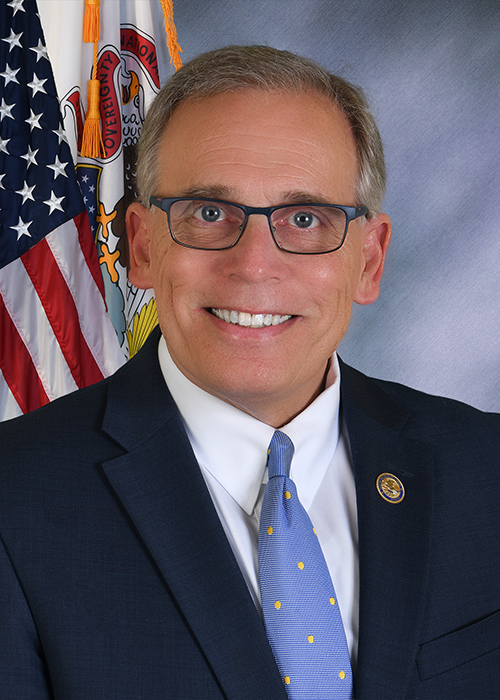
Sen. Dave Syverson
Sponsored bills
Amends the Illinois Municipal Code. Provides that the corporate authorities of a municipality may license and regulate all commercial operations within the municipality's boundaries, whether for profit or not for profit, but may not impose any tax upon their operations except as otherwise authorized by law. Limits the definition of "commercial operations" to exclude agritourism operations, agricultural properties, agribusinesses, agritourism activities, agricultural experiences, and pollution control facilities.
Amends the Civil No Contact Order Act, the Illinois Domestic Violence Act of 1986, and the Protective Orders Article of the Code of Criminal Procedure of 1963. Provides that the court is encouraged to impose (i) a minimum penalty of 48 (rather than 24) hours imprisonment for a first violation of a civil no contact order, an order of protection, or a protective order and (ii) a minimum penalty of 96 (rather than 48) hours imprisonment for a second or subsequent violation of a civil no contact order, an order of protection, or a protective order.
Amends the Criminal Code of 2012. Provides that violation of an order of protection is a Class 4 felony if the defendant has any prior conviction of violation of a civil no contact order, violation of a stalking no contact order, or any prior conviction under the law of another jurisdiction for an offense that could be charged in the State as violation of a civil no contact order or violation of a stalking no contact order. Provides that violation of a civil no contact order is a Class 4 felony if the defendant has any prior conviction for violation of an order of protection, violation of a civil no contact order, or violation of a stalking no contact order, or any prior conviction under the law of another jurisdiction for an offense that could be charged in the State as a violation of an order of protection, violation of a civil no contact order, or violation of a stalking no contact order. Provides that violation of a stalking no contact order is a Class 4 felony if the defendant has any prior conviction under the Code for a violation of an order of protection, violation of a stalking no contact order, or violation of a civil no contact order, or any prior conviction under the law of another jurisdiction for an offense that could be charged in the State as a violation of an order of protection, violation of a civil no contact order, or violation of a stalking no contact order.
Amends the Governmental Account Audit Act. Provides that, beginning in fiscal year 2027, any governmental unit receiving revenue of less than $1,500,000 (rather than $850,000) in the immediately preceding fiscal year shall, in lieu of causing an annual audit of the accounts of the unit to be made, either (i) cause an audit of the accounts of the unit to be made once every 4 years and file with the Comptroller an annual financial report containing information required by the Comptroller or (ii) file with the Comptroller an annual financial report containing information required by the Comptroller, a copy of which has been provided to each member of that governmental unit's board of elected officials, presented either in person or by a live phone or web connection during a public meeting, and approved by a 3/5 majority vote. Provides that, beginning in fiscal year 2028, governmental units receiving revenue of $1,500,000 or more (rather than $850,000) in the immediately preceding fiscal year shall, in addition to complying with the requirements for audits and audit reports, file with the Comptroller the financial report and immediately make one copy of the audit report and one copy of the financial report a part of its public record as required by the Act. Makes conforming changes. Effective immediately.

Amends the Criminal Code of 2012. Increases by one class, the penalties for trafficking in persons, involuntary servitude, and involuntary sexual servitude of a minor. Provides that if the penalty is a Class X felony, provides that the penalty is a Class X felony for which the person shall be sentenced to a term of imprisonment of not less than 9 years and not exceeding 45 years.
Amends the Criminal Code of 2012. Provides that a person charged with involuntary sexual servitude of a minor or trafficking in persons if the victim is under 18 years of age shall not be permitted to plead down to lesser offenses. Provides that no person charged with grooming shall be permitted to plead down to lesser offenses. Provides that prosecutors are prohibited from offering plea bargains to lesser offenses to those individuals charged with grooming. Provides that it is a Class 4 felony for a child sex offender to knowingly operate, manage, be employed by, volunteer at, be associated with, or knowingly be present at any facility providing entertainment exclusively directed toward persons under the age of 18.
Amends the Sex Offender Registration Act. Provides that a registrable sex offense includes the offense of unauthorized video recording and live video transmission, when the victim is a person under 18 years of age, the defendant is not a parent of the victim, the offense was sexually motivated as defined in the Sex Offender Evaluation and Treatment Act, and the offense was committed on or after the effective date of the amendatory Act.
Amends the Illinois Vehicle Code. Provides that the $15 tax imposed on the privilege of using any motor vehicle acquired by gift, transfer, or purchase also applies to grandparents and grandchildren.
Maddy summarySB 3793 reenacts and makes permanent the Invest in Kids Act, allowing Illinois taxpayers to claim a state income tax credit for contributions to scholarship granting organizations (SGOs). These SGOs provide scholarships to eligible students from Illinois households with income at or below 300% of the federal poverty level (initially) and 400% after receiving a scholarship, covering necessary school costs and fees at qualified non-public schools. The scholarships are available for students attending non-public schools, including technical academies with approved career and technical education programs. The bill amends the Illinois Income Tax Act to reflect these changes and takes effect immediately.