

Declares April 10, 2026 as Dolores Huerta Day in the State of Illinois in recognition of Dolores Clara Fernandez Huerta's lifelong commitment to justice and her enduring impact on generations of activists and working families. Commends Dolores Huerta for her extraordinary contributions to civil rights, labor rights, gender equity, and social justice. Recognizes her resilience in sharing her story and her commitment to uplifting the experiences of women whose narratives have too often been overlooked.
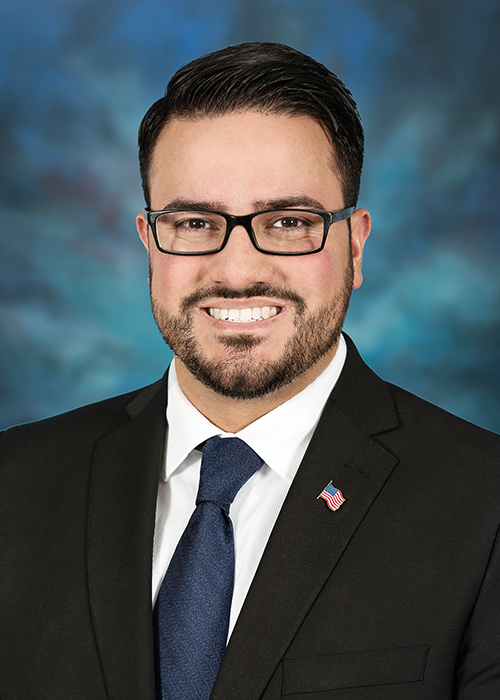
Sen. Omar Aquino
Sponsored bills
Amends the Fair Patient Billing Act. Makes changes to findings and defined terms provisions. Provides that a hospital shall not deny any protection or benefit of the Act on the basis of a patient's citizenship or immigration status or assets or prospective assets. Provides that a patient who inquires about a denial of financial assistance in whole or in part must be permitted to appeal the decision within at least 90 days. Requires a hospital to use only a uniform financial assistance form developed and provided by the Attorney General no later than December 31, 2026. Provides that every hospital bill and every collection notice must notify the patient, in the patient's preferred language, of the availability of hospital financial assistance and charity care. Establishes further provisions concerning hospitals pursuing collection actions; outsourced health care services; patient responsibilities; and applicability of the Act. Amends the Hospital Uninsured Patient Discount Act. Sets forth provisions concerning uninsured patient discounts for specified income levels. Prohibits hospitals from making the availability of a discount under the Act contingent upon the uninsured patient first applying for coverage under public health insurance programs. Provides that patients may not be denied a discount under the Act on the basis of citizenship or immigration status or assets or prospective assets. Makes other changes concerning uninsured patient discounts, outsourcing health care services, and patient responsibilities. Effective immediately.
Maddy summaryHB 228 makes a technical change to the Consumer Legal Funding Act. It amends a section within the Act specifically concerning its short title.
Amends the Medicare-Medicaid Alignment Initiative (MMAI) Nursing Home Residents' Managed Care Rights Law of the Illinois Public Aid Code. Provides that the Article applies to a fully integrated dual eligible special needs plan and any managed care plan for persons who are dually eligible for Medicare and Medicaid. Adds to the definition of "Demonstration Project", a fully integrated dual eligible special needs plan and any managed care plan for persons who are dually eligible for Medicare and Medicaid. Provides that the Department of Healthcare and Family Services shall provide each managed care organization with the quarterly facility-specific nursing component (instead of RUG-IV nursing component) per diem along with any add-ons for enhanced care services, support component per diem, and capital component per diem effective for each nursing home under contract with the managed care organization. Effective immediately.
Creates the Transportation Network Driver Labor Relations Act. Defines "transportation network driver" as an individual who operates a motor vehicle that: (i) is owned, leased, or otherwise authorized for use by the individual; (ii) is not a taxicab or for-hire public passenger vehicle; (iii) is used to provide transportation network company services; and (iv) operates under the license of a transportation network company. Provides that transportation network drivers have the right of self-organization, to form, join, or assist transportation network driver organizations, and to bargain collectively. Sets forth provisions concerning unfair work practices; the prevention of unfair work practices; the designation of bargaining representatives; administrative fees; bargaining, impasse resolution procedures, and final determinations by the Department of Labor; applicability of other labor standards; rulemaking; and public records. Amends the Freedom of Information Act and the Labor Dispute Act to make conforming changes. Effective immediately.
Maddy summarySB 1452 amends Illinois' School Code to allow the Chicago Board of Education to establish compensation for its members through a formal resolution. Currently, board members serve without pay but receive expense reimbursements; this bill would authorize the Board to set salaries or other compensation if it chooses. The change directly affects Chicago Public Schools board members, who would no longer be required to serve without compensation. The bill does not mandate pay but gives the Board the authority to decide whether to provide it. This is a procedural change to the existing law, not a new policy requiring immediate implementation.
Amends the Illinois Income Tax Act. Makes changes to the amount of the child tax credit based on the taxpayer's adjusted gross income. Effective immediately.
Amends the Illinois Insurance Code. Sets forth provisions concerning minimum reimbursement rates that a health insurance company must provide for a physician providing health care services in the specified counties. Prohibits a physician from waiving minimum reimbursement protections as a condition of participation in a health benefit plan or for any other reason. Grants the Department of Insurance rulemaking authority and establishes penalty provisions for violations of the minimum reimbursement provisions.
Amends the Illinois Procurement Code. Provides that a State agency may exercise administrative actions that are specifically provided for in a contract that has been entered into in accordance with the Code without prior procurement compliance monitor review. Removes language providing that each State purchasing officer owes a fiduciary duty to the State.
Amends the Department of Transportation Law of the Civil Administrative Code of Illinois. Requires the Department of Transportation, in consultation and collaboration with the Department of Central Management Services and the Capital Development Board, to develop one or more standards for State purchases of appliances, concrete, asphalt, steel, and other building materials, subject to appropriation or the award of grant funding for this purpose. Provides that in developing these standards, the establishment of a maximum acceptable Global Warming Potential standard, as well as ways to promote and facilitate the use of life cycle assessments and environmental product declarations, shall be considered when considering bids for State-funded infrastructure projects.