

Amends the Cannabis Control Act. Makes a technical change in a Section concerning the short title. House Floor Amendment No. 1 Deletes reference to: 720 ILCS 550/2 Adds reference to: 730 ILCS 5/3-6-3 from Ch. 38, par. 1003-6-3 Replaces everything after the enacting clause. Amends the Unified Code of Corrections. Provides that any inmate currently serving a sentence for an offense committed prior to June 19, 1998 shall receive specified sentence credits if the inmate satisfactorily completes an assigned program as determined by the standards of the Department of Corrections. Provides that all inmates serving a sentence for an offense committed prior to June 19, 1998 who were not provided specified sentence credits prior to the effective date of the amendatory Act shall be provided with sentence credit if the inmate engaged in any full-time in substance abuse programs, correctional industry assignments, educational programs, behavior modification programs, life skills courses, or re-entry planning provided by the Department and satisfactorily completed the assigned program as determined by the standards of the Department prior to the effective date of the amendatory Act. Provides that the rules and regulations of the Department of Corrections shall provide that an additional 180 days of sentence credit shall be awarded to any prisoner who obtains a bachelor's degree while the prisoner is committed to the Department of Corrections, regardless of the date that the bachelor's degree was obtained, including if prior to the effective date of the amendatory Act. Provides that the rules and regulations shall provide that an additional 180 days of sentence credit shall be awarded to any prisoner who obtains a master's or professional degree while the prisoner is committed to the Department of Corrections, regardless of the date that the master's or professional degree was obtained, including if prior to the effective date of the amendatory Act. Provides that if, after an award of the sentence credit has been made and the Department determines that the prisoner was not eligible, then the award shall be revoked. Provides that the Department may also award 180 days of sentence credit to any committed person who earned these degrees while he or she was held in pre-trial detention prior to the current commitment to the Department of Corrections. Makes other changes. Senate Committee Amendment No. 1 Replaces everything after the enacting clause. Amends the Unified Code of Corrections. Provides that the Department of Corrections shall award sentence credit accumulated prior to the effective date of the amendatory Act for participation in full-time substance abuse programs, correctional industry assignments, educational programs, behavior modification programs, life skills courses, or re-entry planning provided by the Department of Corrections in an amount specified in this provision to an inmate serving a sentence for an offense committed prior to June 19, 1998, if the Department determines that the inmate is entitled to this sentence credit, based upon: (1) documentation provided by the Department that the inmate engaged in any full-time substance abuse programs, correctional industry assignments, educational programs, behavior modification programs, life skills courses, or re-entry planning provided by the Department and satisfactorily completed the assigned program as determined by the standards of the Department during the inmate's current term of incarceration; or (2) the inmate's own testimony in the form of an affidavit or documentation, or a third party's documentation or testimony in the form of an affidavit that the inmate likely engaged in any full-time substance abuse programs, correctional industry assignments, educational programs, behavior modification programs, life skills courses, or re-entry planning provided by the Department and satisfactorily completed the assigned program as determined by the standards of the Department during the inmate's current term of incarceration. Provides that if the inmate can provide documentation that he or she is entitled to sentence credit under this provision in excess of 45 days of participation in those programs, the inmate shall receive 90 days of sentence credit. Provides that if the inmate cannot provide documentation of more than 45 days of participation in those programs, the inmate shall receive 45 days of sentence credit. Provides that in the event of a disagreement between the Department and the inmate as to the amount of credit under this provision accumulated, if the Department provides documented proof of a lesser amount of days of participation in those programs, that proof shall control. Provides that if the Department provides no documentary proof, the inmate's proof as set forth in this provision shall control as to the amount of sentence credit provided. Provides that if the inmate has been convicted of a sex offense as defined in the Sex Offender Registration Act, sentencing credits under this provision shall be awarded by the Department only if the inmate successfully completed or is participating in sex offender treatment as defined by the Sex Offender Management Board. Provides that no inmate serving a term of natural life imprisonment shall receive sentence credit under this provision. Provides that sentence credits for specified offenses and purposes do not apply if the prisoner is required to serve 100% of his or her sentence (rather than not applying if the prisoner is serving a sentence for first degree murder or terrorism). Provides that under certain restrictions and exceptions an additional 180 days of sentence credit shall be awarded to any prisoner who obtains a bachelor's degree or who obtains a master's or professional degree while the prisoner is committed to the Department of Corrections.
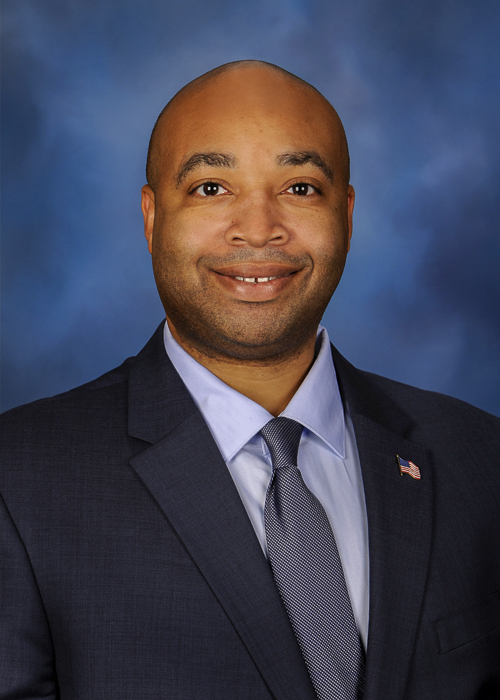
Rep. Justin Slaughter
Sponsored bills
Creates the Re-Entering Citizens Civics Education Act. Provides that the Department of Corrections and the Department of Juvenile Justice shall provide a nonpartisan peer-led civics program throughout the correctional institutions of the State to teach civics to soon-to-be released citizens who will be re-entering society. Provides for the curriculum and eligibility for the program. Provides that the program shall be taught by peer educators who are citizens incarcerated in the Department of Corrections and the Department of Juvenile Justice facilities and specially trained by experienced peer educators and established nonpartisan civic organizations. Provides that the nonpartisan civic organizations shall provide adequate training to peer educators on matters including, but not limited to, voting rights, governmental institutions, current affairs, and simulations of voter registration, election, and democratic processes, and shall provide periodic updates to program content and to peer educators. Provides that the Department of Corrections shall adopt rules to carry out the Act within 6 months after the effective date of the Act. Provides that the funding for the voting rights and registration peer education program shall be subject to appropriation by the General Assembly. Contains provisions regarding funding for the program. Effective January 1, 2020. Senate Floor Amendment No. 2 Provides that the civic education program must be offered by the Department of Corrections and the Department of Juvenile Justice to prisoners scheduled to be discharged within 12 months (rather than 6 months). Provides that established nonpartisan civic organizations may be assisted by area political science or civics educators at colleges, universities, and high schools and by nonpartisan organizations providing re-entry services. Provides that the Department of Corrections and the Department of Juvenile Justice should aim to include the peer reeducation workshop in conjunction with other pre-release procedures and movements. Adds references to "or superintendents" wherever "wardens" appear in the engrossed bill.
Amends the School Code. With respect to school discipline improvement plans, makes changes to how the State Board of Education determines the top 20% of school districts, when notification is given that a plan must be submitted, which school districts are required to submit a plan, the timeframe for school board approval of a plan and submission of that plan to the State Board, and when additional annual progress reports are required. Establishes the Safe Schools and Healthy Learning Environments Grant Program and grants under the program. Sets forth requirements for grant applicants and provisions for the distribution of funds appropriated for the program. Requires the State Board of Education to issue a yearly report on the results of the program in cooperation with school districts participating in the program. Provides that the State Board may adopt any rules necessary for the program. Effective July 1, 2019. Senate Floor Amendment No. 1 Deletes reference to: 105 ILCS 5/2-3.162 Replaces everything after the enacting clause. Reinserts the provisions of the introduced bill with the following changes. Removes any changes to school discipline improvement plans. Gives the bill an immediate effective date.
Amends the State Comptroller Act. Creates the Illinois Bank On Initiative to increase the use of Certified Financial Products and reduce reliance on alternative financial products. Provides that the Illinois Bank On Initiative shall be administered by the Comptroller, and the Comptroller shall be responsible for specified ongoing activities of the Initiative. Creates the Illinois Bank On Initiative Commission and provides for membership of the Commission. Provides for requirements and duties of the Commission. Requires the Comptroller and the Commission to annually prepare and make available on the Controller's website a report concerning the progress of the Illinois Bank On Initiative. Provides that the Comptroller may adopt rules necessary to implement provisions concerning the Illinois Bank On Initiative and Commission. Defines terms. Effective immediately. Senate Floor Amendment No. 2 Modifies the membership requirements of the Illinois Bank On Initiative Commission. Modifies the definition of "Certified Financial Product" and defines "financial institution".
Amends the Illinois Public Aid Code. Provides that for purposes of determining eligibility and the amount of assistance under the Code, the Department of Human Services and local governmental units shall exclude from consideration, for a period of no more than 60 months, any financial assistance, including wages, cash transfers, or gifts, that is provided to a person who is enrolled in a program or research project that is not funded with general revenue funds and that is intended to investigate the impacts of policies or programs designed to reduce poverty, promote social mobility, or increase financial stability for Illinois residents if there is an explicit plan to collect data and evaluate the program or initiative that is developed prior to participants in the study being enrolled in the program and if a research team has been identified to oversee the evaluation. Requires the Department to seek all necessary federal approvals or waivers to implement the provisions of the amendatory Act. Effective immediately.
Amends the Code of Criminal Procedure of 1963. Provides that if the defendant is arraigned on or after the effective date of the amendatory Act and the court fails to advise the defendant before the acceptance of a plea of guilty, guilty but mentally ill, or nolo contendere to a misdemeanor or felony offense of the consequences of the defendant's plea, if an alien, and the defendant shows that conviction of the offense to which the defendant pleaded guilty, guilty but mentally ill, or nolo contendere may have the consequence for the defendant of deportation, exclusion from admission to the United States, or denial of naturalization under the laws of the United States, the court, upon the defendant's motion, shall vacate the judgment and permit the defendant to withdraw the plea of guilty, guilty but mentally ill, or nolo contendere and enter a plea of not guilty. Provides that the motion shall be filed within 2 years of the date of the defendant's conviction.
Amends various Acts relating to the governance of public universities and community colleges in Illinois. With regard to in-state tuition charges, provides that, beginning with the 2019-2020 academic year, per the federal requirements for maintaining approval for veterans' education benefits, if a person who is on active military duty or is receiving veterans' education benefits, then the board of trustees of each university or community college shall deem that person an Illinois resident for tuition purposes for any academic quarter, semester, or term, as applicable. Effective immediately.
Amends the Unified Code of Corrections. Provides that an arrest warrant issued for an offender who violated a condition of his or her probation, conditional discharge, or supervision where there is danger of his or her fleeing the jurisdiction or causing serious harm to others or when the offender fails to answer a summons or notice from the clerk of the court or sheriff shall remain active for a period not to exceed 5 years from the date the warrant was issued unless a motion to extend the warrant is filed by the office of the State's Attorney or by, or on behalf of, the agency supervising the wanted person. Provides that a motion to extend the warrant shall be filed within one year of the date the warrant is issued and notice shall be provided to the office of the sheriff. Provides that if a person is serving a sentence of probation, conditional discharge, or supervision for a firearm offense or forcible felony, the warrant shall remain active for a period of 10 years from the date the warrant was issued at which time the wanted person's period of probation, conditional discharge, or supervision shall terminate unsatisfactorily as a matter of law. Senate Floor Amendment No. 2 Replaces everything after the enacting clause. Reinserts the provisions of the introduced bill with changes. Provides that an arrest warrant issued for an offender who violated a condition of his or her probation, conditional discharge, or supervision where there is danger of his or her fleeing the jurisdiction or causing serious harm to others or when the offender fails to answer a summons or notice from the clerk of the court or sheriff when the underlying conviction is for the offense of theft, retail theft, or possession of a controlled substance shall remain active for a period not to exceed 10 years from the date the warrant was issued unless a motion to extend the warrant is filed by the office of the State's Attorney or by, or on behalf of, the agency supervising the wanted person (in the introduced bill, an arrest warrant issued for an offender who violated a condition of his or her probation, conditional discharge, or supervision where there is danger of his or her fleeing the jurisdiction or causing serious harm to others or when the offender fails to answer a summons or notice from the clerk of the court or sheriff shall remain active for a period not to exceed 5 years from the date the warrant was issued unless a motion to extend the warrant is filed by the office of the State's Attorney or by, or on behalf of, the agency supervising the wanted person). Provides that the provision is applicable to arrest warrants in Cook County on and after the effective date of the amendatory Act. Deletes language that provides that if a person is serving a sentence of probation, conditional discharge, or supervision for a firearm offense or forcible felony, the warrant shall remain active for a period of 10 years from the date the warrant was issued at which time the wanted person's period of probation, conditional discharge, or supervision shall terminate unsatisfactorily as a matter of law. Effective January 1, 2020.
Amends the School Code to create the Office of School Safety within the State Board of Education. Provides for the Office's duties. Requires the Office to create a grant program for expenditures related to improving school safety. Provides that grant funds must be used for school security improvements, including training and safety-related upgrades to school buildings, equipment (including metal detectors and x-ray machines), and facilities. Specifies the grant application requirements. Effective January 1, 2020. Senate Floor Amendment No. 1 Replaces everything after the enacting clause. Amends the School Code. Provides that, subject to appropriation or private donations, the State Board of Education shall award grants to school districts to support school safety and security. Provides that grant funds may be used for school security improvements, including professional development, safety-related upgrades to school buildings, equipment, including metal detectors and x-ray machines, and facilities, including school-based health centers. Requires the State Board to prioritize the distribution of grants to school districts designated as Tier 1 or Tier 2 under the evidence-based funding formula.
Amends the Unified Code of Corrections. Provides that the conditions of every parole and mandatory supervised release include that the subject: (1) not knowingly frequent (rather than frequent) places where controlled substances are illegally sold, used, distributed, or administered; and (2) except when the association described in (2)(A) or (2)(B) involves activities related to community programs, worship services, volunteering, engaging families, or some other pro-social activity in which there is no evidence of criminal intent: (A) not knowingly associate with other persons on parole or mandatory supervised release without prior written permission of his or her parole agent; or (B) not knowingly associate with persons who are members of an organized gang as that term is defined in the Illinois Streetgang Terrorism Omnibus Prevention Act. Effective immediately. Correctional Note (Dept of Corrections) There is no fiscal or population impact on the department.