Maddy summaryThis bill directs the Election Assistance Commission (EAC) to create voluntary guidelines for state and local election offices on managing artificial intelligence (AI) in elections. The guidelines must address AI's risks and benefits, cybersecurity threats, how AI affects sharing accurate election information, and how it might spread disinformation. The EAC must also study AI's use in the 2024 federal elections by July 2026 and update the guidelines based on that study. These guidelines are non-binding, meaning election offices choose whether to adopt them, and they aim to help election administrators navigate AI tools responsibly.
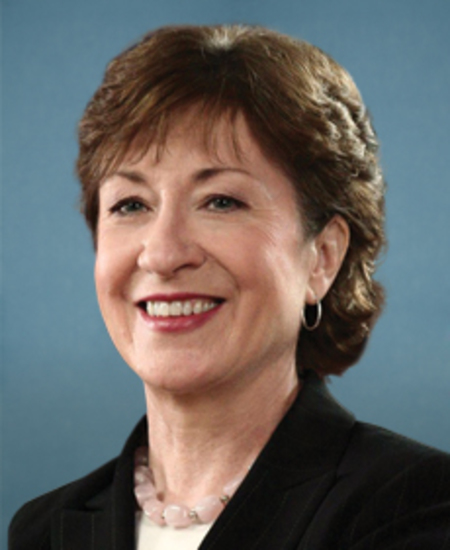
Sen. Susan M. Collins
Sponsored bills
Halt All Lethal Trafficking of Fentanyl Act or the HALT Fentanyl Act This act permanently places fentanyl-related substances as a class into schedule I of the Controlled Substances Act. A schedule I controlled substance is a drug, substance, or chemical that has a high potential for abuse; has no currently accepted medical value; and is subject to regulatory controls and administrative, civil, and criminal penalties under the Controlled Substances Act. Under the act, offenses involving fentanyl-related substances are triggered by the same quantity thresholds and subject to the same penalties as offenses involving fentanyl analogues (e.g., offenses involving 100 grams or more trigger a 10-year mandatory minimum prison term). Additionally, the act establishes a new, alternative registration process for certain schedule I research. The act also makes several other changes to registration requirements for conducting research with controlled substances, including permitting a single registration for related research sites in certain circumstances, waiving the requirement for a new inspection in certain situations, and allowing a registered researcher to perform certain manufacturing activities with small quantities of a substance without obtaining a manufacturing registration. Finally, the act expresses the sense that Congress agrees with the interpretation of the Controlled Substances Act in United States v. McCray , a 2018 case decided by the U.S. District Court for the Western District of New York. In that case, the court held that butyryl fentanyl, a controlled substance, can be considered an analogue of fentanyl even though, under the Controlled Substances Act, the term controlled substance analogue specifically excludes a controlled substance.

Maddy summarySRES 322 designates June 2025 as "National Post-Traumatic Stress Awareness Month" and June 27, 2025, as "National Post-Traumatic Stress Awareness Day" to raise public awareness about post-traumatic stress, particularly among veterans and military personnel. The resolution supports efforts by the Department of Veterans Affairs and Department of Defense to educate about symptoms, treatment, and stigma reduction, while encouraging cultural change and appropriate care. This symbolic gesture has no legal effect or funding implications but aims to reduce stigma and promote mental health support for those affected.
Maddy summaryThis bill reauthorizes federal funding for tick-borne disease programs under the Public Health Service Act. It reduces annual funding levels for two key programs: $8 million per year (from $10 million) for the National Strategy and Regional Centers of Excellence (2026-2030), and $19 million per year (from $20 million) for health department support programs (2026-2030). These changes extend existing programs through 2030 with adjusted funding amounts. The bill directly affects public health programs and state/local health departments addressing tick-borne diseases like Lyme disease.
Farmers First Act of 2025 This bill extends through FY2030 and revises the Farm and Ranch Stress Assistance Network (FRSAN). This Department of Agriculture program provides competitive grants to states, Indian tribes, and qualified nonprofit organizations to provide stress assistance programs (i.e., professional agricultural behavioral health counseling, helplines, and resources) to individuals engaged in farming, ranching, and agriculture-related occupations. The bill specifies that the grant funding for farm telephone helplines and websites may also be used for crisis lines. Further, FRSAN grant recipients may establish referral relationships with providers, including Certified Community Behavioral Health Clinics, health centers, rural health clinics, and critical access hospitals.
Maddy summaryThis bill authorizes the minting of commemorative coins for the 2028 Los Angeles Olympic and Paralympic Games and the 2034 Salt Lake City Olympic and Paralympic Winter Games. It specifies four coin types ($5 gold, $1 silver, half-dollar, and proof silver $1) with defined quantities and designs reflecting U.S. athletic participation. A surcharge on each coin sale (e.g., $35 for $5 coins) funds the respective Olympic committees' legacy programs, including youth sports initiatives. The coins are legal tender but intended solely for commemoration, with surcharges directed to the organizing committees after covering minting costs.
Maddy summaryS 2229, the United States Foreign Service Commemorative Coin Act, authorizes the minting of three commemorative coins to honor the 100th anniversary of the U.S. Foreign Service (established by the 1924 Rogers Act). It specifies $5 gold coins (max 50,000), $1 silver coins (max 400,000), and half-dollar coins (max 750,000) to be issued in 2029, featuring designs symbolizing U.S. diplomacy. A surcharge from each coin sale ($35 for gold, $10 for silver, $5 for half-dollar) will fund the Association for Diplomatic Studies and Training to preserve diplomatic history through oral histories and other programs. The coins are legal tender and will be sold at face value plus surcharge and production costs, with all funds going directly to support the Association's work.
Maddy summaryThis bill reauthorizes two existing federal diabetes programs through 2027. It provides $160 million annually for fiscal years 2026 and 2027 for the Special Diabetes Program for Type I Diabetes (serving people with Type I diabetes) and the Special Diabetes Program for Indians (serving Native American communities through Indian Health Services). A final $40 million is allocated for October-December 2027 for both programs, with all funds remaining available until expended. The bill extends current funding levels without changing program eligibility or structure.
Maddy summaryS 2195, the WWII Nurses Congressional Gold Medal Act, authorizes a Congressional Gold Medal to honor Army and Navy nurses who served during World War II, recognizing their critical military service and devotion to duty. The medal, to be designed and struck by the Secretary of the Treasury, will be displayed at the Smithsonian Institution and specific locations like the Women in Military Service for America Memorial and the National World War II Museum. The bill also permits the sale of bronze duplicates to cover production costs. This legislation provides formal recognition for nurses who provided medical care under combat conditions, including in field hospitals, prisoner-of-war camps, and evacuation efforts across multiple continents.
Maddy summaryThis bill extends the time for same-sex couples legally married before September 16, 2013, to file for tax refunds they missed because they filed separately instead of jointly. It applies to couples who filed individual returns for tax years ending before that date but could have filed joint returns if same-sex marriage recognition had been in effect. The bill extends the deadline for claiming refunds on those returns until the standard tax filing deadline for the year the bill becomes law. It specifically covers changes to marital status under tax law and does not affect other tax filings or claims.