

Equality Act This bill prohibits discrimination based on sex, sexual orientation, and gender identity in areas including public accommodations and facilities, education, federal funding, employment, housing, credit, and the jury system. Specifically, the bill defines and includes sex, sexual orientation, and gender identity among the prohibited categories of discrimination or segregation. The bill expands the definition of public accommodations to include places or establishments that provide (1) exhibitions, recreation, exercise, amusement, gatherings, or displays; (2) goods, services, or programs; and (3) transportation services. The bill allows the Department of Justice to intervene in equal protection actions in federal court on account of sexual orientation or gender identity. The bill prohibits an individual from being denied access to a shared facility, including a restroom, a locker room, and a dressing room, that is in accordance with the individual's gender identity.
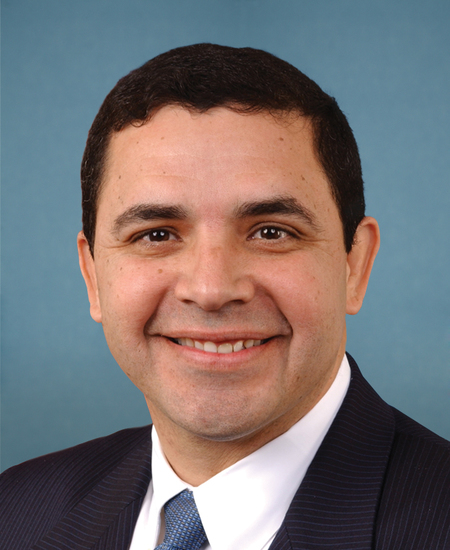
Rep. Henry Cuellar
Sponsored bills
Medicaid Report on Expansion of Access to Coverage for Health Act or the Medicaid REACH Act This bill reduces federal payment for Medicaid administrative expenses incurred by states that have not elected to participate in Medicaid expansion under the Patient Protection and Affordable Care Act (i.e., nonexpansion states) if the state does not comply with specified reporting requirements. The bill requires nonexpansion states to report, among other information, the number of uninsured individuals under the age of 65 and the estimated percentage of such individuals who would be eligible to receive coverage if the state expanded Medicaid.
Developing Responsible Individuals for a Vibrant Economy Act or the DRIVE-SAFE Act This bill directs the Department of Transportation to promulgate regulations to implement an apprenticeship program for licensed commercial motor vehicle drivers under the age of 21. Under the program, an apprentice must complete two probationary periods that total 400 hours of on-duty time, of which at least 240 hours must be driving time in a commercial motor vehicle. Additionally, the apprentice must be accompanied in the cab of the commercial motor vehicle by an experienced driver. Further, the bill requires all commercial motor vehicles used in the program for training to be equipped with safety technology such as active braking collision mitigation systems and video event capturing systems. An employer shall not knowingly allow, require, permit, or authorize a driver under the age of 21 to operate a commercial motor vehicle unless the driver is participating in, or has completed, an apprenticeship program that meets the requirements set forth in this bill.
For the People Act of 2021 This bill addresses voter access, election integrity and security, campaign finance, and ethics for the three branches of government. Specifically, the bill expands voter registration (e.g., automatic and same-day registration) and voting access (e.g., vote-by-mail and early voting). It also limits removing voters from voter rolls. The bill requires states to establish independent redistricting commissions to carry out congressional redistricting. Additionally, the bill sets forth provisions related to election security, including sharing intelligence information with state election officials, supporting states in securing their election systems, developing a national strategy to protect U.S. democratic institutions, establishing in the legislative branch the National Commission to Protect United States Democratic Institutions, and other provisions to improve the cybersecurity of election systems. Further, the bill addresses campaign finance, including by expanding the prohibition on campaign spending by foreign nationals, requiring additional disclosure of campaign-related fundraising and spending, requiring additional disclaimers regarding certain political advertising, and establishing an alternative campaign funding system for certain federal offices. The bill addresses ethics in all three branches of government, including by requiring a code of conduct for Supreme Court Justices, prohibiting Members of the House from serving on the board of a for-profit entity, and establishing additional conflict-of-interest and ethics provisions for federal employees and the White House. The bill requires the President, the Vice President, and certain candidates for those offices to disclose 10 years of tax returns.
Allied Burden Sharing Report Act of 2021 This bill directs the Department of Defense (DOD) to report to Congress on the contributions of allies to the common defense. Specifically, DOD must report on (1) the defense spending and military activities of certain countries with cooperative defense agreements with the United States, (2) whether a country places limits on the use of funds contributed to the common defense, and (3) any U.S. actions to minimize such limitations. The report shall cover each North Atlantic Treaty Organization (NATO) member state, each Gulf Cooperation Council member state, each country party to the Inter-American Treaty of Reciprocal Assistance (Rio Treaty), and other specified countries.
Ports-to-Plains Highway Act of 202 1 This bill expands and designates certain route segments on the National Highway System. Specifically, the bill (1) designates the portion of the Heartland Expressway (relating solely to the portion from Limon, Colorado to Interstate Route I-76 in the vicinity of Brush, Colorado) and the Ports-to-Plains Corridor as future parts of the Interstate System; and (2) permits the continued operation of vehicles on any segment of the Heartland Expressway (relating solely to the portion from Limon, Colorado to I-76 in the vicinity of Brush, Colorado) and the Ports-to-Plains Corridor that is designated as a route on the Interstate System in Texas, Oklahoma, Colorado, and New Mexico, without regard to vehicle weight limitation requirements.
George Floyd Justice in Policing Act of 2021 This bill addresses a wide range of policies and issues regarding policing practices and law enforcement accountability. It increases accountability for law enforcement misconduct, restricts the use of certain policing practices, enhances transparency and data collection, and establishes best practices and training requirements. The bill enhances existing enforcement mechanisms to remedy violations by law enforcement. Among other things, it does the following: lowers the criminal intent standard—from willful to knowing or reckless—to convict a law enforcement officer for misconduct in a federal prosecution, limits qualified immunity as a defense to liability in a private civil action against a law enforcement officer, and grants administrative subpoena power to the Department of Justice (DOJ) in pattern-or-practice investigations. It establishes a framework to prevent and remedy racial profiling by law enforcement at the federal, state, and local levels. It also limits the unnecessary use of force and restricts the use of no-knock warrants, chokeholds, and carotid holds. The bill creates a national registry—the National Police Misconduct Registry—to compile data on complaints and records of police misconduct. It also establishes new reporting requirements, including on the use of force, officer misconduct, and routine policing practices (e.g., stops and searches). Finally, it directs DOJ to create uniform accreditation standards for law enforcement agencies and requires law enforcement officers to complete training on racial profiling, implicit bias, and the duty to intervene when another officer uses excessive force.
This resolution honors Officers Brian Sicknick and Howard Liebengood of the U.S. Capitol Police, and it commends the bravery and service demonstrated by officers of the U.S. Capitol Police, the Metropolitan Police Department of the District of Columbia, and the other law enforcement agencies and protective entities that assisted in responding to the January 6, 2021, attack on the U.S. Capitol.
Binational Health Strategies Act of 2021 This bill requires the President and the United States-Mexico Border Health Commission to take certain actions related to COVID-19. Specifically, the bill directs the President to seek to begin negotiations with Mexico to address infectious disease preparedness in the U.S.-Mexico border area with respect to COVID-19 and other infectious diseases. The bill further requires the United States-Mexico Border Health Commission to (1) report on the border area's response to COVID-19 in both the United States and Mexico, (2) submit a binational strategic plan with respect to COVID-19, and (3) submit a plan to prepare and respond to future infectious diseases within the border area.
Ellie Helton, Lisa Colagrossi, Kristen Shafer Englert, Teresa Anne Lawrence, and Jennifer Sedney Focused Research Act or Ellie's Law This bill authorizes appropriations for the National Institute of Neurological Disorders and Stroke to conduct or support research on unruptured brain aneurysms in a patient population diversified by age, sex, and race.