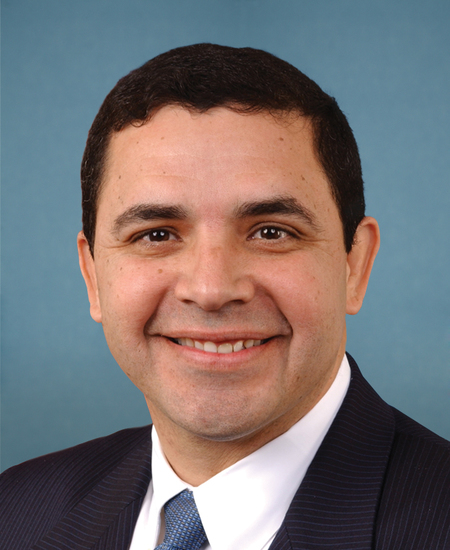
Photo of Henry Cuellar
D United States House · District 28 · Texas On the 2026 ballot

Rep. Henry Cuellar

Compare
Total votes
2,818
all sessions
Attendance
98%
43 missed
Near the chamber average
With party
86%
of cast votes
Lower than 100% of chamber peers
Bipartisan score
7%
crosses aisle rarely
Higher than 99% of chamber peers
Sponsored
763
bills & resolutions
Lower than 78% of chamber peers
Committees
4
assignments
763 bills and resolutions

Sponsored bills

Total
763
Primary
26
Co-sponsor
737
This page
763
matching current filters
Co-sponsor HJRES 17
Passed · Florida House · Co-sponsor
Removing the deadline for the ratification of the equal rights amendment.

This joint resolution eliminates the deadline for the ratification of the Equal Rights Amendment, which prohibits discrimination based on sex. The amendment was proposed to the states in House Joint Resolution 208 of the 92nd Congress, as agreed to in the Senate on March 22, 1972. The amendment shall be part of the Constitution whenever ratified by the legislatures of three-fourths of the states.

Passed Mar 23, 2021 1 co-sponsor
Co-sponsor HR 2143
In committee · Florida House · Co-sponsor
Neighborhood Homes Investment Act

Neighborhood Homes Investment Act This bill establishes a new business-related tax credit to finance home building and rehabilitation in neighborhoods that meet certain eligibility criteria relating to poverty rates, income, and home values. The credit is limited to 35% of the lesser of the qualified development cost (i.e., the cost of construction, substantial rehabilitation, demolition, and environmental remediation of residential properties) or 80% of the national median sale price for new homes. The credit applies to single family homes containing four or fewer residential units, condominiums, or houses or apartments owned by cooperative housing corporations.

In committee Mar 23, 2021 1 co-sponsor
Co-sponsor HR 2126
In committee · Florida House · Co-sponsor
Housing Supply and Affordability Act

Housing Supply and Affordability Act This bill allows the Department of Housing and Urban Development to award grants to states, local governments, Indian tribes, and Native Hawaiian organizations for the development and implementation of housing policy plans. These plans must increase the housing supply while avoiding resident displacement, increase housing affordability, and reduce barriers to housing development. The amounts provided by the bill are designated as an emergency requirement pursuant to the Statutory Pay-As-You-Go Act of 2010 (PAYGO) and the Senate PAYGO rule. (This excludes the budget effects from being counted for the purposes of enforcing the PAYGO rules.)

In committee Mar 23, 2021 1 co-sponsor
Co-sponsor HR 1603
Passed · Florida House · Co-sponsor
Farm Workforce Modernization Act of 2021

Farm Workforce Modernization Act of 2021 This bill contains provisions related to alien farmworkers, including provisions establishing a certified agricultural worker (CAW) status and changing the H-2A temporary worker program. The Department of Homeland Security (DHS) may grant CAW status to an applying alien who (1) performed at least 1,035 hours of agricultural labor during the two-year period prior to March 8, 2021; (2) on that date was inadmissible, deportable, or under a grant of deferred enforced departure or temporary protected status; and (3) has been continuously present in the United States from that date until receiving CAW status. The bill imposes additional crime-related inadmissibility grounds on CAW applicants and makes some other grounds inapplicable. CAW status shall be valid for 5.5 years and may be extended. DHS may grant dependent status to the spouse or children of a principal alien. An alien with a pending application may not be detained or removed by DHS and shall be authorized for employment until DHS makes a final decision on the application. A CAW alien (and dependents) may apply for lawful permanent resident status after meeting various requirements, including performing a certain amount of agricultural labor for a number of years. DHS shall create an electronic platform for (1) filing H-2A petitions, (2) facilitating the processing of H-2A cases, and (3) providing agencies a single tool for obtaining H-2A-related case information. The bill makes various changes to the H-2A program, such as (1) modifying the method for calculating and making adjustments to the H-2A worker minimum wage, (2) specifying how an employer may satisfy requirements that it attempted to recruit U.S. workers, (3) requiring H-2A employers to guarantee certain minimum work hours, (4) making the program available for agricultural work that is not temporary or seasonal, and (5) reserving a visa allocation for the dairy industry. DHS shall establish a pilot program allowing certain H-2A workers to apply for portable status, which gives the worker 60 days after leaving a position to secure new employment with a registered H-2A employer. DHS shall establish an electronic system patterned on the E-Verify Program for employers to verify an individual's identity and employment authorization. Employers hiring individuals for agricultural employment must use the system. This bill permanently establishes the Housing Preservation and Revitalization Program, which provides financing assistance for rural rental housing and off-farm labor housing and rental assistance for qualified tenants of such housing. It also authorizes the Department of Agriculture to provide various assistance, including funding for insuring loans and grants for new farmworker housing.

Passed Mar 22, 2021 1 co-sponsor
Co-sponsor HR 701
In committee · Florida House · Co-sponsor
Unfunded Mandates Accountability and Transparency Act

Unfunded Mandates Accountability and Transparency Act This bill revises rulemaking requirements with respect to unfunded mandates. Specifically, the bill requires federal agencies to prepare and publish in the Federal Register an initial and final regulatory impact analysis prior to promulgating any proposed or final major rule. The analysis must include regulatory alternatives to the rule. Major rule means a rule that the Office of Information and Regulatory Affairs determines is likely to cause an annual effect on the economy of $100 million or more; a major increase in costs or prices for consumers, individual industries, federal, state, local, or tribal government agencies, or geographic regions; or significant adverse effects on competition, employment, investment, productivity, innovation, public health and safety, or the ability of U.S.-based enterprises to compete with foreign-based enterprises in domestic and export markets. Before promulgating any proposed or final major rule, an agency shall select the regulatory alternative that maximizes net benefits, taking into consideration only the costs and benefits that arise within the scope of the statutory provision that authorizes the rulemaking, with exceptions. The bill prohibits Congress from considering a bill that increases private sector costs more than a certain amount unless certain conditions are met.


In committee Mar 22, 2021 1 co-sponsor
Co-sponsor HR 2045
In committee · Florida House · Co-sponsor
BITMAP Authorization Act

Biometric Identification Transnational Migration Alert Program Authorization Act or the BITMAP Authorization Act This bill provides statutory authority for the Department of Homeland Security (DHS) Biometric Identification Transnational Migration Alert Program (BITMAP). That program was established to address and reduce national security, border security, and terrorist threats before such threats reach the international border of the United States. Before carrying out BITMAP operations in a foreign country, DHS must enter into an agreement with the government of such country that sets forth program goals for such country and must provide the congressional homeland security committees with a copy of the agreement.

In committee Mar 19, 2021 1 co-sponsor
Co-sponsor HR 1861
In committee · Florida House · Co-sponsor
Whole Milk for Healthy Kids Act of 2021

Whole Milk for Healthy Kids Act of 2021 This bill revises requirements for milk provided by the National School Lunch Program of the Department of Agriculture (USDA). Currently, schools participating in the program must provide milk that is consistent with the most recent Dietary Guidelines for Americans; USDA regulations require milk to be fat-free or low-fat and allow only fat-free milk to be flavored. The bill removes these restrictions and instead permits schools to offer students whole, reduced-fat, low-fat, and fat-free flavored and unflavored milk.

In committee Mar 19, 2021 1 co-sponsor
Co-sponsor HR 2011
In committee · Florida House · Co-sponsor
WIC Act of 2021

Wise Investment in Children Act of 2021 or the WIC Act of 20 21 This bill expands eligibility for children to receive benefits under the Special Supplemental Nutrition Program for Women, Infants, and Children (WIC). The bill authorizes the Department of Agriculture to grant a waiver to a state, on request, that waives certification deadline requirements under the program if such state demonstrates there are unusual technological barriers to implementation, operational costs are not affordable within the nutrition services and administration grant of the state, or it is in the best interest of the program. If a waiver is granted, the bill extends eligibility for the program until the period that ends on the earlier of the sixth birthday of a child or when the child enters kindergarten; extends the certification period under the program for infants to up to two years, instead of the current one year; and increases the certification time under the program for postpartum women to a period of up to two years.

In committee Mar 18, 2021 1 co-sponsor
Co-sponsor HR 2030
In committee · Florida House · Co-sponsor
College Transparency Act

College Transparency Act This bill requires the National Center for Education Statistics to establish a secure and privacy-protected data system that contains information about postsecondary students. Specifically, the data system must evaluate student enrollment patterns, progression, completion, and postcollegiate outcomes, and higher education costs and financial aid; provide complete and customizable information for students and families making decisions about postsecondary education; reduce the requirements for reporting by institutions of higher education; and periodically match with other federal systems of data. The bill also establishes a postsecondary student data system advisory committee.

In committee Mar 18, 2021 1 co-sponsor
Showing 701 to 710 of 763 bills
Previous 1 70 71 72 77 Next