

SFC Heath Robinson Burn Pit Transparency Act This bill implements reporting requirements and policies related to the treatment and documentation of veterans who have been exposed to open burn pits. A burn pit is an area used for burning solid waste in open air without equipment. First, the bill requires the Department of Veterans Affairs (VA) to submit quarterly reports on veterans' burn pit exposure The bill also requires the VA to collaborate with the Department of Defense to submit an annual report detailing specified information about veterans who have been exposed to open burn pits, such as the number of claims for disability compensation approved and denied (including the rationale for denials). The bill authorizes the survivor of a deceased veteran to report a veteran's exposure to toxic substances from an open burn pit in the Airborne Hazards and Open Burn Pit Registry, even if the veteran was not included prior to their death. VA medical professionals must inform veterans of the registry if they present at a medical facility for treatment related to exposure to toxic chemicals by open burn pits. Finally, the Government Accountability Office must report on the effectiveness of any memorandum of understanding entered into by the VA with respect to the processing of reported cases of burn pit exposure and the coordination of care and provision of health care related to such cases at VA and non-VA facilities.
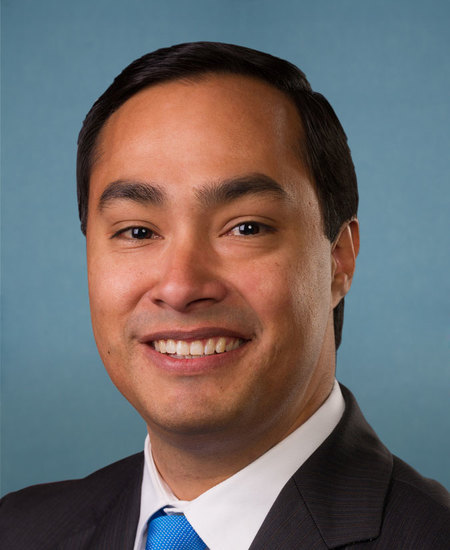
Rep. Joaquin Castro
Sponsored bills
Jennifer Kepner Healthcare for Open air burn Pit Exposure Act or the Jennifer Kepner HOPE Act This bill extends eligibility for hospital, nursing home, and medical services from the Department of Veterans Affairs to veterans who were exposed to burn pits on or after January 1, 1990, while serving in support of a contingency operation. Burn pits are areas used for burning solid waste in open air without equipment.
Veterans' Right to Breathe Act This bill provides a presumption of service-connection to burn pit-exposed veterans for certain diseases. Under a presumption of service-connection, specific conditions diagnosed in certain veterans are presumed to have been caused by the circumstances of their military service. Health care benefits and disability compensation may then be awarded. A burn pit-exposed veteran is a veteran who was supporting a contingency operation on or after January 1, 1990, and was stationed at a location where an open burn pit (an area used for burning solid waste in open air without equipment) was used.
This bill repeals the joint resolution of March 9, 1957, that provided for the use of certain funds to promote peace and stability in the Middle East.
This bill repeals the January 14, 1991, resolution authorizing the use of military force against Iraq.
Safe Schools Improvement Act of 2021 This bill requires states to direct their local educational agencies (LEAs) to establish policies that prevent and prohibit bullying and harassment of elementary and secondary school students. In particular, these policies must prohibit bullying and harassment based on race, color, national origin, sex, sexual orientation, gender identity, disability, or religion. Further, LEAs must provide (1) students, parents, and educational professionals with annual notice of the conduct prohibited in their disciplinary policies; (2) students and parents with grievance procedures that target such conduct; and (3) the public with annual data on the incidence and frequency of that conduct at the school and LEA level. The Department of Education must conduct and report on an independent biennial evaluation of programs and policies to combat bullying and harassment in elementary and secondary schools. The National Center for Education Statistics must collect state data to determine the incidence and frequency of the conduct prohibited by LEA disciplinary policies.
Medicare Dental, Vision, and Hearing Benefit Act of 2021 This bill provides for Medicare coverage of dental, vision, and hearing care. Coverage includes (1) routine dental cleanings and exams, basic and major dental services, emergency dental care, and dentures; (2) routine eye exams, eyeglasses, and contact lenses; and (3) routine hearing exams, hearing aids, and exams for hearing aids. With respect to such care, the bill establishes special payment rules, limitations, and coinsurance requirements.
Foreign Service Families Act of 2021 This bill increases access to career and educational opportunities for eligible family members of foreign service employees. Specifically, the Department of State must use additional hiring preferences and apply appropriate hiring standards to eligible family members seeking employment in certain civil service positions overseas. Additionally, the State Department may take other steps to improve job portability and otherwise support employment of eligible family members who work in the federal civil service or private sector jobs. The State Department must also report on the implementation of the Foreign Service Family Reserve Corps, a program that expedites hiring and onboarding processes for family members who are eligible for appointment to positions overseas. Furthermore, each federal agency must include in its telework policy the circumstances under which an employee may temporarily work from an approved location overseas. The bill also makes foreign service employees (or their spouses and dependent children) who are domiciled or assigned to a duty station in a given state eligible for in-state tuition at public institutions of higher education in that state. Such individuals retain their eligibility for in-state tuition provided they maintain continuous enrollment even if their domicile or duty station changes.
Federal Retirement Fairness Act This bill modifies the federal civilian service that is creditable service under the Federal Employees Retirement System (FERS). Specifically, it expands the nondeduction service that may be creditable under FERS. Nondeduction service is federal service where an employee's pay is not subject to retirement deductions (e.g., service under a temporary appointment). Currently, nondeduction service performed before January 1, 1989, is creditable under FERS so long as a deposit is made into the retirement fund to cover the period of nondeduction service. This bill allows nondeduction service performed on or after January 1, 1989, to be creditable under FERS so long as a deposit is made into the retirement fund.
This resolution urges the President to facilitate private medical supply donations and to deliver urgently needed medical supplies, including oxygen generator plants, to India and countries neighboring India that are facing the spread of COVID-19.