

Incentivizing Medicaid Expansion Act of 2021 This bill provides an enhanced federal matching rate to every state that expands Medicaid coverage for individuals who are newly eligible under the Patient Protection and Affordable Care Act, regardless of when such expansion takes place. Under current law, the enhanced Federal Medical Assistance Percentage (FMAP) is equivalent to 100% in 2014 through 2016, 95% in 2017, 94% in 2018, 93% in 2019, and 90% thereafter. The bill retains this enhanced FMAP, but bases it on a term of years rather than on specific dates. The bill applies retroactively.
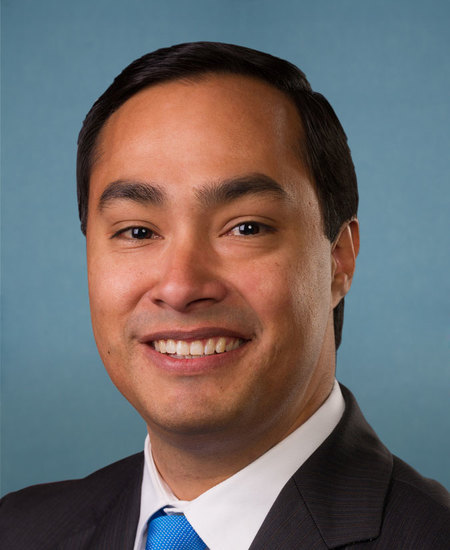
Rep. Joaquin Castro
Sponsored bills
This joint resolution prohibits the issuance of a manufacturing license, technical assistance license, or export license with respect to certain proposed agreements or transfers of specified defense articles or services to Saudi Arabia, the United Kingdom, Spain, or Italy.
This joint resolution prohibits the proposed foreign military sale of certain defense articles and services to Saudi Arabia.
This resolution expresses the sense of the House of Representatives that Congress should ensure that the U.S. Postal Service is not privatized and remains an independent establishment of the federal government.
This resolution calls upon Vice President Michael R. Pence (1) to immediately use his powers under section 4 of the Twenty-fifth Amendment to convene and mobilize the principal officers of the executive departments to declare that the President is unable to successfully discharge the duties and powers of his office, and (2) to transmit to the President pro tempore of the Senate and the Speaker of the House notice that he will be immediately assuming the powers and duties of the office as Acting President.
Guam Supplemental Security Income Equality Act This bill extends the Supplemental Security Income (SSI) program to Guam. This is a federal program designed to help aged, blind, and disabled individuals with limited income and resources meet basic needs. When Congress created the SSI program in 1972, it excluded Puerto Rico, the Virgin Islands, and Guam. The Social Security Administration may waive or modify statutory requirements relating to the provision of benefits as necessary to adapt the program to Guam.