

Improving Medicare Coverage Act This bill temporarily expands eligibility for Medicare. It also temporarily establishes a premium and cost-sharing assistance program for low-income beneficiaries. Specifically, the bill lowers the age of eligibility for Medicare from 65 to 60. The Centers for Medicare & Medicaid Services must establish procedures to provide for automatic enrollment of qualifying individuals. Enrollment must be completed within 11 months of the bill's enactment. The bill also establishes a program under Medicare to assist low-income Medicare beneficiaries with premiums, coinsurance, deductibles, and other costs. Currently, such assistance is provided through Medicare Savings Programs, which are administered by state Medicaid programs. The bill also establishes a related special enrollment period under Medicare, expands eligibility for assistance to beneficiaries with income up to 200% of the federal poverty line, and provides for joint eligibility determinations with respect to the bill's program and the low-income subsidy program under the Medicare prescription drug benefit. The bill's provisions generally take effect six months after the bill's enactment and terminate five years later.
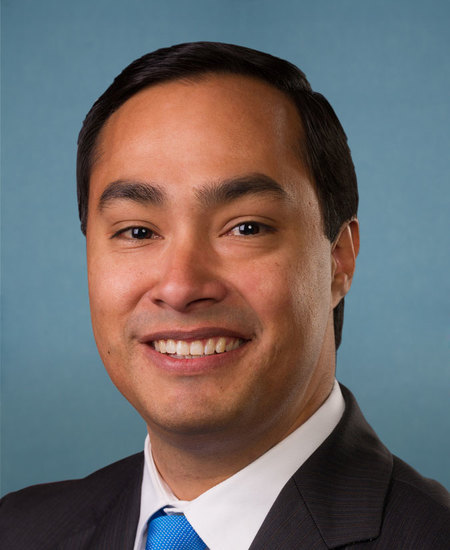
Rep. Joaquin Castro
Sponsored bills
Harlem Hellfighters Congressional Gold Medal Act This bill provides for the award of a Congressional Gold Medal to the 369th Infantry Regiment, commonly known as the Harlem Hellfighters, in recognition of their bravery and outstanding service during World War I.
This resolution expresses respect for and solidarity with the families and friends of those killed, tortured, and imprisoned for participating in prodemocracy demonstrations during the spring of 1989 in Tiananmen Square. It also reaffirms support for those who continue to work for political reform, rule of law, and human rights in China.
Open Translation and Analysis Center Authorization Act This bill establishes the Open Translation and Analysis Center as a federally funded research and development center sponsored by the Department of State. The center must disseminate translations and analysis of foreign language materials from China and other countries of strategic interest, with a particular focus on government materials (e.g., documents, reports, and speeches of political and military leadership). To carry out its activities, the center must (1) select appropriate materials for translation and analysis; (2) train analysts and linguists; (3) use technologies to expedite translations; and (4) otherwise coordinate its work with federal agencies, foreign allies, and others. Specifically, the center must cooperate and consult with relevant federal agencies and stakeholders, including grantees of the United States Agency for Global Media and research organizations. The center may consult with foreign governments if the State Department certifies that the consultation serves U.S. national interests. Additionally, the center must maintain a publicly available website of all translations and analyses that are not subject to copyright or intellectual property protections. Materials subject to those protections must be made available at no cost on a private website to federal employees and contractors and members of Congress and their staff. The bill designates the State Department as the primary sponsor of the center. However, the State Department may enter into sponsorship agreements with other federal agencies, such as the Central Intelligence Agency.
Restoring U.S. Leadership in International Organizations Act of 2021 This bill makes changes and establishes requirements to expand U.S. engagement with international organizations. Changes include eliminating (1) a limitation on the number of foreign service employees on the staff of the U.S. Mission to the United Nations who are eligible for housing benefits, and (2) a requirement that those employees contribute a portion of their pay toward housing costs. Additionally, the value of the housing benefits is excluded from income for federal tax purposes. The bill also allows consideration of an employee's service formulating policy for or representing the United States at an international, multilateral, or similar organization in Foreign Service processes for promotions, performance pay, and related matters. The Department of State must establish training on conducting diplomacy at international and multilateral organizations and on negotiating multilateral international agreements. The bill requires this training for certain State Department employees, such as those assigned to U.S. missions at international organizations. Furthermore, the bill designates the U.S. Special Representative to the United Nations as a standing member of the President's cabinet and outlines U.S. policy for staffing and paying dues to international and multilateral organizations. The State Department must annually report to Congress about the number of and related information about federal employees detailed or transferred to international organizations.
Expanding Broadcast Ownership Opportunities Act of 2021 This bill requires the Federal Communications Commission (FCC) to take certain actions to increase diversity of ownership in the broadcasting industry and establishes a related tax incentive. Specifically, the bill requires the FCC to report to Congress regarding (1) recommendations for increasing the total number of broadcast stations that are owned or controlled by members of minority groups or women, (2) the total number of broadcast stations that are owned or controlled by members of minority groups or women, and (3) whether there is a nexus between diversity of ownership or control of broadcast stations and the diversity of the viewpoints expressed on the stations. In addition, the bill allows companies engaged in the qualifying sale of a broadcast station to receive favorable tax treatment by electing nonrecognition of the gain or loss resulting from the sale. To qualify for this treatment, the sale must result in or preserve ownership and control of a broadcast station by socially disadvantaged individuals.
Domestic Workers Bill of Rights Act This bill provides rights and protections for domestic workers (e.g., housekeepers, nannies, caretakers, personal assistants, and chauffeurs), including pay and leave rights, and health and safety protections. Specifically, the bill repeals the exemption of domestic live-in employees from certain minimum wage and maximum hour requirements. Employers must provide written notice of termination and provide at least 30 days of lodging and two weeks of severance pay to terminated live-in employees. Live-in employees also must be provided with reasonable access to telephone and internet service during their employment. The bill requires employers to provide domestic workers with a written agreement covering wages, sick leave, benefits, and other matters. Further, domestic workers may request and be granted changes to work schedules due to personal events. The bill also provides domestic workers with certain privacy rights, extends to domestic workers protections against discrimination in employment, and increases the federal medical assistance percentage (FMAP) for certain Medicaid-funded medical services provided by domestic workers. The Department of Labor must (1) award grants for a domestic worker national hotline for reporting emergencies, training on hazards facing domestic workers, and workforce investment activities for domestic workers; and (2) establish a Domestic Worker Wage and Standards Board to investigate standards in the domestic workers industry. Labor must publish online a document that describes the rights and protections for domestic workers under this bill.
Protecting Renters from Evictions Act of 2021 This bill extends through December 31, 2021, the order issued by the Centers for Disease Control and Prevention titled Temporary Halt in Residential Evictions To Prevent the Further Spread of COVID–19 and published on September 4, 2020.
This resolution condemns the assassination of Haitian President Jovenel Moise on July 7, 2021, and extends condolences to his family and the people of Haiti.
This resolution expresses the sense of the House of Representatives that the murder of Alireza Fazeli Monfared should be investigated and prosecuted and that the practice of honor killings in Iran is a violation of internationally recognized human rights. Further, it urges the Department of State to rebuke Iran for this practice and to condemn Iranian human rights abuses against vulnerable populations, including abuses based on sex, sexual orientation, and gender expression.