

Agriculture Civil Rights and Equality Act or the ACRE Act This bill prohibits the Department of Agriculture (USDA) from discriminating or providing preferential treatment to any person or group on the basis of race, color, national origin, or sex. The prohibitions also apply to the administration of USDA programs, including programs administered by states, territories, private entities, and institutions of higher education that utilize USDA funds. Any person who is aggrieved by conduct prohibited under the bill may commence a civil action in the appropriate U.S. district court to obtain relief.
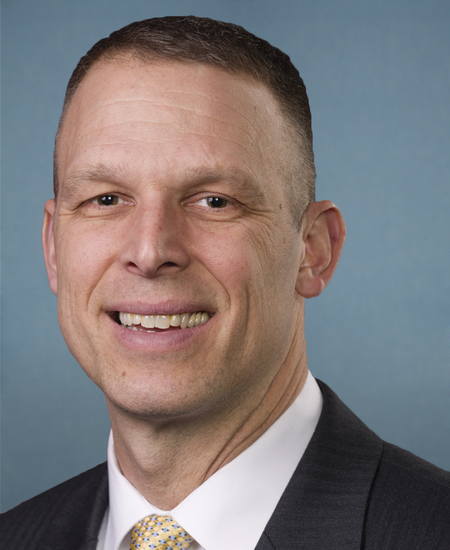
Rep. Scott Perry
Sponsored bills
Davis-Bacon Repeal Act This bill repeals the Davis-Bacon Act, which requires that the locally prevailing wage rate be paid to various classes of laborers and mechanics working under federally-financed or federally-assisted contracts for construction, alteration, and repair of public buildings or public works. References in any law to a requirement under the Davis-Bacon Act shall be null and void.
Federal Agency Sunset Commission Act of 2021 This bill provides for the establishment of the Federal Agency Sunset Commission to submit to Congress a schedule for review and abolishment of each agency, including each advisory committee. The schedule for review shall be in the form of a joint resolution. Each agency shall be abolished unless reauthorized by Congress. For each agency, the commission must schedule a date of abolishment to occur at least once every 12 years. The commission must (1) review and evaluate the efficiency and public need for each agency using specified criteria; (2) analyze the authority claimed by the executive branch but not specifically authorized by statute; (3) recommend whether each agency should be abolished, reorganized, or continued; and (4) report to Congress on introduced legislation that would establish a new agency or a new program. The Government Accountability Office and the Congressional Budget Office, in cooperation with the Congressional Research Service, shall prepare an inventory of federal programs to assist Congress and the commission in carrying out this bill. The bill provides for expedited consideration of the schedule for review and abolishment.
This bill directs the Department of State to include additional information in its annual reports concerning Taiwan's participation at the World Health Organization's World Health Assembly (WHA) as an observer. The report shall describe changes and improvements to the State Department's plan to support Taiwan's observer status at the WHA, following any meetings at which Taiwan did not participate under such status. (China has opposed Taiwan's participation in the WHA.)
Preventing SBA Assistance from Going to China Act This bill prohibits the Small Business Administration from providing aid, counsel, or assistance to a small business concern that (1) is headquartered in China, or (2) has more than 25% of voting stock owned by citizens of China.
Providing Americans with LNG Safely Act or the PALS Act This bill prohibits the Department of Transportation (DOT) from issuing any regulation or order that (1) prohibits the transportation of liquefied natural gas (LNG) by rail, or (2) restricts the transportation of LNG by rail in DOT-113 tank cars. The bill does not limit the authority of DOT to issue short-term emergency orders related to the transportation of LNG by rail.
This bill prohibits the use of federal funds (1) 15 days after its enactment, to support the mission of the National Guard in the District of Columbia in response to the attacks on the U.S. Capitol buildings and grounds on January 6, 2021; or (2) to install permanent fencing around the perimeter of any U.S. Capitol buildings or grounds. On January 7, 2021, in response to the attacks, razor wire fencing was erected to secure the perimeter of the U.S. Capitol; the fencing was initially to remain in place for 30 days and was kept in place through periodic extensions.
Heartbeat Protection Act of 2021 This bill makes it a crime for a physician to knowingly perform an abortion (1) without determining whether the fetus has a detectable heartbeat, (2) without informing the mother of the results, or (3) after determining that a fetus has a detectable heartbeat. It provides an exception for an abortion that is necessary to save the life of a mother whose life is endangered by a physical (but not psychological or emotional) disorder, illness, or condition. A physician who performs a prohibited abortion is subject to criminal penalties—a fine, up to five years in prison, or both. A woman who undergoes a prohibited abortion may not be prosecuted for violating or conspiring to violate the provisions of this bill.
Recognition of Local Interests in NEPA Decision Making This bill sets forth requirements for determining the venue for judicial review of an agency action under the National Environmental Policy Act of 1969 (NEPA). Specifically, the bill requires a proceeding for judicial review of an agency's compliance with NEPA to be brought in the U.S. district court for a district in which the authorized activity is proposed to be carried out or the U.S. District Court for the District of Columbia.
Born-Alive Abortion Survivors Protection Act This bill establishes requirements for the degree of care a health care practitioner must provide in the case of a child born alive following an abortion or attempted abortion. Specifically, a health care practitioner who is present must (1) exercise the same degree of care as would reasonably be provided to any other child born alive at the same gestational age, and (2) ensure the child is immediately admitted to a hospital. Additionally, a health care practitioner or other employee who has knowledge of a failure to comply with the degree-of-care requirements must immediately report such failure to law enforcement. A health care practitioner who fails to provide the required degree of care, or a health care practitioner or other employee who fails to report such failure, is subject to criminal penalties—a fine, up to five years in prison, or both. An individual who intentionally kills or attempts to kill a child born alive is subject to prosecution for murder. The bill bars the criminal prosecution of a mother of a child born alive under this bill and allows her to bring a civil action against a health care practitioner or other employee for violations.