Securing Access to Lower Taxes by ensuring Deductibility Act or the SALT Deductibility Act This bill repeals the temporary restrictions in taxable years 2018 through 2025 on the deductibility of state and local taxes.
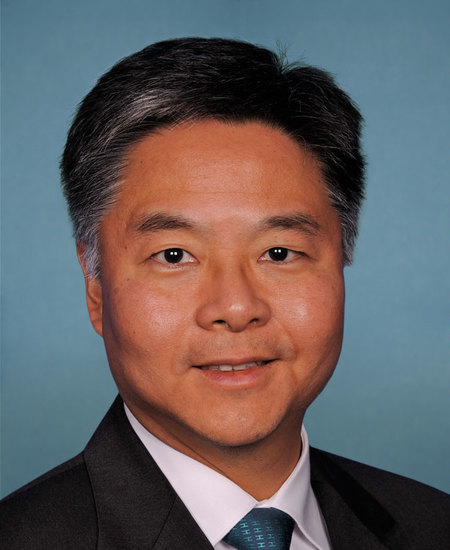
Rep. Ted Lieu
Sponsored bills
Raise the Wage Act of 2021 This bill increases the federal minimum wage for regular employees over a 5-year period, for tipped employees, and for newly hired employees who are less than 20 years old. The bill sets forth a schedule of annual increases in the federal minimum wage for individuals with disabilities. The Department of Labor shall no longer issue special certificates for the payment of subminimum wages to such individuals after the final wage increase under this bill for such individuals takes effect. Labor shall provide, upon request, technical assistance and information to employers to (1) help them transition their practices to comply with wage increases and other requirements under this bill for individuals with disabilities, and (2) ensure continuing employment opportunities for such individuals. The bill eliminates the separate minimum wage requirements for tipped, newly hired, and disabled employees. After a specified period, these employees shall be paid the same minimum wage as regular employees. Labor must publish any increase in the minimum wage in the Federal Register and on its website 60 days before it takes effect.
Access Technology Affordability Act of 2021 This bill allows a refundable tax credit equal to the amounts paid for qualified access technology for use by a blind individual who is the taxpayer, the taxpayer's spouse, or a dependent of the taxpayer. Qualified access technology is hardware, software, or other information technology with the primary function of converting or adapting information that is visually represented into forms or formats useable by blind individuals. The credit is limited to (1) costs that are not compensated by insurance or otherwise, and (2) an aggregate amount of $2,000 per blind individual in any period of three consecutive taxable years. The credit must be adjusted for inflation after 2021 and terminates after 2026.
COVID-19 Student Loan Relief Extension Act This bill extends certain temporary relief related to federal student loans and expands eligibility for such relief to additional types of loans. Specifically, the bill extends the current suspension of payments due on federal student loans to 30 days after the end of the COVID-19 (i.e., coronavirus disease 2019) public health emergency. It also extends the suspension of interest due on these loans until the economy shows specified initial signs of recovery. Further, the bill expands eligibility for temporary relief on federal student loans to include Federal Family Education Loans (FFELs) and Federal Perkins Loans that are not held by the Department of Education (ED) and certain health profession and nursing loans. (Currently, these temporary relief provisions are only applicable to certain Federal Direct Loans and FFELs that are held by ED.) Additionally, the bill makes this eligibility retroactive to March 13, 2020. Finally, ED and the Department of Health and Human Services must carry out a program, beginning on August 1, 2021, to provide at least six notices to borrowers that normal payment obligations will resume.

This bill repeals the prohibition on the use of certain funds by the Securities and Exchange Commission to implement a rule, regulation, or order to require the disclosure of political contributions, contributions to tax exempt organizations, or dues paid to trade associations.
This joint resolution prohibits the issuance of a manufacturing license, technical assistance license, or export license with respect to certain proposed agreements or transfers of specified defense articles or services to Saudi Arabia, the United Kingdom, Spain, or Italy.
This joint resolution prohibits the proposed foreign military sale of certain defense articles and services to Saudi Arabia.
End Dark Money Act This bill repeals in FY2021 the restriction on the use of funds by the Internal Revenue Service to issue any regulation or guidance relating to the standard for determining whether certain nonprofit civic organizations are being operated exclusively for the promotion of social welfare.
This resolution expresses support for the goals and ideals of Korean American Day and honors the 118th anniversary of the arrival of the first Korean immigrants to the United States.
This resolution expresses the sense of the House of Representatives that Congress should ensure that the U.S. Postal Service is not privatized and remains an independent establishment of the federal government.