

Maddy summaryThis bill establishes a new federal entity called the Language Access Board to ensure individuals with limited English proficiency can access government programs and services. The Board will be composed of 32 members, including public appointees and heads of federal agencies, who will develop standards for public-facing resources like websites and forms. Federal departments must comply with these accessibility standards, and the Board has the authority to investigate complaints and issue orders of compliance. Additionally, the Board will review existing language access laws and submit regular reports to Congress on progress and enforcement actions.
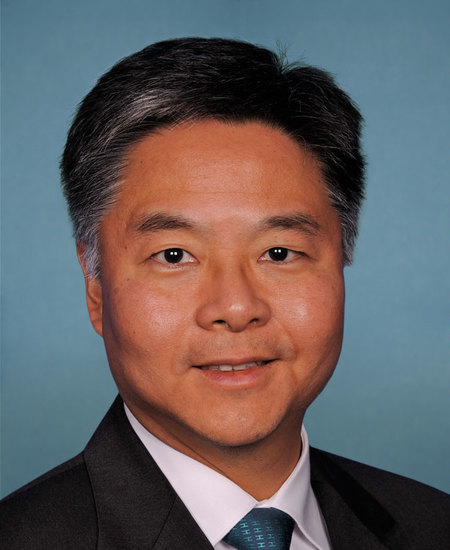
Rep. Ted Lieu
Sponsored bills
Maddy summaryThis bill, titled the Protecting Human Rights and Public Health in Foreign Assistance Act, aims to cancel specific regulations issued by the Department of State. It directly affects the federal government by prohibiting any department or agency from enforcing, implementing, or proposing rules related to protecting life, combating discriminatory equity ideology, and combating gender ideology in foreign aid programs. The legislation treats these cancelled rules as if they never existed, effectively nullifying their impact on future foreign assistance policies.
Maddy summaryHR 2488 designates the U.S. Postal Service facility at 3817 Marysville Boulevard in Sacramento, California, as the "Grantland Johnson Post Office." This bill updates all federal references in laws, maps, and documents to use the new name for that specific location. It directly affects the postal service facility and any federal records mentioning it. The bill is purely procedural, with no policy changes or financial impacts beyond the name designation.
Maddy summaryThis concurrent resolution directs the President to withdraw U.S. military forces from hostilities with Iran. It invokes Section 5(c) of the War Powers Resolution, which allows Congress to end ongoing military engagements. The bill permits keeping troops only if they are needed to defend the U.S. or its allies from an immediate attack, provided the President follows specific reporting rules. All other forces must be removed unless Congress has passed a formal declaration of war or a specific authorization for using military force against Iran.
Maddy summaryThe Living Wage For All Act raises the federal minimum wage in a tiered schedule, requiring large corporations to reach $25 per hour by 2031 while giving smaller businesses a longer timeline to catch up. Once the standard is met, the law automatically indexes the minimum wage to two-thirds of the national median hourly wage to ensure it keeps pace with economic changes. The bill also eliminates the lower minimum wage for tipped employees and youth workers, phasing them out until they match the general standard, and extends similar protections to incarcerated workers. Additionally, the legislation restricts the issuance of special minimum wage certificates for workers with disabilities and mandates that employers provide technical assistance during the transition period.
Maddy summaryThe American Leadership in AI Act establishes a new Center for AI Standards and Innovation at the National Institute of Standards and Technology to develop voluntary guidelines and testing methods for ensuring artificial intelligence systems are safe, secure, and reliable. It creates a large National Artificial Intelligence Research Resource to provide researchers and students with access to advanced computing power and data, while also launching prize competitions to solve specific challenges in areas like national security and health care. The bill mandates that every federal agency appoint a full-time Chief Artificial Intelligence Officer to oversee responsible AI use and requires the development of federal standards for AI procurement and security. Additionally, the legislation strengthens penalties for financial crimes committed using AI, protects workers who report AI safety violations from retaliation, and expands educational programs to improve AI literacy among K-12 students and the broader workforce.
Maddy summaryThe Piers Reinvestment Act expands federal funding opportunities for local governments to strengthen, upgrade, or improve municipal piers. It achieves this by adding piers to the list of eligible projects for resilience improvement grants and including them in at-risk coastal infrastructure grants. Additionally, the bill increases the total funding available for these coastal projects from $300 million to $500 million. This legislation directly affects municipalities and coastal communities that rely on piers for transportation, fishing, or tourism.
Maddy summaryThis bill amends the Marine Mammal Protection Act to require federal officials to identify marine mammal species and populations facing population declines due to climate change. It mandates the creation of specific management plans for these species, which must include strategies to reduce human impacts, monitor interactions with fisheries, and improve habitat resiliency. The legislation also establishes a new monitoring program to track climate effects and authorizes funding for these conservation efforts from 2027 through 2031.
Maddy summaryThis House Resolution commends the Holy See for its enduring diplomatic relationship with Taiwan and affirms the U.S. Congress's support for preserving these ties. It also recognizes Taiwan's commitment to religious freedom, contrasting it with actions by the People's Republic of China. The resolution encourages expanded engagement between Taiwan and the Holy See, specifically through increased high-level visits by clergy and church officials.
Maddy summaryThe "Funding Early Childhood is the Right IDEA Act" proposes to increase authorized funding for specific programs under the Individuals with Disabilities Education Act (IDEA). This bill sets new appropriation levels for Part C of IDEA, which provides early intervention services for infants and toddlers with disabilities and their families. It also increases authorized funding for Section 619 of IDEA, which supports preschool special education for children aged three to five. These funding authorizations are scheduled for fiscal years 2027 through 2031, directly affecting children with disabilities and the state and local agencies that provide these services.