Protection of Women in Olympic and Amateur Sports Act This bill requires certified national governing bodies (NGBs) of amateur sports (e.g., USA Gymnastics) to prohibit a person whose sex is male from participating in an amateur athletic competition that is designated for females, women, or girls. Under the bill, male means an individual who has, had, will have—or would have, but for a developmental or genetic anomaly or historical accident—the reproductive system that at some point produces, transports, and utilizes sperm for fertilization.
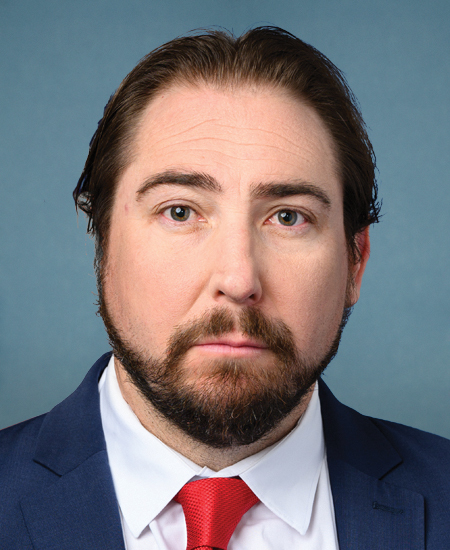
Rep. Elijah Crane
Sponsored bills
Maddy summaryThis bill amends an existing provision in the MAP-21 law to set a specific deadline for airports to transition to quieter aircraft technology. It directly affects airports and aircraft operators required to meet federal noise standards. The key change replaces a flexible "15 years after enactment" deadline with a fixed date of December 31, 2032, for compliance. This is a procedural amendment to an existing regulatory requirement, not a new policy.
Maddy summaryThe No Tax Dollars for Terrorists Act requires the U.S. State Department to identify foreign countries and organizations receiving U.S. foreign aid that have provided financial or material support to the Taliban, including the amounts of aid they receive and the support they give to the Taliban. It mandates a strategy to use U.S. aid to discourage such support, with initial and follow-up reports to Congress on the strategy and its implementation. The bill also demands detailed reports on U.S. cash assistance programs in Afghanistan and the Afghan Fund, explaining how funds are transferred (including traditional money transfer systems) and how safeguards prevent Taliban access.
Maddy summaryThe LASSO Act requires 10% of annual revenue generated from public lands managed by the Interior Department and Agriculture Department (including national forests and Outer Continental Shelf areas) to be deposited into the Social Security Trust Fund. This directly affects the Social Security Trust Fund by increasing its funding, while ensuring no fee hikes for public land activities or reductions in funds for states, tribes, or local governments. The bill mandates this transfer annually without altering existing revenue-sharing agreements or pricing structures. It aims to bolster Social Security finances through a specific, measurable mechanism tied to federal land management.
Maddy summaryHR 7421, the SAFE Olympic Sports Act, requires national governing bodies for Olympic sports to maintain eligibility rules based on an athlete's biological sex as defined in the bill. It mandates that competitions must restrict participation to athletes whose sex at conception aligns with the event's category (e.g., female-only events for those biologically female). The bill defines "sex" as an immutable biological classification determined at conception, with specific biological criteria for male and female. This applies to Olympic, Paralympic, Pan-American, and other sanctioned amateur competitions, requiring governing bodies to continue sanctioning single-sex events they previously approved.
Maddy summaryThis bill, titled the Stop Gender Trafficking of Minors Act, would create a new federal crime for knowingly transporting minors across state lines to receive gender transition procedures. The law defines these procedures to include puberty blockers, hormone therapy, and surgeries intended to alter sex characteristics, and would allow for up to ten years in prison or fines for violators. It also permits civil lawsuits by minors or parents seeking damages and prohibits federal funding for states that permit such transportation or refuse to cooperate with federal investigations. The legislation is based on the argument that the federal government has an interest in protecting minors from medical procedures that may cause long-term harm.
Maddy summaryThis bill modifies federal budget rules for unspent agency funds. It requires federal agencies to allocate 49% of unused funds to the next fiscal year, 49% toward paying the national debt, and 2% for retention bonuses (capped at 10% of an employee's base pay). Agencies must also limit future budget requests to the previous year's amount adjusted for inflation. The bill directly affects all executive branch agencies (excluding the Red Cross), altering how they manage leftover budget authority. It does not create new savings programs for individuals but changes government fiscal management procedures.
This bill directs the Forest Service to convey specified property to Gila County, Arizona, upon the county's submission of a written request for such conveyance. The property, identified as the Gila County Area, consists of approximately 232.9 acres of National Forest System land located in the Tonto National Forest in Arizona. The county must use the land for the purposes of serving and supporting veterans. If any land conveyed under this bill ceases to be used for such purpose, all right, title, and interest in and to the land shall revert to the United States, at the discretion of the Forest Service. The conveyance must be made with a quitclaim deed and without consideration (value, such as payment, provided in exchange for the property). The Forest Service must not be required to provide any covenant or warranty for the land and improvements conveyed to the county under such conveyance. As a condition of the conveyance, the county must pay all the costs associated with the conveyance, including any (1) surveys, (2) environmental analysis or resource survey required under federal law, and (3) analysis required to comply with certain provisions of the National Historic Preservation Act.
Safeguard American Voter Eligibility Act or the SAVE America Act This bill requires individuals to provide documentary proof of U.S. citizenship when registering to vote, and requires photo identification to vote, in federal elections. Specifically, the bill prohibits states from accepting and processing an application to register to vote in a federal election unless the applicant presents documentary proof of U.S. citizenship. The bill specifies what documents are considered acceptable proof of U.S. citizenship, such as identification that complies with the REAL ID Act of 2005 that indicates U.S. citizenship. Further, the bill (1) prohibits states from registering an individual to vote in a federal election unless, at the time the individual applies to register to vote, the individual provides documentary proof of U.S. citizenship; and (2) requires states to establish an alternative process to demonstrate U.S. citizenship. Each state must take affirmative steps on an ongoing basis to ensure that only U.S. citizens are registered to vote, which shall include establishing a program to identify individuals who are not U.S. citizens using information supplied by certain sources. Additionally, states must remove noncitizens from their official lists of eligible voters. The bill (1) provides for a private right of action for certain violations, and (2) establishes criminal penalties for certain offenses. Individuals voting in federal elections must present an eligible photo identification document. An individual who votes by absentee ballot must submit a copy of their identification document with both the request for, and the submission of, the absentee ballot.

Maddy summaryHR 1295, the Reorganizing Government Act of 2025, amends federal law to streamline executive branch operations. It requires all executive departments (like the Departments of Defense or Education) to eliminate unnecessary programs, reduce federal employee numbers, and cut burdensome regulations that increase compliance costs. The bill updates deadlines for reorganization plans from 1984 to 2026 and explicitly mandates that all government operations must serve the public interest. These changes apply broadly across the federal government, focusing on efficiency and cost reduction.