

Maddy summaryS 2023, the *Seeds and Breeds for the Future Act*, establishes a $75 million annual funding set-aside to support the development of publicly available plant and animal varieties through federally funded breeding programs. It directly affects public research institutions (like land-grant universities), breeders developing non-proprietary varieties, and farmers who use these public cultivars or animal breeds. Key mechanisms include requiring that any public cultivar or animal breed developed with federal funds must be produced substantially in the U.S., prioritizing projects for climate resilience and Indigenous food systems, and creating a USDA coordinator to oversee research coordination and public reporting. The bill mandates annual reports to Congress tracking funded projects, commercialized varieties, and research gaps.
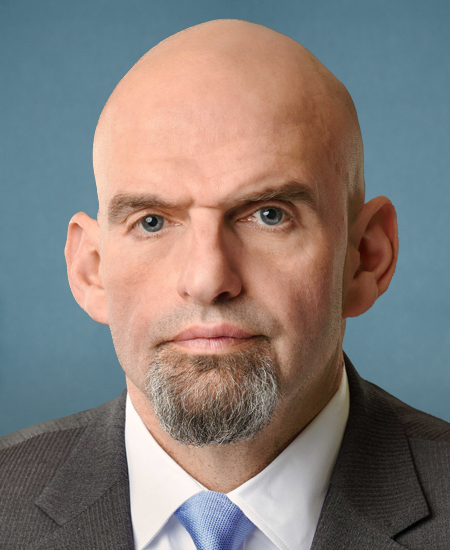
Sen. John Fetterman
Sponsored bills
Maddy summaryThis bill amends the de minimis import rule (allowing low-value shipments under $800 to enter duty-free) to block duty-free entry for goods from nonmarket economy countries (like China or Russia) or countries on a U.S. trade watch list. It requires importers to submit detailed documentation about the item's origin, value, shipper, and importer to U.S. Customs. Importers who provide false information face civil penalties of $5,000 for the first violation. The law directly affects businesses importing small shipments from targeted countries and increases U.S. Customs’ authority to detain and process such goods.
Maddy summaryThe SAFE Act of 2023 amends a federal law to prohibit the slaughter of horses and other equines (such as donkeys) for human consumption. It extends an existing ban on slaughtering dogs and cats for food to include equines, closing a gap in current law. The key change modifies Section 12515 of the 2018 Agriculture Improvement Act to replace "dog or cat" with "dog, cat, or equine" in the prohibition language. This directly affects meat processors and businesses that might have engaged in slaughtering equines for human consumption, making such activity illegal under federal law.
Maddy summaryThe Working Families Tax Relief Act of 2023 expands tax benefits for low-to-moderate income workers and families with children. It lowers the minimum age for the Earned Income Credit from 25 to 19 (with exceptions for students, former foster youth, and homeless youth), removes the age 65 maximum, and increases credit amounts and income thresholds. The bill also establishes a permanent system for monthly advance payments of the Child Tax Credit, with higher payments ($300 monthly) for children under age 6 compared to $250 for older children. It includes inflation adjustments to maintain the value of these credits over time and creates mechanisms for determining eligibility and recapturing payments in certain circumstances. The provisions apply to all states and U.S. territories, including Puerto Rico and American Samoa.
Maddy summaryThe Right to Contraception Act (S 1999) establishes a federal statutory right for individuals to access contraceptives and related information without government interference, directly affecting all people seeking reproductive care and health care providers who offer these services. Key provisions prohibit state or federal laws that restrict contraceptive access, single out contraceptive services, or allow provider refusals based on personal beliefs, while requiring any restrictions to be narrowly tailored to advance access. The bill preempts conflicting state laws, allows enforcement through lawsuits by affected individuals or the Attorney General, and explicitly protects access for historically marginalized groups facing barriers. It does not alter existing insurance coverage requirements under the Affordable Care Act but ensures contraceptive access remains protected from restrictive state policies.
Maddy summaryThis bill (S 1989) requires the U.S. Department of Agriculture to train regional and state employees who work on multifamily housing programs about the agency's rural housing and development initiatives. It mandates comprehensive training covering how to combine multiple programs for single projects, including loan/grant options under the 1949 Housing Act, technical assistance providers, and other federal housing programs like HOME and low-income housing tax credits. The training aims to improve employees' ability to support rural communities by explaining these interconnected resources. It directly affects Agriculture Department staff classified as national employees working on rural housing projects.
Maddy summaryS 305 authorizes the U.S. Mint to produce and sell commemorative coins (gold, silver, and half-dollar denominations) to mark the U.S. Marine Corps' 250th anniversary in 2025. Each coin sale includes a surcharge ($5 to $35 per coin) that will fund the Marine Corps Heritage Center's educational programs, with proceeds paid directly to the Marine Corps Heritage Foundation. The coins will be sold from January 1 to December 31, 2025, and the surcharge structure ensures no net cost to taxpayers by covering production expenses through sales. This bill directly affects the U.S. Mint (in coin production), the Marine Corps Heritage Foundation (as recipient of funds), and the public (as potential buyers).
Maddy summaryThis Senate resolution condemns Russia's deportation and forcible transfer of Ukrainian children from occupied territories, calling these actions violations of the Genocide Convention and Fourth Geneva Convention. It specifically references Russia's breaches of international law, including the unlawful transfer of children to Russia and efforts to erase Ukrainian identity through forced adoptions. The resolution declares these acts constitute genocide, targeting Ukrainian children to undermine Ukraine's future cultural and national identity. It directly addresses the Russian government's actions, which have affected thousands of children separated from their families since Russia's 2022 invasion.
Maddy summaryThe Bridge Corrosion Prevention and Repair Act of 2023 requires federal funding for highway and railroad bridge projects to implement corrosion management systems, including certified contractors and trained workers for tasks like surface preparation, coating application, and hazardous coating removal. It amends federal grant rules to allow funding specifically for corrosion control work on rail bridges and mandates a study on inspecting and maintaining weathering steel bridges - vulnerable to corrosion, as highlighted by the 2022 Pittsburgh bridge collapse. These changes directly affect state transportation agencies, bridge contractors, and federal programs managing infrastructure. The bill focuses on concrete standards for prevention, not outcomes or political advocacy.
Maddy summaryThis bill changes school lunch rules to allow schools to serve whole milk as part of the National School Lunch Program. It amends the law to explicitly include "whole, reduced-fat, low-fat, and fat-free" milks as acceptable options. Crucially, it clarifies that milk fat in fluid milk provided under this rule will not count toward the meal's saturated fat limit for compliance purposes. This directly affects school nutrition programs nationwide by expanding milk choices and simplifying meal planning around fat content.