

Maddy summaryThe Workforce Recovery and Resilience Act amends the Workforce Innovation and Opportunity Act to direct federal resources toward communities significantly affected by high rates of substance use disorders. It requires the Secretary of Labor to annually update and distribute evidence-based practices to states and local areas for addressing the economic impacts of these disorders. Additionally, the bill creates a new category of national dislocated worker grants that can be awarded to entities providing employment and training related to addiction treatment, mental health care, and pain management in areas where demand exceeds local resources. Eligible recipients for this assistance include dislocated workers, long-term unemployed individuals, those underemployed due to widespread substance use, and healthcare professionals involved in these treatment fields.
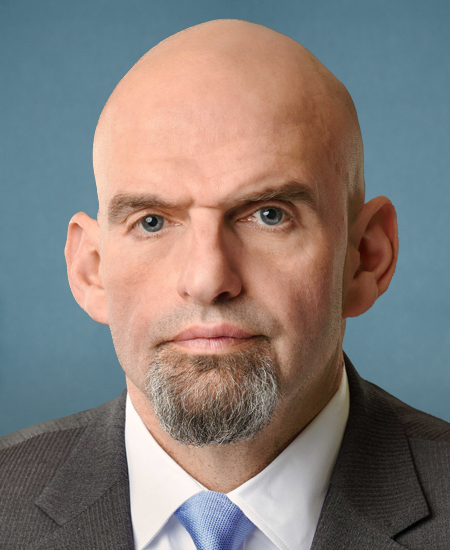
Sen. John Fetterman
Sponsored bills
Maddy summaryThe Stroke Act directs the Department of Health and Human Services to conduct research on stroke care delivery and award grants to improve national stroke data collection and quality. The legislation authorizes funding for a national stroke registry that gathers standardized information from various types of hospitals to support quality improvement and benchmarking. Additionally, it provides grants for training emergency medical personnel, expanding telestroke services in underserved areas, and coordinating post-stroke rehabilitation. Finally, the bill funds a national public education campaign aimed at promoting stroke prevention and encouraging individuals to seek immediate treatment for symptoms.
Maddy summaryThe Kids Online Safety Act (S 1748) requires major social media platforms, online video games, and other "covered platforms" to implement specific safety features for minors (under 17). These features include default privacy settings that limit harmful design features like infinite scrolling and auto-play, parental controls for managing minors' accounts, and restrictions on advertising illegal products to minors. The bill also mandates annual transparency reports about how platforms are used by minors and requires platforms to provide clear notices about their content algorithms. It creates a Kids Online Safety Council to advise Congress on online safety issues for children. The law applies to platforms with more than 10 million monthly users in the U.S. and takes effect 18 months after enactment.
Maddy summaryThis resolution designates August 1, 2026, as Gold Star Children's Day to honor the sacrifices and hardships faced by children of fallen members of the U.S. Armed Forces. The bill does not create new laws or change government operations; instead, it serves as a formal expression of gratitude from the Senate and encourages the public to observe this day in support of these families. By establishing this specific date, the measure aims to raise awareness about the legacy carried by children who lost a parent in military service.
Maddy summaryThis resolution designates the week of August 2 through August 8, 2026, as "National Farmers Market Week" to honor the importance of local food markets. It serves as a symbolic gesture to recognize how these markets support farmers' livelihoods, strengthen local economies, and connect urban and rural communities. The bill does not create new laws or funding but instead formally acknowledges the role farmers markets play in promoting sustainable farming and public health.
Maddy summaryThe Lori Jackson-Nicolette Elias Domestic Violence Survivor Protection Act expands federal firearm restrictions to include individuals subject to any domestic violence restraining order, including temporary or emergency orders issued without the abuser's presence. It broadens the legal definition of an "intimate partner" to cover dating partners and other relationships protected by state laws, closing previous loopholes that allowed some abusers to keep guns. The bill also creates a federal grant program for states and tribes to fund the removal, storage, and return of firearms from individuals subject to these orders, requiring them to partner with local domestic violence service providers to ensure victim safety.
Maddy summaryThe Spotted Lanternfly Research and Development Act designates the fight against the invasive spotted lanternfly as a top research priority for federal agricultural programs. It authorizes the issuance of grants to develop and share new tools and treatments aimed at controlling this pest. Additionally, the bill extends the funding period for these high-priority agricultural research initiatives from 2023 to 2028.
Maddy summaryThis bill updates federal laws to ensure that members of the Army, Navy, Marine Corps, Air Force, and Space Force cannot be excluded from jobs or assignments based on their gender. It requires the Department of Defense to establish occupational standards using scientifically rigorous methods that evaluate technical, tactical, cognitive, and physical abilities without gender bias. Additionally, the legislation mandates annual reports to Congress detailing any involuntary reclassifications or separations and requires a detailed review of the operational effectiveness of Army and Marine Corps ground combat units. These changes are scheduled to take effect on September 30, 2026, with the first required report due the following year.
Maddy summaryThe Kidd's Stuttering Act requires Medicaid and CHIP programs to include screening for childhood-onset fluency disorders, such as stuttering, in well-child visits for children aged 2 to 6. Starting in 2028, these screenings must be added to standard health quality measures, and by 2029, states must provide coverage for specific speech therapy services treating these disorders. The law ensures that coverage for stuttering therapy is not more restrictive than coverage for other speech and language disorders and allows these services to be delivered via telehealth. Additionally, managed care organizations and insurance plans must follow established rules to guarantee equal access to these treatments.
Maddy summaryThis bill strengthens protections and administrative processes for whistleblowers who report violations to the Commodity Futures Trading Commission. It expands the definition of a whistleblower to include individuals reporting misconduct to supervisors or internal investigators, while also adding a right to a jury trial for those facing retaliation. The legislation requires registered entities to provide mandatory training to employees about whistleblower rights and mandates that the Commission issue preliminary decisions on award claims within one year. Additionally, the bill creates a separate account within the Commission's customer protection fund to finance education initiatives and administrative expenses, and it increases the fund's total capacity.