

Access to Contraception for Servicemembers and Dependents Act of 2021 This bill addresses Department of Defense (DOD) contraceptive care and family planning services. Specifically, the bill prohibits cost-sharing requirements with respect to TRICARE beneficiaries for specified prescription contraceptives. Additionally, the bill prohibits cost-sharing requirements for TRICARE Select and TRICARE Prime beneficiaries in relation to any in-network method of contraception or contraceptive care (including with respect to insertion, removal, and follow-up), any sterilization procedure, or any related patient education or counseling service. The bill requires DOD to provide information on all methods of emergency contraception and care to sexual assault survivors at its medical treatment facilities. Upon request by a sexual assault survivor, DOD must provide such emergency contraception or a prescription for emergency contraception. Finally, DOD must establish a uniform standard curriculum for education programs on family planning for all members of the Armed Forces. Such education programs must be provided to service members during their first year of service and at other appropriate times, as determined by each military department.
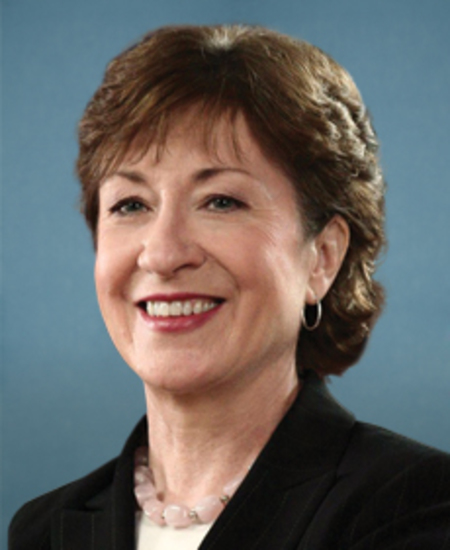
Sen. Susan M. Collins
Sponsored bills
Big Cat Public Safety Act This bill revises requirements governing the trade of big cats (i.e., species of lion, tiger, leopard, cheetah, jaguar, or cougar or any hybrid of such species). Specifically, it revises restrictions on the possession and exhibition of big cats, including to restrict direct contact between the public and big cats.
Fair PPP Accounting Act This bill modifies eligibility for second draw loans under the Paycheck Protection Program, established to support small businesses in response to COVID-19 (i.e., coronavirus disease 2019). Specifically, the bill provides for a period of 90 consecutive days to determine whether a borrower experienced a loss in revenue from 2019 to 2020 that qualifies them for a second draw loan. Currently, this qualification period must align with a corresponding calendar quarter from the previous year.
This resolution designates April 17, 2021, through April 25, 2021, as National Park Week. The resolution also encourages the people of the United States and the world to responsibly visit, experience, and support the treasured national parks of the United States while protecting public health during the coronavirus pandemic.
Seasonal Business PPP Parity Act This bill increases the maximum loan amount for second draw loans under the Paycheck Protection Program, which was established to support small businesses in response to the COVID-19 pandemic. Currently, program participants may receive second draw loans of up to $2 million. Under the program, certain small businesses (e.g., seasonal businesses) were eligible to receive increased amounts for first draw loans based on a revised calculation applicable to those businesses. However, a number of such businesses applied for and received loan forgiveness prior to the application of this revised calculation, which resulted in their receiving a lower amount than that to which they were entitled. The bill allows businesses that received forgiveness for their first draw loan prior to the implementation of the revised calculation to take advantage of the new calculation in order to receive a larger amount for their second draw loan in addition to the standard loan amount of up to $2 million.
United States-Israel Cybersecurity Cooperation Enhancement Act of 2021 This bill requires the Department of Homeland Security to establish a grant program that contributes to the homeland security capabilities of both the United States and Israel by supporting cybersecurity research and development as well as the demonstration and commercialization of cybersecurity technology. Grant applicants must address a requirement in the area of cybersecurity research or cybersecurity technology and be comprised of a joint venture between a U.S. entity and an Israeli entity (or the governments of each country).
Biomass Thermal Utilization Act of 2021 or the BTU Act of 2021 This bill expands the 30% energy tax credit to include open-loop biomass heating property and extends the residential energy efficient property tax credit for five years. The bill defines open-loop biomass heating property as any property that uses open-loop biomass to produce thermal energy in the form of heat, hot water, hot air, or steam and is used for space heating, air conditioning, domestic hot water, or industrial process heat, but does not include any boiler or furnace unless they operate at thermal output efficiencies of at least 75% and are installed indoors.
Summer Meals Act of 2021 This bill revises provisions related to the Summer Food Service Program (SFSP) of the Department of Agriculture (USDA), which provides meals to children and teens in low-income areas during the summer months when school is not in session. The bill redefines areas in which poor economic conditions exist , where the SFSP may operate, as areas in which at least 40% (currently, 50%) of the children have been determined to be eligible for free or reduced price school meals under the school lunch and breakfast programs. The bill reimburses service institutions (other than school food authorities) for up to one meal and one snack per child each day during after-school hours, weekends, and school holidays during the regular school calendar. Currently, such institutions are reimbursed for meals and snacks served to children over the summer months or to children who are on vacation under a continuous school calendar. USDA must award competitive grants to service institutions to increase participation in the summer food service program for children who lack the ability to access a congregate feeding site through (1) innovative approaches to limited transportation, (2) mobile meal trucks, and (3) any other method or approach that does not require children to access a congregate feeding site. Service institutions that are participating in the summer food service program for children may serve up to three meals, or two meals and one snack, during each day of operation. Currently, this option is reserved for camps and service institutions that serve meals primarily to migrant children.
Cultivating Opportunity and Recovery from the Pandemic through Service Act or the CORPS Act This bill expands and modifies the administration of national service programs, including the National Senior Corps, to address the COVID-19 pandemic and its recovery period (i.e., through FY2024). The bill also (1) revises certain living allowances of particular national service corps participants; (2) expands the Senior Service Corps; (3) establishes a COVID-19 educational award; (4) implements a pilot program under which state commissions may directly place individuals in approved national service positions; and (5) excludes from gross income, for income tax purposes, any living allowance provided to national public service participants and any national service educational award.
Affordable Housing Credit Improvement Act of 2021 This bill revises provisions of the low-income housing tax credit and renames it as the affordable housing credit . The bill increases the per capita dollar amount of the credit and its minimum ceiling amount beginning in 2021 and extends the inflation adjustment for such amounts. The bill modifies tenant income eligibility requirements and the average income formula for determining such income. It also revises rules for student occupancy of rental units and tenant voucher payments, and prohibits any refusal to rent to victims of domestic abuse. The bill further modifies the credit to increase state allocations of the credit; repeal the qualified census tract population cap; prohibit local approval and contribution requirements; increase the credit for certain projects designated to serve extremely low-income households; increase the credit for certain bond-financed projects designated by state agencies; eliminate the basis reduction for properties that receive certain energy-related tax benefits; and increase the population cap for difficult development areas (i.e., areas with high construction, land, and utility costs relative to area median gross income). The bill also includes Indian and rural areas as difficult development areas and modifies other requirements relating to casualty losses, acquisition credits, and foreclosures.