

Maddy summaryThis resolution expresses the House of Representatives' opinion that the Department of Justice and other federal agencies should not administratively settle legal claims for money filed against the United States by a sitting President, specifically referencing President Donald Trump. The House believes that such settlements would violate the Domestic Emoluments Clause of the Constitution, which prevents a President from receiving payments from the government beyond their official salary. Therefore, the resolution advises the Department of Justice to refuse any administrative settlement of these claims, while clarifying that a President can still pursue lawsuits in independent courts. This position directly affects how the Department of Justice would handle such claims from a President.
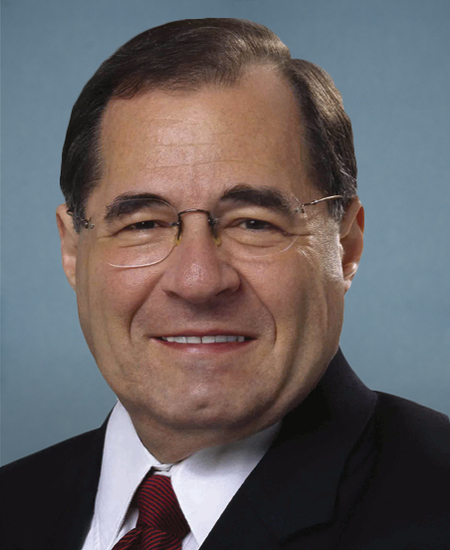
Rep. Jerrold Nadler
Sponsored bills
Maddy summaryThe Transit Workforce Development Act expands how federal grants for buses and bus facilities can be used for workforce training. It increases the portion of these grants that transit agencies can dedicate to workforce development from 5% to 10% of the allocated funds. Additionally, the bill broadens the types of training eligible for these funds, allowing them to cover all buses, related equipment, and facility construction,
Maddy summaryThis concurrent resolution (HCONRES 40) directs the President to remove U.S. military forces from hostilities with Iran, as required by the War Powers Resolution. It applies directly to U.S. Armed Forces deployed in conflict with Iran, except for forces needed to defend the U.S. or allies from imminent attack. The bill mandates removal unless the President complies with War Powers Resolution reporting requirements for self-defense actions, without needing new congressional authorization. As a procedural resolution, it does not create new law but compels executive action under existing legal framework.
Maddy summaryThis bill establishes a 17-member Commission on Presidential Capacity to Discharge the Powers and Duties of the Office. This commission, composed primarily of medical professionals and former high-ranking executive officials, would be activated by a concurrent resolution of Congress. Its duty would be to conduct a medical examination of the President to determine if they are mentally or physically unable to discharge the powers and duties of the office due to conditions such as illness, disability, or substance use. Following the examination, the commission would report its findings and a declaration on the President's capacity to Congress and the Vice President, with any refusal by the President to undergo examination taken into consideration.
Maddy summaryThe Helicopter Safety Parity Act of 2026 requires turbine-powered helicopters carrying two or more passengers to follow the same safety standards as commercial airlines, including stricter rules for pilot training, rest periods, maintenance, and equipment. This legislation directly affects helicopter operators currently regulated under Part 135 of federal aviation regulations, mandating compliance with Part 121 airline standards within 24 months of enactment. Key provisions include requirements for terrain awareness systems, cockpit and flight data recording, and the elimination of inconsistent exemptions by the Federal Aviation Administration. The bill also authorizes $50 million annually through 2030 for enforcement, oversight, and hiring additional safety inspectors, while excluding emergency medical services operations from these requirements.
Maddy summaryThis concurrent resolution formally recognizes the ongoing disparity between wages paid to men and women in the United States and reaffirms Congress's commitment to supporting equal pay. It highlights statistical data showing that women earn approximately 81 cents for every dollar earned by men, with significant variations across racial and ethnic groups, and notes that the gender wage gap has widened over the past two years. The document also identifies contributing factors such as occupational segregation, lack of family-friendly workplace policies, and workplace harassment, while emphasizing the economic impact on women's retirement security and family incomes.
Maddy summaryHR 6194, the Protecting Americans from Russian Litigation Act of 2025, prevents U.S. persons (individuals or businesses) from facing civil lawsuits in U.S. courts related to complying with U.S. sanctions or export controls. It blocks the enforcement of foreign court judgments or arbitral awards where the claim arose from actions taken to comply with U.S. sanctions, or where foreign courts based jurisdiction on those sanctions. The law requires federal or state courts to dismiss such cases and applies broadly to all U.S. sanctions, not just those targeting Russia. Exceptions include lawsuits related to terrorism, torture, or contractual disputes resolved under U.S. courts or arbitration.
Maddy summaryThis bill establishes a new annual wealth tax on individuals with net assets exceeding $50 million, requiring them to pay a percentage of their total asset value each year. The tax applies a 2 percent rate to assets between $50 million and $1 billion, with a higher rate of 3 percent or 6 percent on assets above $1 billion depending on whether a universal health insurance program is enacted. Married couples are taxed as a single unit, and certain assets like primary residences and small personal items are excluded from the calculation. The legislation also mandates enhanced reporting requirements for asset values, requires the IRS to audit at least 30 percent of taxpayers subject to this tax annually, and authorizes $100 billion in funding over ten years to support enforcement and administration of the new tax system.
Extending WIC for New Moms Act This bill amends the Special Supplemental Nutrition Program for Women, Infants, and Children (WIC) to extend the eligibility periods for breastfeeding and postpartum women. Specifically, a state program may elect to certify a breastfeeding woman for up to 24 months (currently 1 year) postpartum. The bill also expands the eligibility period for postpartum women to up to 24 months after termination of pregnancy (currently 6 months). The Department of Agriculture must submit a report to Congress evaluating the effect of these changes to the program on (1) maternal and infant health outcomes, (2) breastfeeding rates, and (3) qualitative evaluations of family experiences under WIC.
Maddy summaryHR 7251, the "Prohibit Partisan Park Passes Act," amends federal law to prevent the use of living political figures on National Park Service and federal recreational lands passes. The bill specifically prohibits including images of current or former elected officials or other living political figures on these passes. This change directly affects the National Park Service, which issues the passes, and ensures the design remains neutral. The law modifies existing regulations under the Federal Lands Recreation Enhancement Act to remove partisan imagery from these commonly used visitor passes.