

Women's Health Protection Act of 2021 This bill prohibits governmental restrictions on the provision of, and access to, abortion services. Specifically, governments may not limit a provider's ability to prescribe certain drugs, offer abortion services via telemedicine, or immediately provide abortion services when the provider determines a delay risks the patient's health. Furthermore, governments may not require a provider to perform unnecessary medical procedures, provide medically inaccurate information, comply with credentialing or other conditions that do not apply to providers whose services are medically comparable to abortions, or carry out all services connected to an abortion. In addition, governments may not (1) require patients to make medically unnecessary in-person visits before receiving abortion services or disclose their reasons for obtaining such services, or (2) prohibit abortion services before fetal viability or after fetal viability when a provider determines the pregnancy risks the patient's life or health. The bill also prohibits other governmental measures that are similar to the bill's specified restrictions or that otherwise single out and impede access to abortion services, unless a government demonstrates that the measure significantly advances the safety of abortion services or health of patients and cannot be achieved through less restrictive means. The Department of Justice, individuals, or providers may bring a lawsuit to enforce this bill, and states are not immune from suits for violations. The bill applies to restrictions imposed both prior and subsequent to the bill's enactment.
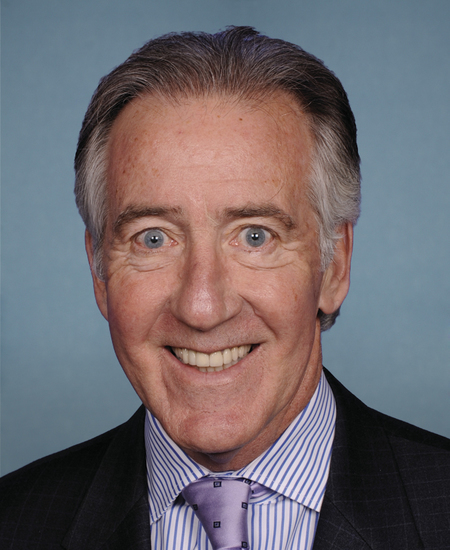
Rep. Richard E. Neal
Sponsored bills
America's Call To Improve Opportunities Now for National Service Act or the ACTION for National Service Act This bill (1) converts the Corporation for National and Community Service into the AmeriCorps Administration and revises its membership, leadership, and authority; (2) reauthorizes programs carried out by the administration; (3) establishes a National Service Foundation to accept and administer gifts on behalf of the administration; (4) modifies the calculation of national service educational awards; and (5) otherwise modifies provisions related to national and volunteer service programs. Additionally, the bill creates an interagency Civilian Climate Corps, operated by the administration, to conduct service projects addressing climate change.
First Rhode Island Regiment Congressional Gold Medal Act This bill provides for the award of a single Congressional Gold Medal to the First Rhode Island Regiment, collectively, in recognition of their dedicated service during the Revolutionary War.
This resolution supports the goals of National Catholic Schools Week, an event cosponsored by the National Catholic Educational Association and the U.S. Conference of Catholic Bishops and established to recognize the contributions of Catholic elementary and secondary schools in the United States.
This bill modifies provisions specifying the date for making refunds of the refundable portion of the child tax credit and the earned income tax credit to provide that no credit or refund of an overpayment resulting from such credits shall be made to a taxpayer before the earlier of the date on which the Internal Revenue Service completes a matching of information relevant to such credits and other wage information, or the 15th day of the second month after the close of the taxable year (i.e., February, for taxable years that are calendar years).
This bill posthumously provides for the award of a Congressional Gold Medal in commemoration of the 13 service members who died on August 26, 2021, while stationed at Hamid Karzai International Airport in Afghanistan.
Protecting Our Democracy Act This bill addresses issues involving (1) abuses of presidential power; (2) checks and balances, accountability, and transparency; and (3) election integrity and security. Specifically, regarding abuses of presidential power, the bill requires the Department of Justice (DOJ) and the President to submit to Congress specified materials relating to certain pardons, prohibits presidential self-pardons, suspends the statute of limitations for federal offenses committed by a sitting President or Vice President, prohibits the acceptance of foreign or domestic emoluments, and sets forth provisions regarding Office of Government Ethics and Office of Special Counsel jurisdiction and enforcement authority. To address checks and balances, accountability, and transparency, the bill authorizes specified actions to enforce congressional subpoenas, imposes limits on presidential declarations of emergencies, requires DOJ to maintain a log of specified communications between it and the White House, requires cause for removal of inspectors general, increases whistleblower protections, and requires a candidate for President or Vice President to provide copies of tax returns for the 10 most recent taxable years to the Federal Election Commission. To address election integrity and security, the bill requires federal campaign reporting of foreign contacts, makes various changes to requirements concerning foreign donations to political campaigns and candidates and foreign contributions to online electioneering communications, prohibits distribution of materially deceptive audio or visual media prior to an election (i.e., deepfakes), and establishes a program to support states and localities transition to ranked choice voting systems.
Protecting Community Television Act This bill revises the definition of a franchise fee that is paid by a cable operator or cable subscriber to encompass only a tax, fee, or other monetary assessment that is imposed by a franchising authority or other governmental entity.
Humane Cosmetics Act of 2021 This bill generally prohibits animal testing in the evaluation of cosmetic products, and it prohibits the sale or transport of cosmetics developed using animal testing, subject to civil penalties. These prohibitions begin one year after enactment. The bill specifies exceptions to these prohibitions, including if such animal testing (1) is conducted outside the United States to comply with a foreign regulatory authority; (2) is pursuant to a specified finding that there are no nonanimal alternatives to test the safety of a potentially dangerous cosmetic product or ingredient; (3) is of a product or ingredient for a drug or device subject to regulation by the Food and Drug Administration (FDA); or (4) is required for a noncosmetic purpose pursuant to a state, federal, or foreign regulatory authority. Further, no animal-testing evidence may be used to establish the safety of a cosmetic product or ingredient that is regulated by the FDA after the effective date of this bill, subject to limited exceptions.
Mental Health in International Development and Humanitarian Settings Act or the MINDS Act This bill directs the U.S. Agency for International Development (USAID) and the Department of State to integrate mental health and psychosocial support activities across all U.S. foreign assistance programs, with a particular focus on children and other vulnerable populations. To facilitate this integration, the bill makes organizational changes at the USAID. It authorizes the USAID to appoint a coordinator to oversee and direct mental health and psychosocial support activities. The coordinator must ensure that these activities focus on children, adult caretakers and families, displaced populations, and other vulnerable groups. In addition, the bill establishes a working group comprised of representatives from every USAID bureau and the Department of State to coordinate interagency efforts related to, promote best practices for, and ensure sustainability and continuity of mental health and psychosocial support activities. The USAID and the State Department must brief Congress about the amount of foreign assistance spending on mental health and psychosocial support activities and related matters.