

Maddy summaryHR 162, the First Amendment Accountability Act, creates a legal right for individuals to sue federal employees who violate their First Amendment rights (such as free speech or assembly) while acting under government authority. It directly affects citizens whose rights are infringed and federal employees (excluding the President/Vice President) who may face lawsuits. The bill allows victims to seek redress through court action, with courts having discretion to award attorney fees to the winning party. It explicitly excludes lawsuits against the federal government or employer for conduct within the scope of employment.
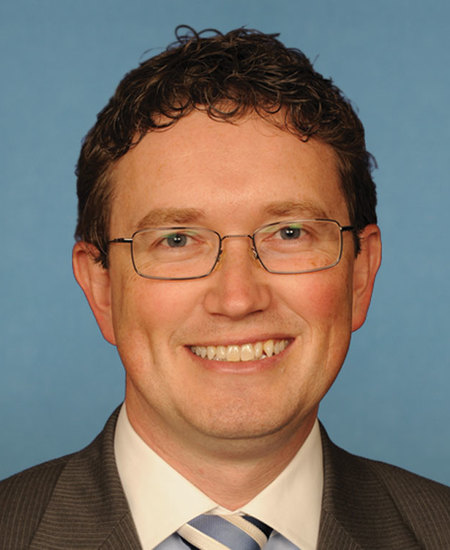
Rep. Thomas Massie
Sponsored bills
Maddy summaryThis bill requires Congress to approve major federal regulations before they take effect. It would mandate that agencies submit detailed reports including cost-benefit analyses, economic impact assessments, and other information to Congress before implementing significant regulations. Major rules - defined as those with at least $100 million annual economic impact or significant effects on costs, competition, or employment - would need a joint resolution of approval from Congress within 70 session days. Nonmajor rules would follow a less stringent disapproval process. The bill aims to increase legislative oversight of the regulatory process, requiring Congress to formally review and approve rules that significantly impact the economy or public regulations.
Maddy summaryThe ARTICLE ONE Act would significantly increase congressional oversight of national emergencies by requiring the President to specify which laws they plan to use during an emergency and giving Congress 30 days to approve the declaration before emergency powers can be exercised. The bill would mandate detailed reports from the President about the emergency's circumstances, estimated duration, and planned actions, with additional reports every six months during the emergency. If Congress doesn't approve an emergency declaration within 30 days, the President cannot extend it or use the emergency powers for the same situation. This would limit national emergencies to 30 days unless renewed through congressional approval, fundamentally changing how presidential emergency powers operate.
Maddy summaryThe FOCA Act of 2023 requires federal agencies to stop mandating or banning contractor agreements with labor organizations (like union contracts) in construction project bids and contracts. It directly affects federal contractors, subcontractors, and agencies managing construction projects funded by the government. The bill prohibits favoring or penalizing contractors based on their labor affiliation status, aiming to promote fair competition and reduce costs. It also mandates updates to federal contracting rules within 60 days of enactment to implement these changes.
Maddy summaryThis bill adds audiology services to Medicare's covered benefits under Section 1861(s)(2)(KK), effective January 1, 2025. It allows qualified audiologists to provide hearing and balance assessments and diagnostic/treatment services without requiring a physician referral or supervision, directly affecting Medicare beneficiaries seeking these services and audiologists practicing under state law. Payment will be 80% of the lower of actual charge or the Medicare fee schedule. The bill does not expand the types of audiology services covered but changes how they are accessed and paid for under Medicare.
Maddy summaryThis bill repeals the tax on Social Security benefits for seniors, making those benefits fully tax-free. It directly affects seniors who receive Social Security benefits and are currently subject to income tax on a portion of those payments. The key provision removes Section 86 of the tax code that previously included benefits in gross income, while a separate funding mechanism appropriates money to Social Security trust funds to replace the lost revenue. The bill ensures Social Security trust funds remain fully funded without requiring new tax increases.
Maddy summaryThe Pharmacy Benefit Manager Sunshine and Accountability Act requires Pharmacy Benefit Managers (PBMs) to publicly disclose detailed financial information about their contracts with drug manufacturers and health plans. Specifically, PBMs must report total rebates received, administrative fees collected, amounts retained (not passed through to health plans), and the retained rebate percentage for each contract. This data, including the highest and lowest retained rebate percentages across all contracts, must be submitted annually to the Department of Health and Human Services and published on a public website. The bill directly affects PBMs and the health plans/insurance issuers they serve by increasing transparency in how drug pricing and rebates are managed.
Maddy summaryHR 1610 would modernize Medicare coverage for chiropractic care by removing the current restriction that limited beneficiaries to one chiropractic service per visit. It expands coverage to include all services provided by licensed chiropractors within their state-authorized scope, aligning Medicare with VA, military, and private insurance practices. The bill requires chiropractors to complete a Secretary-approved educational webinar to cover non-spinal services, while still allowing payment for spinal manipulation treatments without this requirement. This directly affects Medicare beneficiaries seeking chiropractic care and chiropractors seeking Medicare reimbursement for their services.
Maddy summaryThis bill amends the Social Security Act to exclude wages earned and self-employment income derived from unauthorized employment in the United States from being counted toward Social Security credits. It directly affects undocumented immigrants who work without authorization, preventing those earnings from contributing to their future Social Security benefits. The law changes existing Social Security rules by adding specific exclusions for "service performed by an alien while employed... not authorized to be so employed" and similar self-employment activities. These changes apply to all wages and income earned before, during, or after the bill's enactment, with Social Security recompiling existing benefit calculations to reflect the new rules.
Maddy summaryHR 497, the Freedom for Health Care Workers Act, eliminates a federal requirement for healthcare workers in Medicare and Medicaid programs to be vaccinated against COVID-19. The bill directly affects healthcare providers who treat patients under these federally funded programs by preventing the enforcement of the November 2021 HHS rule mandating staff vaccinations. Its key provision prohibits the Department of Health and Human Services from implementing, enforcing, or creating a similar rule regarding vaccination for these workers. This bill changes the policy by removing a specific vaccine mandate for providers in Medicare and Medicaid programs.