

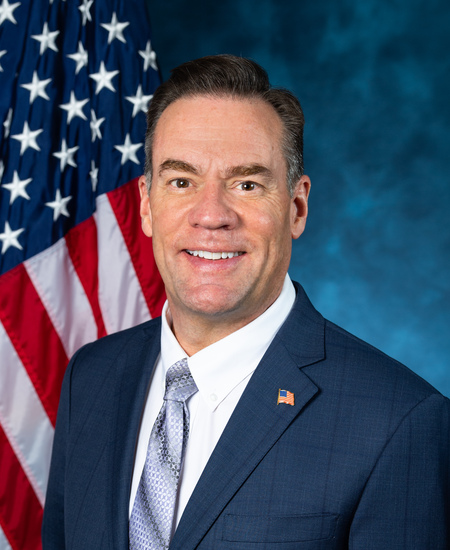
Photo of Russ Fulcher
R United States House · District 1 · Idaho On the 2026 ballot

Rep. Russ Fulcher

Compare
Total votes
2,818
all sessions
Attendance
98%
66 missed
Near the chamber average
With party
92%
of cast votes
Lower than 84% of chamber peers
Bipartisan score
4%
crosses aisle rarely
Higher than 83% of chamber peers
Sponsored
594
bills & resolutions
Near the chamber average
Committees
7
assignments
594 bills and resolutions

Sponsored bills

Total
594
Primary
41
Co-sponsor
553
This page
594
matching current filters
Co-sponsor HR 2072
In committee · Delaware House · Co-sponsor
To require the Federal Energy Regulatory Commission to extend the time period during which licensees are required to commence construction of certain hydropower projects.

Maddy summaryHR 2072 allows hydropower project licensees to request extended construction timelines from the Federal Energy Regulatory Commission (FERC). It specifically applies to projects licensed before March 13, 2020, with original construction deadlines expiring after December 31, 2023. FERC may extend the construction period by up to 6 additional years (in 2-year increments) if a licensee demonstrates good cause, and will automatically reinstate expired licenses for affected projects upon the bill's enactment. This bill directly affects hydropower developers whose licenses were nearing expiration due to delays, providing administrative flexibility without changing core licensing requirements.

In committee Feb 2, 2026 1 co-sponsor
Co-sponsor HR 7296
In committee · Delaware House · Co-sponsor
SAVE America Act

Safeguard American Voter Eligibility Act or the SAVE America Act This bill requires individuals to provide documentary proof of U.S. citizenship when registering to vote, and requires photo identification to vote, in federal elections. Specifically, the bill prohibits states from accepting and processing an application to register to vote in a federal election unless the applicant presents documentary proof of U.S. citizenship. The bill specifies what documents are considered acceptable proof of U.S. citizenship, such as identification that complies with the REAL ID Act of 2005 that indicates U.S. citizenship. Further, the bill (1) prohibits states from registering an individual to vote in a federal election unless, at the time the individual applies to register to vote, the individual provides documentary proof of U.S. citizenship; and (2) requires states to establish an alternative process to demonstrate U.S. citizenship. Each state must take affirmative steps on an ongoing basis to ensure that only U.S. citizens are registered to vote, which shall include establishing a program to identify individuals who are not U.S. citizens using information supplied by certain sources. Additionally, states must remove noncitizens from their official lists of eligible voters. The bill (1) provides for a private right of action for certain violations, and (2) establishes criminal penalties for certain offenses. Individuals voting in federal elections must present an eligible photo identification document. An individual who votes by absentee ballot must submit a copy of their identification document with both the request for, and the submission of, the absentee ballot.

In committee Jan 30, 2026 1 co-sponsor
Co-sponsor HR 6945
Passed · Delaware House · Co-sponsor
Supporting Pregnant and Parenting Women and Families Act

Maddy summaryHR 6945 clarifies that states may use federal grants under Section 403 of the Social Security Act to support pregnancy centers meeting specific criteria. These centers must promote protecting both mother and unborn child life while providing services like counseling, pregnancy testing, and material support (e.g., diapers, baby clothes). The bill explicitly prohibits interpreting existing law as barring such funding for eligible centers. It does not create new funding but defines which pregnancy resource organizations qualify for existing grants.

Passed Jan 26, 2026 1 co-sponsor
Co-sponsor HR 1723
In committee · Delaware House · Co-sponsor
Tribal Labor Sovereignty Act of 2025

Maddy summaryThe Tribal Labor Sovereignty Act of 2025 amends the National Labor Relations Act to explicitly include tribal governments and their enterprises as covered employers under federal labor law. It adds new definitions clarifying that "Indian tribe," "Indian," and "Indian lands" encompass federally recognized tribes, their members, and lands held in trust or within reservation boundaries. This change directly affects tribal nations, their member-owned businesses, and tribal employees by bringing them under the same labor protections (like collective bargaining rights) previously applicable to most private-sector employers. The bill does not create new programs but adjusts the legal definition to ensure tribal entities operating on tribal lands are subject to the NLRA’s standard labor regulations.

In committee Jan 16, 2026 1 co-sponsor
Co-sponsor HR 7074
In committee · Delaware House · Co-sponsor
Keeping Public Lands Out of Adversarial Hands Act

Maddy summaryHR 7074 requires the Secretary of the Interior to join the Committee on Foreign Investment in the United States (CFIUS) when reviewing transactions involving land or resources near federal lands managed by agencies like the Bureau of Land Management, National Park Service, or Bureau of Indian Affairs. It specifically targets acquisitions by foreign entities from China, North Korea, Russia, or Iran, mandating CFIUS to assess whether such transactions - reported by the Interior Secretary - constitute a "covered transaction" requiring review. The bill creates a new process for evaluating these land deals, with the review ending for a specific country once it’s removed from the U.S. list of "foreign adversaries." This directly affects foreign buyers from those four nations seeking to acquire land adjacent to federally protected areas.

In committee Jan 14, 2026 1 co-sponsor
Co-sponsor HR 6277
In committee · Delaware House · Co-sponsor
SAWMILL Act

Maddy summaryHR 6277, the SAWMILL Act, creates a loan guarantee program to support rural sawmills and wood-processing facilities. It provides guaranteed loans to eligible entities (like sawmill owners in rural areas) seeking to establish, expand, or improve operations within 250 miles of federal lands identified for ecological restoration involving vegetation removal. The program aims to reduce the cost of these restoration projects by ensuring local mills process the removed vegetation. The Department of Agriculture will offer up to $220 million in total loan guarantees under this program, with specific conditions set by the Secretary.

In committee Jan 13, 2026 1 co-sponsor
Co-sponsor HR 187
Signed into law · Delaware House · Co-sponsor
MAPWaters Act of 2025

Modernizing Access to our Public Waters Act or the MAPWaters Act of 2025 or the MAPWaters Act of 2025 This act directs the Forest Service and the Department of the Interior to standardize and publish data relating to the public's access to federal waterways for recreational use. (Sec. 3) The Forest Service and Interior must jointly develop and adopt interagency standards for data collection and dissemination of geospatial data relating to public outdoor recreational access of federal waterways and federal fishing restrictions. The standards must ensure compatibility and interoperability among applicable federal databases with respect to collection and dissemination of such data. (Sec. 4) Within five years, the Forest Service and Interior must also digitize and make publicly available online certain geographic information system data about (1) federal waterway restrictions, (2) federal waterway access and navigation information, and (3) federal fishing restrictions. They must also update the data about waterway restrictions, waterway access, and navigation information at least twice per year. Data about fishing restrictions must be updated in real time as changes go into effect. The Forest Service and Interior must also develop a process to allow members of the public to submit questions or comments regarding the data regarding waterway restrictions, waterway access, and navigation information. The requirements under this section do not apply to irrigation canals and flowage easements. (Sec. 5) To carry out the act, the Forest Service and Interior may (1) coordinate and partner with nonfederal agencies, private entities, and nonprofit partners; and (2) enter into agreements with third parties. The Forest Service and Interior may work with the U.S. Geological Survey to collect, aggregate, digitize, standardize, and publish data on their behalf. (Sec. 6) The Forest Service and Interior must annually report to specified congressional committees on their progress in meeting the requirements of this act.

Signed into law Dec 26, 2025 1 co-sponsor
Co-sponsor HR 6873
In committee · Delaware House · Co-sponsor
Geothermal Tax Parity Act

Maddy summaryThe Geothermal Tax Parity Act (HR 6873) updates U.S. tax code to treat geothermal energy projects the same as oil and gas projects for tax purposes. It allows geothermal developers to deduct exploration and development costs (amortization) and removes restrictions on passive loss deductions that previously limited geothermal investments. This directly affects geothermal energy companies, investors, and developers by providing tax parity with the oil and gas industry. The changes apply to taxable years beginning after the bill’s enactment date. The bill makes no new funding commitments but adjusts existing tax rules to support geothermal development.

In committee Dec 18, 2025 1 co-sponsor
Co-sponsor HR 845
Passed · Delaware House · Co-sponsor
Pet and Livestock Protection Act

Maddy summaryThis bill, titled "Pet and Livestock Protection Act," is misleading; it actually focuses on gray wolf management. It requires the Secretary of the Interior to reissue a 2020 rule removing gray wolves from the endangered species list within 60 days of enactment. The bill also prohibits courts from reviewing this reissuance. This directly affects gray wolf populations and management policies in states where wolves are present, shifting regulatory control away from federal endangered species protections.

Passed Dec 18, 2025 1 co-sponsor
Co-sponsor HR 6766
In committee · Delaware House · Co-sponsor
Essential Caregivers Act of 2025

Essential Caregivers Act of 2025   This bill prohibits certain health care facilities from limiting the access of essential caregivers to residents of those facilities, including during designated emergency periods.   Specifically, the bill generally prohibits Medicare skilled nursing facilities, Medicaid nursing facilities, Medicaid intermediate care facilities, and associated inpatient rehabilitation facilities from restricting the access of essential caregivers to residents of the facilities, including during emergency periods in which visitation rights are otherwise restricted. During emergency periods, facilities may restrict access for an initial period of up to seven days and for one additional maximum seven-day period (if the additional period is approved by the state health department). Facilities may restrict access for a total of 7 days (or 14 days with the approval of the state health department) during an emergency period. Essential caregivers must agree to comply with any safety protocols set by the facility, which may be no more stringent for caregivers compared to those for staff. Caregivers who fail to comply with these requirements may be denied access, subject to an appeals process.

In committee Dec 16, 2025 1 co-sponsor
Showing 61 to 70 of 594 bills
Previous 1 6 7 8 60 Next